Have you heard of mini-retirements? Until a few days ago I certainly hadn’t. And what are mini-retirements anyway? Is it something like mini golf, a small playful version of real retirement? Or is it a thing that has been around forever, but some creative media decided to rebrand it, give it a new name and make it trendy?

Judith on the 2026 Odyssey
There is a rider on the current Odyssey tour in Europe, who happens to be my sister, who graduated from university with a masters degree in economics and received an excellent position in the Canadian Ministry of Finance. Her future looked bright. Except there was a minor problem – after a few years, she wasn’t happy. She wanted to quit. What she really wanted to do is travel the world.
I suggested that she ask for a leave of absence for a year. She was reluctant, who will give her a leave of absence after only few years of working? She spoke to her colleagues whose reaction was “this will be the end of your career”. She tried anyway. To her surprise the Ministry gave her a leave of absence or call it sabbatical without pay. She spent a year bumming around Asia and came back to work.
A few months later, there was an opening at the office of the Canadian Executive Director at the IMF in Washington DC for an advisor. This was rather a desirable position and a dozen people put their name down including our wanderer. She thought that her chances were slim but it turned out that the Executive Director was looking for someone who had a broad world view, and given her recent travels, she was selected. She never looked back…
On the first Tour d’Afrique Cycling Expedition we had the pleasure of having a senior detective with Manchester police riding with us. When he heard about a bicycle expedition tour across Africa from Cairo to Cape Town, he went to his boss and said: ‘I am burned out. There are two options, I quit or you give me a year of absence’. The captain knew what to do. There are other similar stories that participants from our expedition tours tell.

A leave of absence can lead to unexpected roads – and unexpected opportunities.
Why am I telling you this? Well according to Reuters story published on 29th of May by Hani Richter ‘Why more young people are taking mini retirements’ the individuals above took mini retirements. Who knew! I guess they were trend setters.
The author writes that “a 2025 HSBC Quality of Life report found that Gen Z and millennials are leading a shift among affluent investors … towards treating retirement not as a single moment at the end of working life, but as a series of planned career breaks.”
As I read that I thought of Alex, an engineer who negotiated with his boss for a four-month leave but also managed to negotiate his salary in such a way that his income was reduced by two months in two calendar years and thus saving on taxes he pays. Creativity is the name of the game.
Whatever it is called, a break from work, a mini-retirement, sabbatical, leave of absence, gap year, a necessary strategic reset to supercharge their careers, I am all for it. I may be biased but if you want to supercharge a career, consider taking one of our company’s epic expeditions or start with something shorter. In a recent blog, – It Takes A Village: The TDA Global Cycling Community – I wrote about one of the riders whose life and career took a completely different direction as a result of a tour. And he is not the only one.
There are other reasons why long breaks are a positive idea. On a web site called MONEY UNDER 30 on a subject of mini retirements Chris Muller writes: “According to a study the Society for Human Resource Management, more companies are offering sabbaticals and extended time away from work than ever before. The study also found that employees who take time away from work for a more extended period come back feeling mentally refreshed, psychologically energized, and overall more productive and happier.
Mueller goes on: Many people realize that waiting until you’re in your mid-60s to start a life of peace and relaxation isn’t always what it’s cracked up to be. We don’t know where we’ll be financially or physically at that time.”

A change of scenery often leads to a change in perspective.
He then goes on mentioning Tim Ferris book The Four-Hour Workweek and how important it is to enjoy life now. He continues by giving an example of graphic designer Stefan Sagmeister who is known for a TED talk and how he shuts his studio for a full year every seven years to help him become more creative.”
I can only add that though they may not have written books or given TED talks, over the years participants on our epic tours were artists, designers, businessman, high tech workers, physicians and others who took the time off to cycle the world and in the process recharge, redirect, reassess, reboot.
So, if you are one of the people who are contemplating a mini retirement, or just need a longish break, check our offering of adventures. There is much to choose from.

Adventure, friendship, inspiration – and occasionally much more
By the way, you will recall the senior detective mentioned above. On the tour he met another rider a lovely human rights lawyer. Though a policeman and a progressive minded liberal lawyer are not a common match, I am happy to report that they are now happily married and bringing up two youngsters.
]]>
“Nothing makes the earth seem so spacious as to have friends at a distance; they make the latitudes and longitudes.”
– Henry David Thoreau
Having started TDA Global Cycling almost a quarter of a century ago, I periodically get heartwarming emails from past and present participants from our bicycle expeditions. One such email came a couple of weeks ago. “Today, May 11, 2026, marks exactly 13 years since our arrival of the 2013 edition of the Tour d’Afrique in Cape Town.” Alexandre Nascinamento goes on to say that, “The truth is that such a remarkable experience did not end for me when I crossed the finish line!” Alex went on to write a book about the tour – Mais que um Leão por Diam – and then “followed an academic path with bicycles and Africa as my fields of study, eventually getting a PhD.”

It is not only these emails that are touching. On each tour that I have ridden in the last few years, there are always some participants who come up to me with a simple message – these tours changed our lives. ‘We have gone to places we would have never seen, we have experienced things we have never dreamed of, we have been challenged and have done things we never imagined we could do, we have met wonderful people from all around the world, we have made life-long friends.’

Friendships are a very dear thing. Having friends is linked to happiness and life satisfaction. They are important when we are young and they become even more important as we age. When we are just starting out we make friends easily, in school, university and through our jobs. But as we age, we lose friends for many reasons and our lives get lonelier – it just the way it is. Sad, but true. For most of us, it becomes very difficult to make new, good friends.

To me, one of the most unexpected things that has resulted from our company’s cycling adventures is the wonderful community of people that has been created. Not just amongst our riders but also including our incredible staff members. On our tours – the longer they are, the more the impact – everyone experiences the same things, they get closer to others, they become friends. After the tours are over, people stay in touch. They go visit each other, they even plan their own cycling tours. They share a common interest, they exchange stories, tell each other about their lives, the good and the not so good, and as a result, their lives are much richer.

In an essay in the Hedgehog Review – A (Partial) Defence of Travel Writing – the writer Claire Coffey notes that “Travel brings you into contact with other minds, other worlds, not only across space and culture, but across time.” When you travel by bicycle with people from different continents and countries, young and old, as happens during our tours, and add to that the aspect of physical and mental challenge, the results are much more intense. When you undertake a cycling adventure that is longer than a month, the rewards are far beyond just an enjoyable cycling trip. This is what our TDA community is all about.
]]>
“One day you will wake up & there won’t be any more time to do the things you’ve always wanted. Do it now.” – Paulo Coelho
In a couple of weeks I will be leaving for another new cycling adventure, this one called Olive Route. This tour originated with Michael, our Customer Service Manager, who one night had a dream and the next thing we knew, there was a plan for a new tour from Athens to Lisbon.
I don’t know if you like olives – I do – but on this trip I expect I could become a connoisseur of olives. I mean, I will be eating Greek, Italian, French, Spanish and finally Portuguese olives. While I will be enjoying North Mediterranean olives, our Operations Manager Miles, who cooked up the Road of Empires tour, will be sampling some of the best North African olives in Algeria and Tunisia, both of which are in the top ten of olive producing countries. After the tours we can compare notes.
These two new routes are a continuation of our company’s tradition of creating challenging and fun cycling tours. In the case of the Road of Empires Tour, as with the first Tour d’Afrique and Silk Route Expeditions, we are breaking new ground for cyclotourism. To our knowledge there are no other organized long distance cycling tours in Algeria and Tunisia.

On the road in Algeria
Challenging and fun? Well, Bruce Chatwin, who wrote a couple of good books on travel, once wrote “The word ‘travel’ is the same as the French travail. It means hard work, penance and finally a journey. There was an idea, particularly in the Middle Ages, that by going on pilgrimage, as Muslim pilgrims do, you were reinstating the original condition of man. The act of walking through a wilderness was thought to bring you back to God. That is something you find in all the religions.” Of course, on our cycling tours we are not walking because that would take way too long, and anyway, I think cycling is more fun.
If you are familiar with the New Yorker magazine you will be aware of – or at least of his cartoons – a very talented French illustrator by the name Jacques Sempe. Several of his illustrations had bicycles in them. And the reason for it was very simple. He drew what he saw. His obituary in the Economist mentioned some examples: “A middle-aged businessman kicked up fallen leaves in a park; an office worker, returning home, flicked the pedal of a drum kit. Another, smiling blissfully, rocked on a playground swing to contemplate the sunset. A plutocrat sat splashing in his villa’s private pool. Cyclists, the happiest of beings, raced down tracks together, brought cities alive with their colours and coasted solo above gridlocked traffic over the Brooklyn Bridge. At the edge of the gigantic sea, on a vast beach, a tiny figure in red shorts did a handstand for sheer joy.” Yes, we cyclists are the happiest of beings.
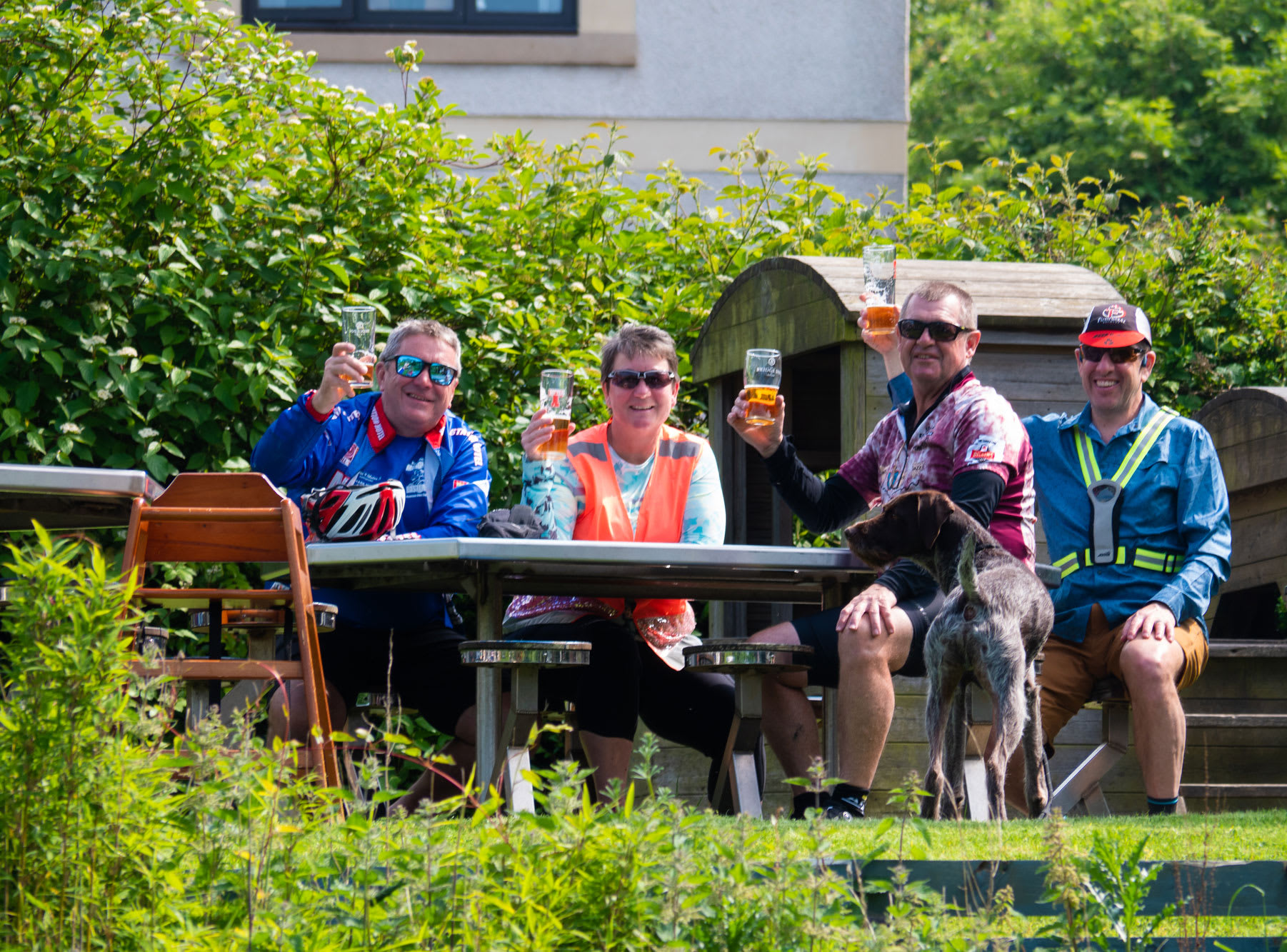
I could go on and write why cyclists are the happiest but poets and songwriters can do this better. Take this French song called ‘Nous Voyageons De Ville En Ville’. Here is an excerpt – with the help of Google translate:
We travel from town to town
Our tomorrows are uncertain
A blonde holds out her hand to you
It’s easy life again
One day here, one day there
Our life is like a romance
Soars to a tune of luck
Running from happiness to happiness
Preferring joy to unhappiness
Intelligence to stupidity
Frankness to hypocrisy
To the police, people of heart
We travel from party to party
They point at us
They call us the itinerants
Truly, we are poets
One day serious, one day laughing
Our life plays alternately
The tragedy of existence
And the comedy of happiness
Friends for life, for death
In my recent blog, Cycling in Stressful Times, I wrote that in challenging times, as we are all experiencing now, in order to maintain our calmness and happiness some escapism is in order. So that is what I am doing. I am escaping for two months and becoming an itinerant.

And if you, like me, are in need of some escapism, Michael recently wrote two helpful blogs, What’s on Tap in 2025 and What’s On Tap For 2026. We are running 13 tours in 2025, and I haven’t even counted how many countries we cycle in but I do know that in 2026 we are biking in 47 countries. I would say that is plenty of opportunity to escape for a while, be challenged and, most importantly, be happy.
RELATED
TOUR
Olive Route
The Olive. The food most closely associated with Western European civilization. Olive oil. One of the most important ingredients in European cuisine...
]]>
The French have a word – ‘boulverser’ – that I really like. Depending how you use it, it can mean to move deeply, to upset, to change drastically or to turn upside down. All of this seems to be happening around the world, even here in Canada! Years ago, I worked in isolated areas of Africa and the only way to find out what was happening in the world was listening to BBC radio news on short wave – most young people probably have no idea what I am talking about. In any case, even then news was always about the distressful things happening around the world. I used to joke that the newscaster should finish by saying, “and nothing happened in Canada today.” Well, this is no longer the case. We are no longer an exception. We are being ‘boulverserized’ in Canada as well.

It all seems to come in cycles. Apparently, even biblical prophets talked about 80 year cycles. We humans simply don’t seem to be able to change. We are very good at inventing new things, at going where no human has ever gone before, at healing our bodies, at controlling (or is it at destroying nature?) but the one thing we are unable to change is our nature…or at least how to control the blind ambitions of people who rise to the highest ranks among us; the emperors, tzars, kings and wannabes. No matter that when all is said and done, these ambitious (or maybe deranged) individuals, are likely to die in violence, imprisoned, abandoned and ridiculed but the damage they cause on the rest of us doesn’t seem to bother them one bit.
What is one to do? When I write this question, what pops into my mind is Rudyard Kipling and his poem ‘If’.
If you can keep your head when all about you
Are losing theirs and blaming it on you;
If you can trust yourself when all men doubt you,
But make allowance for their doubting too; If you can wait and not be tired by waiting,
Or, being lied about, don’t deal in lies,
Or, being hated, don’t give way to hating,
And yet don’t look too good, nor talk too wise;
If you can dream—and not make dreams your master;
If you can think—and not make thoughts your aim;
If you can meet with triumph and disaster
And treat those two impostors just the same;
If you can bear to hear the truth you’ve spoken
Twisted by knaves to make a trap for fools,
Or watch the things you gave your life to broken,
And stoop and build ’em up with worn out tools;
If you can make one heap of all your winnings
And risk it on one turn of pitch-and-toss,
And lose, and start again at your beginnings
And never breathe a word about your loss;
If you can force your heart and nerve and sinew
To serve your turn long after they are gone,
And so hold on when there is nothing in you
Except the Will which says to them: “Hold on”;
If you can talk with crowds and keep your virtue,
Or walk with kings—nor lose the common touch;
If neither foes nor loving friends can hurt you;
If all men count with you, but none too much;
If you can fill the unforgiving minute
With sixty seconds’ worth of distance run—
Yours is the Earth and everything that’s in it,
And—which is more—you’ll be a Man, my son!
Kipling obviously was a wise and insightful man.
 The other thing that keeps popping into my mind at this time of stress and cacophony emanating from all around is how to deal with it. Of course, it is the famous motto – Keep Calm. Yes, ‘Keep Calm And Ride On’.
We all know that cycling has many benefits. There are books, magazines, websites, blogs that extoll physical activity, particularly cycling, with its ability to reduce stress and anxiety. That is so because cycling combines physical activity with the soothing benefits accrued from being in nature (well, depending on where you cycle). According to studies, cycling can lower cortisol levels which is associated with stress and increases the amount of endorphins that we all know make us feel good.
So here in Toronto, we stay calm, keep our heads and run TDA tours. Yes, there are, and will be obstacles; route changes, interruptions, wars and the impact from geopolitics and economics. We do what we always do. We are problem solvers, we adapt, we create new routes. Rulers change, sometimes very slowly and then quickly, and better times arrive.
In the meantime, if you follow our blogs and social media, you will find that we have a full menu planned for 2025 and for 2026. And as far as I know there is no better way of escaping the ‘noise’ than going on a bicycle adventure, preferably the longer the better. Call it escapism if you wish. Our Operations Manager recently suggested a new tour called ‘In the Footsteps of Chaos’. Anyone interested?
PS: I hear that the one and only Warren Buffet had one very important suggestion to investors…he told them to read Kipling’s ‘If’!!
]]>
“In playing ball, and in life, a person occasionally gets the opportunity to do something great. When that time comes, only two things matter: being prepared to seize the moment and having the courage to take your best swing.” – Hank Aaron
“Carpe diem! Rejoice while you are alive; enjoy the day; live life to the fullest; make the most of what you have. It is later than you think.” – Horace
One of the unique aspects of our TDA tours, particularly because of their length and challenges, is that we meet likeminded people from around the world with whom we become friends and, as friends tend to do, we make new plans with them. This applies for me as well. Last fall I joined the latest addition to our company’s repertoire of adventures, the Golden Buddha Ride.
It was a splendid adventure but what enhanced the experience was spending time with riders from previous tours with whom I made new friendships, something not easy to do as we age. So it wasn’t that surprising that one day in the middle of the winter, I got an email with subject line – Can u canoe?.

2023 TDA AGM
As it happens, I do enjoy canoeing, to the point that our TDA core team held our 2023 AGM paddling and camping in Algonquin Provincial Park. The email was from Jonathan Klein, who I had the pleasure to meet and befriend on the Golden Buddha Ride where he was fond of saying, “Good suffering is hard to find.” Several exchanges followed. I was apprehensive as I had not canoed white water for decades and there was mention of a 4 mile portage. In addition, I had re-injured a tendon in my shoulder in the winter that wasn’t healing, on top of all the wear and tear of the last 25 years. I had doubts this was a sane thing to do but I committed myself to join Jonathan and two of his buddies on a white-water canoeing expedition on Burnside River in Nunavut Canada.

For those who have never heard of Nunavut, it is the vast remote northernmost territory of Canada that runs the extent of the central and eastern part of the Canadian Arctic. The truth is that I had always wanted to canoe the northern part of Canada, particularly the world renown Nahanni River, and now being the age I am, I figured it was now or never. So, Carpe Diem, grab the opportunity. It was, however, really Jonathan (pictured below) who directly and indirectly persuaded me to come. When I brought up the issue that I might be too old for this and didn’t want to be a burden in such a remote area, he responded that he was older than me – by less than a month – and that a third member of the expedition was also our age.

Yet we shared more than just our age. Jonathan, like me, had a terrifying encounter with wildlife. In my case, an elephant in India, in his case, a hungry bear in Canada. We were both very lucky to be here and be able to enjoy what we love doing. I had an opportunity to hear Jonathan reading a chapter from his just published book – Back to The Trees and Caves on the Golden Buddha Ride tour that described the encounter with the self-deprecating humour, drama and suspense that is reflective of the man himself. While lying in my tent with 24 hours of sunshine, I read Jonathan’s book, which gave me more insight about him, his work, his lifelong love of the outdoors and his lamentations on a wilderness that has almost disappeared from the planet. The book itself is in a form of diary, that describes Jonathan’s raison d’etre for a three-month river journey in a canoe by himself in the wilderness of the Canadian north along the Churchill River. And it is a very good read.
Grabbing the opportunity when it presents itself or undertaking something that you have always wanted to do is something that I often talk and write about. There are always plenty of reasons to ‘not do’ something that seems scary, difficult or just not in our comfort zone but more often than not, when we do decide to go ahead, the rewards and satisfaction are such that afterwords you think, why did I hesitate, what held me back? So it was with the canoe trip. If you hold to a fantasy that you now think is too late to make into reality, such as crossing a continent on a bike, I think the Olympic champion wrestler Jordan Burroughs said it best – “It’s never too late to be great.”
Oh, and the best part of the canoe trip beside the scenic wilderness? Not meeting another human being, having no access to the internet and my companions.
]]>
“To the Canadian organizer of the first Tour d’Afrique, cycling 11,000 kilometres from Cairo to Cape Town seemed like a good idea at the time. And after the lava fields, the bandit territory, the stone-throwing kids and the tire-swallowing sand, it seemed like an even better idea.”
Thus begins the introduction to the article I wrote for Explore Magazine about the first Tour d’Afrique. Crossing Africa from top to bottom on a bicycle was an idea that, when an article that publicized the expedition appeared in Canada’s national newspaper, The Globe Mail, resulted in a variety of reactions from ‘I am in’ to ‘this is simply not possible’ to ‘you have no idea what it takes to cross borders in Africa’ and ‘you have obviously not spent a day in Africa – if you had you would know this is simply impossible‘ or ‘this is mad, you are endangering your and the group lives’, finally ‘you are suicidal.’ Even friends who knew me well reacted with wonder – “Henry, this time you really lost it.” It turned out I wasn’t suicidal, nor apparently, mad.

2003 riders crossing Lake Nasser
Towards the end of the first Tour d’Afrique, with only a few days to go, riding through the Karoo, a semi-desert region in South Africa, with a handful of fellows that called themselves ‘the backpack’, as we were always the last people cycling into campsites, one of them popped a question – “Henry, now that we have crossed Africa, what is next?” I was neither thinking about this, nor prepared to answer. But an answer did, indeed, come out of my mouth – “The Silk Route, of course.”

Orient Express riders at the start
It turned out that the Silk Route was not the next tour, the next one was the Orient Express crossing Europe, but an idea was born then and there. We will cycle the world. We will create a company that will undertake cycling expeditions all over the world. At the tender age of 51 years old, I found a purpose for the rest of my life. To create a company that will enable regular folks, young and old, male and female, who are neither extreme athletes, nor dedicated lifelong fitness buffs – though both types are welcome to join – to get on a bike and simply have the adventure of a lifetime, get to know a bit of the world, experience different cultures and in the process change their perspective on this amazing planet we live on and perhaps even changing or improving their lives.

Riding the Bolivian Salt Flats
After the Tour d’Afrique came the Orient Express, then the Silk Route, then the Vuelta Sud America, then the Bamboo Road and so on and so on. Just click on our company calendar to see the extent of our reach. All created, organized and run by a small group of dedicated adventurists who work full or part time within our blessed company. One should keep in mind that each of those tours are unique and almost never the same as the previous. Each one requires an enormous amount of planning, lots of hard work and most of all a devoted and enthusiastic team that has the ability to prepare for the unexpected challenges that arise.

Cycling past temples in Thailand
And today as I write this, our little company is in the midst of running its 100th expedition. Yes, one hundred expeditions that have visited and traversed through 83 countries on 6 continents, with hundreds of riders from all over the world who have collectively pedalled over 15 million km on our tours.
To mark this little achievement, we have created an animated short that shows where we have cycled and illustrates that bicycles can reach anywhere in the whole world. Take a look. And keep on pedalling. Here’s is to the next hundred cycling adventures. May the force be with us, and with you.
You will most likely have seen this before. You see a picture and you are asked to identify the place. Yes, it is Arc de Triomphe. No, it isn’t Paris. It is Arc de Triomphe in Vientiane, Laos where we are enjoying a rest day. It is day 25 of the Golden Buddha Ride, and we are halfway to our destination, Bangkok.

Cycling past the Arch
The Arc de Triomphe, also called Patuxai Arch, is a war monument situated in the middle of Vientiane, the capital of Laos, and is dedicated to those who fought in the struggle for independence from France. It is hard to believe that this city, the largest in the country with population of over one million, had only 9,000 people living here less than hundred years ago. Today it is a bustling metropolis and is attracting foreign capital which is changing not only the city but the whole country. Not so long ago this was a land where Buddhist monks collecting morning alms outnumbered the cars on the road.

Take for example, the Allianz building that I passed by on my way to the Arch. Looking at it made think again of ‘the three wise men with one ear’ I mentioned in my last blog in Vietnam. Yes, here too in Laos, ‘the three wise men’ played a key role and the country has been ruled for the last fifty years by the Communist Party. As the picture indicates, communism and capitalism seem, after all the historical bloodshed, to be getting along just fine. This, after all, is the place during the Vietnam war, whose aim was to stop communism from taking over Southeast Asia, where the American military dropped more than 2 million tons of bombs, making it the most bombed country in the world. To this day there is unexploded ordnance, including cluster bombs, being identified and removed. And yes, there are victims, particularly children in the countryside.
It was then I suppose propitious that as I was taking a picture of the Allianz building, a lady who was tending a small food stall asked me if I wanted to exchange some US dollars for a better rate than the banks and currency exchange shops were offering. I smiled as I recalled my childhood in Czechoslovakia where the black market for US dollars thrived and everyone who could, would get a few dollars for protection from inflation and an unpredictable economy.

Details of the Arch
The Arch is appropriately nicknamed the ‘vertical runway’ as it was built with US funds that were meant to be spent on an airport and is decorated with mythological Laotian figures. Leaving the Arch, I headed to the nearby That Dam, a stupa that was once coated in a layer of gold. The gold apparently was stolen by pillaging Siamese in 1828, and now the stupa looks rather sad.
Across from the stupa I saw a café, ‘coffee culture’ being very popular in Vientiane, possibly due to its colonial connection to France. I decided it was time for an iced cappuccino and while sipping my coffee, a Laotian man, or so I thought, approached me and asked me in English if I was an American. No, I said, I am Canadian. With a strong Laotian accent he replied, “I am an American from Utah. You know, the Mormon state.” Our conversation turned to how a successful Laotian American with a business in US decided that he could make more money in Laos. Now, 12 years later, he proudly pointed to his shinny pickup parked in front and showed me pictures of his farm and produce. “Laos is a good place to invest” he told me, “but one has to be careful, politics.” While his wife and kids are carrying on in the USA, he is taking care of business here in Laos.
 I moved on through side streets, admiring one Buddhist temple after another, each covered with elaborate religious motifs and shinning golden decorations. I also noticed in front of every home and building, ornate miniature temples. These, I learned, are dwellings occupied by the spirit guardian of each home. These spirits must be kept happy and properly fed, otherwise the household will be in trouble so one sees all kinds of offerings left in these tiny temples.
Ostensibly when the Communist Party took power, they tried to forbid, or at least limit both Buddhism and spirit worship, but soon enough they realized that if they wanted to stay in power, they better change their mind. And so the Communist Party, Buddhism and the spirit world now seem to coexist rather peacefully to the benefit of all.
It is this co-existence that I thought of as I wandered on, pondering how we humans – seems like all of us no matter the creed, religion, or race – believe with fervour and fight for one ‘ism’ or another, with all the energy and force we can muster. And more often than not, it brings us grief and tragedy. But somehow, humankind manages to muddle on into the unknown future.
As for us on the Golden Buddha Ride, shortly we will once again get on our bicycles and pedal on into our own unknown future.
RELATED
TOUR
]]>
“Just possibly, Ikigai makes a Peter Pan of all of us. And that is not necessarily a bad thing. Let us all be twelve years old! Youthfulness of mind is important in Ikigai, but so is commitment and passion, however seemingly insignificant your goal.” – Ken Mogi
“Ikigai is the action we take in pursuit of happiness.” – Yukari Mitsuhashi
This morning, as with many mornings during the last month, while sipping my morning coffee I had an Ikigai moment – ‘something that brings pleasure or fulfilment’. Over a month has passed since our company’s inaugural cycling tour through Japan, the Journey to the East, ended in Sapporo. Every time I think of my time on the tour, I have a big smile plastered on my face.

Anyone who follows my blogs or has spoken to any of the participants will already know that cycling in Japan was not only a joy but also gratifying in so many ways. For myself, learning firsthand what makes Japan unique was one of the best rewards. And one of the things I learned is the concept of Ikigai. According to Wikipedia, “The Oxford Dictionary defines Ikigai as ‘a motivating force; something or someone that gives a person a sense of purpose or a reason for living”. More generally it may refer to something that brings pleasure or fulfilment.'”

All smiles
Our Content Creator on the tour, Coby, recently sent a reminder to all participants to download the pictures they liked from his extensive files. Looking at these pictures I couldn’t help noting how everyone seems to have been smiling all the time. There was no doubt in my mind that they were experiencing the same type of Ikigai that I was.
Ikigai seems to have other meanings. Many active people are familiar with the concept of ‘flow’ that Hungarian–American psychologist Mihaly Csikszentmihalyi developed. Wikipedia explains that, “Colloquially a flow state is being in the zone. It is the mental state in which a person performing some activity is fully immersed in a feeling of energized focus, full involvement, and enjoyment in the process of the activity. In essence, flow is characterized by the complete absorption in what one does, and a resulting transformation in one’s sense of time.” In my blog, Sayonora From The Journey to The East, I wrote, “Persistence, as often in life, eventually paid off. It was a tour that will stick in our minds for the rest of our lives. After the delays, it finally seemed as if everything was working in our favour.” In short we were in Flow/Ikigai.

Local Japanese man painting along the Oirase Gorge
There apparently is a Japanese proverb that says, “Only being active will make you want to live a hundred years.” One of the most fascinating things we saw as we cycled across Japan, was a country whose citizens have the world’s longest lifespans. Everywhere we cycled we encountered people well past retirement age working the fields, directing traffic and generally keeping busy. Apparently, Ikigai also means ‘the happiness of always being busy’. You could certainly say that cycling in Japan kept us busy all right.

Dinning in Aso, Japan
There were climbs to conquer, volcanos to observe, not to mention all the temples and shrines to visit. After a satisfying daily ride, came scrubbing in the ‘onsens’ followed by rehydration therapy in a form of a beer or two. To end the day, it was time for a long elaborate, exquisite Japanese dinner. It is no wonder then that when looking at the pictures from the tour everyone is always smiling. The Oxford Dictionary explains that Ikigai combines two Japanese words, “to arrive at ‘a reason for living; a meaning for/to life; what/something that makes life worth living; a ‘raison d’être’.“

That Ikigai feeling!
All this musing makes me think of a quote from the American philosopher, poet and abolitionist Ralf Waldo Emerson who wrote, “The purpose of life is not being happy. It is to be useful, to be honourable, compassionate, to have to make some difference that you have lived and lived well.” I would venture to suggest that all the Journey to the East participants would heartily agree that their time spent on the tour was a time of living well.
RELATED
TOUR
Journey to the East
While South Korea and Japan are close neighbors, their lands and cultures are completely unique. Cycling across these countries, one after the other...
]]>
“Even if I think something might not be possible, I try it. And surprisingly it turns out to be possible.”
– Hiromu Ianada
The chances that you have heard of Hiromu Ianada are slim, very slim. I came across his name recently when looking through a recent National Geographic issue with the cover story – Aging in Japan. I will be in Japan in less than three months on the inaugural Journey to the East Cycling Tour. I am not getting any younger, so it is perhaps not a surprise that I read the story with great interest.

In the feature there is a picture of Mr. Ianada sitting on an exercise bike, with his spandex cycling shirt zipped down almost to his belly button, working out. Beside him is a young man, at most in his mid 20s, also on the bike, both going all out. What is remarkable about this 89-year-old man is that since he turned 70, he has completed 66 triathlons! In 2018 he became the oldest triathlete to finish the Ironman World championship.

Eric on the road in India
In a video, Eric Wolinsky, a rider on the 2023 Hippie Trail, remarked, “If you are going on a TDA tour, you are going to find out what are you capable of. You just gotta go for it.” When we first dreamed up the Tour d’Afrique Cycling Expedition from Cairo to Cape Town, we thought we could pull it off, but we really had no idea. And there was no lack of naysayers who told us that, not only we re going to fail but we were also being irresponsible and putting lives at risk.
Another story I read in Ars Technica – I Disconnected From The Electric Grid For 8 Months – In Manhattan – described how Joshua Spodek, writer, adjunct professor at NYU and a host of The Sustainable Life podcast, did the unthinkable in the most urban of all places, why he did it and, to his amazement, the benefits he accrued. “Attitude was more important than technology”, he wrote.
Indeed, attitude is the main ingredient in what makes the impossible possible and it makes a difference in every aspect of our lives. In a recent interview on CBC radio about his book – The Good Life: Lessons From The World’s Longest Scientific Study Of Happiness – Dr. Robert Waldinger, a psychiatrist and the director of the Harvard Study of Adult Development, said, “A good life is not a necessarily an easy one.” Elias Baron, another participant in the video from the Hippie Trail agreed, commenting that “sometimes joy and happiness is associated with efforts.”

In a recent Washington Post story – Americans Over 50 Are Doing Extreme Sports Their Grandparents Never Imagined – the author Tara Bahrampour wrote, “As athletic achievement across all age groups pushes human boundaries, more people in their 50s, 60s, 70s and 80s are performing feats previous generations might have had a hard time imagining.” She quotes an 86 old weightlifter, Keo Capestany of Seattle, who told her that he had “to push back against family member’s and friend’s preconceptions of what they’re capable of. ‘Our concept is old people, you have to be careful, you have to mind your age‘.”
Such stereotypes can be self-fulfilling says Tom Kamber, executive director of Older Adults Technology Services from AARP. “When we have these prejudices, they really hold us back on a group level. People start to be restrained by those parameters,” he said. “But seeing older people engage in high-risk or physically gruelling activities “gives us a chance to check our ageism a little bit [and] widen the spectrum of what we think is possible.”
In that interview on the Happiness study, Dr. Waldinger says that “happiness comes and goes….” His secret is “finding activities I care about.” In a new 6 part documentary – Limitless – well known actor Chris Hemsworth explores how we can all live better and longer and says that “a good death for him would be having a good life.”

All of this, of course, is not surprising, nor earth shattering news to the participants of our TDA Global Cycling Tours. It may, however, be a surprise to all the detractors and skeptics littering our lives.
]]>
What makes an epic tour, or for that matter any cycling tour, great? Which of all the elements that make up an expedition is the most important? Is it the countries one sees, the terrain, the vistas, the food, the cultures? Anyone who has been following my blogs through the years will not be surprised that I am very interested in space exploration and have written several pieces about TDA tours and space travel.
So a month ago when I saw an article on CNN – Inside The Secretive Process To Select The First Astronauts For NASA’s Next Moon Mission – you can bet that I clicked on it. In the next two or three months, NASA will announce who will be the crew that, after a hiatus of five decades, will be heading back to explore the moon. The most likely person to lead the team is a man who in November resigned from the very prestigious job of selecting the crew for missions. By doing so, he became the most eligible candidate to be selected. His name is Ted Wisemen, a decorated naval aviator, test pilot and an astronaut since 2009.

Helping out with a flat
My fascination with space travel started long before I read Tom Wolfe’s famous book – The Right Stuff – and the subsequent 1983 film based on that story. I bring this up because whoever is choosing the final crew from the 41 eligible astronauts, the most important element in the mix is not only that they have the ‘right stuff’ but that they will fit into the ‘right team’. Every one of the possible choices on the list has the courage, skills and other abilities that have allowed them to become astronauts. To be chosen for this important mission, there is another vital consideration, one that anyone who has participated on our tours may recall being discussed – Expeditionary Behaviour. Ted Wiseman had this to say on the subject – “We (at NASA) pride ourselves on expeditionary behaviour: being a good teammate, emptying the trash can when it’s full, cleaning out the dishwasher when your parents ask you. Those sorts of things.” “That’s really what we’re looking for in those first Artemis (to the moon) missions. Technical expertise. Team player.”
In my blogs, I have often compared our long distance cycling tours to missions in space and stressed how important expedition behaviour is for the riders and staff while on tour. While participants on our tours are not trained astronauts with millions of dollars invested in them, the same elements that create a successful space mission, are also part of what creates, not only a successful tour, but also a tour that is a great tour, the memory of a wonderful adventure and a job well done. We all have bad days, when nothing goes right, when we are tired or sick. There are also days on tours that, no matter how much we prepare or how much experience we have dealing with tough situation, when things happen that are out of our control, when border crossings become a nightmare, when vehicles break down, when road conditions or security concerns require changing course, when food goes bad or gets burned.

Riders at lunch discussing the morning ride
It is so very easy to lose one’s perspective and to start looking for scapegoats. It is easy to become negative, to make a list of everything that is wrong with the staff, with the company, with the design of the tour, particularly when one is unfamiliar with the challenges and uncertainties that exist behind the scenes. Or you can remind yourself of Expedition Behaviour and be the positive force that helps everyone through difficult, often totally unexpected circumstances. That is being part of the Right Team.
In his book – Endurance: A Year in Space a Lifetime of Discovery – Commander Mark Kelly writes that there are astronauts who only went to space once. The main reason for them not going up again was their Expedition Behaviour. We at TDA are not NASA, we don’t choose the people who register for our tours. What we try do is to point out to them how important their attitude is to the success of the tour. Many come prepared, understanding their own challenges and those of the company organizing such tours in an unpredictable world. Some participants may not initially understand the importance of positive attitude but then surprise themselves and make a positive contribution and feel good about it. Others don’t, at least immediately, but years later they write us about the amazing tour they were part of. From some, we never hear anything ever again. C’est la vie!
]]>
Is there something magical about the number 80? Did Jules Verne know when he wrote, Around the World in 80 Days, that he was creating a whole new industry of books, plays and films of ‘Around the World in 80….’? I was recently looking for a book on the Toronto Public Library website when I stumbled upon a whole range of books – Around the World in 80 Books, Around the World in 80 Plants, Around the World in 80 Trees, Around the World in 80 Musical Instruments, Around the world in 80 Tales, in 80 Festivals, in 80 Birds, in 80 Plants, in 80 Recipes, in 80 Spiritual Places, in 80 Words, in 80 Trains, in 80 Treasures, in 80 Record Stores, even Around the World in 80 Purees. Wow! Who knew?

Credit: Wkimedia Commons
While scrolling through the list, it got me thinking. If you go to the TDA Global Cycling website, we also have the magical 80 number – “Choose a tour on one of 6 continents and in over 80 countries.” A potentially great idea suddenly took hold of me. Is there a book here? And if so, what would be the subject matter? Would it be – Around the World with TDA in 80 countries, Around the World in 80 Cycling Stages, Around the World in 80 Cycling Shorts, Around the World in 80 Flats, Around the World in 80 Cycling Pubs, Around the World in 80 Bikes? I mean, why not use a winning formula and start an industry of our own. After pondering on this for what seemed like a minute or two, I decided that I could kick start a book called – Around the World in 80 Cycling Vignettes.
Here are the first two vignettes which both transpired in Tanzania during different years.
How a big cockroach almost ate me
In 2004, on the 2nd Tour d’Afrique, I was riding with the ‘back-pack’ of riders, commiserating on the intense equatorial heat. During lunch, with the heat only intensifying, I told the riders not to despair, that we would soon be cycling past a dam. The year before, the 2003 ‘back-pack’ had enjoyed cooling off at the dam. Arriving at the reservoir, we took a short dirt road to the edge of the water. While taking off my shirt, I heard a man in uniform yelling something. The heat was overwhelming and my mind was only focused on the water. I couldn’t care less about a man in uniform. As I stepped into the water, I finally understood what the screaming man was saying, “big cockroach, big cockroach.” I shrugged my shoulders and jumped in.
Once in the water, I noticed the man was now extremely agitated but I was enjoying myself too much to pay him any attention. I swam a few strokes. Raising my head, I heard the screaming again, “big cockroach, big cockroach.” It was probably because of the yelling, that no one else had followed me in. And then it hit me. Big cockroach meant Big crocodile! Quickly, I leapt out of the water. Who wants to have a confrontation with a ‘big cockroach’ when even an encounter with a small cockroach in your kitchen is not a pleasant experience. Back on my bike, I contemplated the incident and once again, for thousandth time, thanked my exhausted angels for protecting me. I suspect that once I cross over to the other side, they will want to have a sincere heart-to-heart chat with me.
Where are you going?
 The other story took part a year earlier on the first Tour d’Afrique. Anyone who has cycled from Cairo down towards the Cape of Good Hope will tell you that just about every day, locals will yell a greeting, and often pose the question, “Where are you going” or, as they say in the ancient Amharic dialect, “Where are you go?” Answering back “Cape Town” doesn’t draw a reaction, as it is not really something that a rural farmer, who likely would not even have an interest in visiting their capital city, could easily fathom. So, I would just say the name of the next town or big city on route. So when a young woman working in her fields yelled at me, “Where are you going?”, I don’t know why, whether it was her good English or the smile on her face or just because I couldn’t think of the next big town, so I responded, “Cape Town.” To my utter surprise she responded, “Why?” I slowed down, hesitated, and then yelled back, “Good question. Very good question.” Why do we throw caution to the winds, why do we say goodbye to our family and friends, why do we take unknown roads?
J.R.L Anderson, a British journalist, who at the age of 55 undertook a risky boating expedition and subsequently wrote a book – The Ulysses Factor: The Exploring Instinct in Man, explained why. “There is some factor in man, some special adaptation, which prompts a few individuals to exploits which, however purposeless they may seem, are of value to the survival of the race.” At this stage, I honestly must admit that under no circumstances did I think what I and the rest of us were doing was of value to the human race but now, deep down, there is a little voice saying, “I sure hope so.”
Do you have a vignette to contribute to – Around the World in 80 Cycling Vignettes?
]]>
“I am free and that is why I am lost.” – Franz Kafka
“My slogan is dare to be different,” said the female voice on the BBC radio show. I was in the basement of my home, it was the holiday season, and I was doing my best to stretch my abused body. Instantly, the voice on the radio had my full attention. After all, for anyone who has scrolled through the TDA website, one of our ‘calls to action’ is – Dare to be different!
The voice belonged to Anna Kiesonhofer, a mathematician by profession, and the surprise winner of the 147 km road cycling event during the 2021 Tokyo Olympics. “Alone against the odds the non-pro Austrian cyclist who beat the best, without the support of a single teammate,” began the podcast. She was considered a novice, with no coach nor support team and when the 30-year-old lined up at the start, not one of the experienced competitors and talking heads paid any attention to her.

On the ferry crossing Lake Nasser, 2003
The comments brought up memories. It was just about 20 years ago, January 18th, 2003 to be exact, that I and 32 other cyclists lined up in front of the Great Pyramid of Giza and dared to be different. It was the first day of a bicycle journey that took us across the African continent – from Cairo to Cape Town in 120 days.
Most people that heard about our plans were more than sceptical. Friends and relatives, when not worried about us, were silently praying for our wellbeing. But we dared. And in end, although we didn’t win an Olympic medal, we achieved more. Each one of us had the unforgettable journey of a lifetime. We overcame our fears and our limitations, we learned so much, we made friends that have lasted a lifetime and, most important of all, we became better human beings.

At the finish line in Cape Town in 2003
The journey didn’t end there. Explore Magazine published my story of the first Tour d’Afrique and noted that, “To the Canadian organizer of the first Tour d’Afrique, cycling 11,000 kilometres from Cairo to Cape Town seemed like a good idea at the time. And after the lava fields, the bandit territory, the stone-throwing kids and the tire-swallowing sand, it seemed like an even better idea.”
The Tour d’Afrique has become an annual event, allowing hundreds of other ordinary folks to experience what we did on the first ride across Africa. Cycling across other continents soon followed, each route bringing joy and fulfillment to the participants, providing the opportunity for them to experience all the world has to offer. This ‘good idea’ has grown so much that in 2022 we ran ten amazing tours on six continents. Every time I meet someone who asks me if I go on all these tours, I smile and say, “I would if I could only clone myself.” The growth continues. In 2023, we are planning to run another 11 fabulous tours that will enable hundreds more cyclists ‘to dare to be different’ and follow the call of their hearts.

I started this blog with a quote from Franz Kafka, the author of such 20th century masterpieces as The Metamorphosis and The Trial. He was born and lived in Prague but wrote his masterpieces in German. A Bohemian Jew, he was the ultimate outsider. A lifelong outsider myself, who grew up in what was then Czechoslovakia, in my youth I had a fascination with Franz Kafka. It was reading about him that I discovered that before he started writing, he was contemplating publishing travel books – Lonely Planet guides before Lonely Planets even existed! Kafka thought of calling them Dare to Be Different. I would think that the literary world is glad that he decided not to write the travel books but Kafka certainly dared to be different, as did Anna Kiesonhofer, and as do the TDA community of riders.
On her personal webpage Anna Kiesonhofer responded to the question – Was it a childhood dream of yours to participate at the Olympic Games? Her answer was, “I focused on smaller goals and took it step-by-step, from local races to national and international races… Until finally the director of the Austrian women’s national team approached me in 2019 and mentioned that the next Olympic road race had a course profile that might suit me and asked if perhaps that might interest me…”
The rest is history. You could say that it all started by daring to be different.
]]>
The holiday season is almost here, and it is time to relax, to spend time with family and friends, to sip a drink or two, to reflect, and to reminisce. What a year it has been for TDA Global Cycling. Around this time last December, two years into COVID, we had just cancelled a trip we had planned for the beginning of 2022 in Costa Rica, due to yet another rise in COVID infections. Subsequently, our flagship expedition, the Tour d’Afrique, was reduced in terms of distance and length.
However, we refused to give up and we planned and we hoped and finally our persistence paid off. A year later, all of us at TDA and the rest of our cycling community can raise a glass or two, or maybe as many as the number of tours we managed to pull off this year?
Would you like to know how many wonderful tours we ran in 2022 – some epic, some ‘only’ five or six weeks long and even a couple of new ones? If you do, you will have to scroll down to see the finish line photos of smiling riders and staff at the completion of their tours.
So here is to you, the participants and the the staff that made it happen. Thank you! May you have a wonderful festive season and a magnificent 2023 full of adventures – visiting friends and family, enjoying a lot of great meals and naturally, adding a lot of revolutions to your bicycle wheels. One more little thing. To paraphrase one of the participants from Bamboo Road who thanked us for his adventure, all of us at TDA wish you ‘to continue dreaming big’.
Africa (Tour d’Afrique & Morocco: Kingdom of the West)

The Americas (South American Epic & North American Epic

Europe (Pub Ride, The Odyssey & Viva Italia)

Asia & Oceania (Trans-Caucasus, Bamboo Road & Trans-Oceania)

]]>
“The greatest danger in life is not to take the adventure.” – George Mallory
A long time ago, as in once upon a time, popular outdoor magazines were thick, the stories long and colourful, informative and entertaining, and it was fun to collect them. Why? Well, when winter came and long evenings set in, you could go through the accumulated pile, pick one or two magazines and read and dream of the great places you will go one day…maybe. Except somehow, even on those long evenings, there were always more pressing things to do and so the pile of old magazines grew and grew. And I never had the heart to throw them away.
Nowadays, periodically I go to that pile, pick up a magazine or two, and, yes, find a story that is fascinating. And thus, I came upon a story about George Mallory, the man who may or may not have been the first person on top of Mount Everest. George Mallory is also the person who in responding to the question, “Why climb Mount Everest” simply said, “Because it is there”. Whether he was just tired of the endless inquiries or just having fun is now immaterial. As our South African colleague, Sharita, would say, “It is what it is”.

It was almost five years ago when, in a blog called ‘Trans Himalaya Adventure – “Because It Is There‘, I introduced our company’s latest cycling adventure – a six-week journey from Kashmir to Kathmandu. It would be a most unique way to experience the sights, sounds, smells and more, much more of the highest mountain range of the world – The Himalaya.
The truth of the matter is that, besides knowing Mallory’s quote and the fact that he died on the mountain, I knew very little about him. Yet reading about him brought back many fond memories from the inaugural Trans Himalaya tour in 2019. In the process, I was discovering a kindred spirit. I too, as a kid, loved climbing boulders, trees, fences. I still do, particularly fences, especially those with overhanging fruit, although falling is no longer much fun.

Why a kindred spirit? Here is a quote, “Why do we travel to remote locations? To prove our adventurous spirit or to tell stories about incredible things? We do it to be alone amongst friends and to find ourselves in a land without man.” I thought, what a way to describe the camaraderie of cyclists, thinking back to our own struggles up endless mountain passes over 5,000 metres high. As an aside, one of my companions from those climbs, less than a month ago waited hours for me in the hotel lobby in Rome on our last day on the Viva Italia Cycling Tour, just to spend an hour or two reminiscing about our adventure.
“There are seven continents – and we cycle on six of them – but there is only one Himalaya Mountain range and there we do not cycle.” So begins the first sentence of the blog, Trans Himalaya Adventure – ‘Because It Is There’. Crossing a continent or the world’s highest mountain range by bicycle is a remarkable thing to do: it is long, arduous, requires commitment in time, energy, resources, and demands sacrifices such as leaving your loved ones behind. Mallory understood this, “To struggle and to understand. Never the last without the first. That is the law”.

Reading about Mallory, what comes through loud and clear is that he was a remarkable human being, a great climber, teacher and soldier but most importantly, a decent human being. That is perhaps why I liked this quote the best, “We don’t live to eat and make money. We eat and make money to be able to enjoy life. That is what life means, and that is what life is for”.
So, what is life for? I can only tell you that on the 2019 Trans-Himalaya, I had a great time, learned a lot, struggled a lot, walked a lot, contemplated a lot, had lots of fun, and now have many wonderful memories of my time cycling the mighty Himalaya.
Limited spaces are still available for the 2023 Trans-Himalaya Cycling Adventure.
RELATED
TOUR
“Veni, vidi, vici.” – Julius Caesar.
The 2022 Viva Italia is done and dusted. Yes, we came, we saw, but didn’t conquer, and had no plans to do so. We came to experience and relish the magical qualities of Italy, from gnocchi to gelato, from vino to pasta, from great pizzas to tasty specialties, from each region we cycled through. We saw magnificent art and glorious architecture, mind boggling museums and out of this world Duomos (cathedrals), azure bays and sandy beaches, orchards of olives and fields of tomatoes, rugged mountains and green valleys, vistas that take your breath away and towns that seems about to slide into the sea.

Here and there we conquered a steep climb and a long cycling day. But we didn’t come to conquer. We came to cycle and enjoy, we came to absorb as much as possible of this vibrant place and live in the moment. And perhaps, we also came to reflect. After all, when you visit and walk through the ruins of Pompei, or wander the streets of Florence, Rome, or Palermo, you inevitably ponder about lives lived, about personal ambitions, glories, the futility of war, the impact of religious beliefs, the impermanence of things, the shortness of our lives and what we do with our time on this planet.
 In the final days, as the tour approached the finish line, while cycling and between foraging for different crops – after all there is nothing better tasting than a fresh fruit picked from an overhanging branch – I was reflecting that not so long ago, I and the rest of our company staff were lingering at home, wondering when we would again be able to roam the world and do what we love doing. And now, in the last days of Viva Italia, our little company was actually running five different trips on five continents. In addition to the Viva Italia, we had the Trans Oceania, the North American Epic, the Bamboo Road, and the South American Epic, all running smoothly. Not bad, I quipped to myself. What would be a good tag line for us, I quietly mused? If you have an idea, please do let me know.
“How did you manage to survive and recover so well. It was a subject of conversation on the Tour d’Afrique this year” asked Uwe, one of the participants on the shortened 2022 Tour d’Afrique and enjoying cycling on the Viva Italia? Well Uwe, we had help from our government, we had, and still have, resilience – I even wrote a blog about that during Covid – and we have a wonderful team that knows what is important and what is not. But perhaps the answer is to be found in my first blog, written in isolation in my basement just as the COVID pandemic went worldwide. I had just arrived home from our company annual meeting in the Azores.

Cycling in Corsica
In that first blog – A Few Thoughts From My Basement – I wrote, “Yes, currently there are many unknown unknowns, but our modus operandi has not changed. We, as always, strive to do the right thing, whether that means taking steps to protect our participants or offer full refunds for our cancelled tours. We also try to see the big picture, keep our wits about us and deal with whatever comes up in a rational way. The coronavirus is a challenge but if you look at the big picture of humanity and the adversity it has overcome, if we all keep our wits about us, soon enough it will be just another virus which humanity has learned to deal with and overcome. We at TDA certainly have no doubts about it. And this one thing is certainly not an unknown fact.”
In another blog that I wrote during the pandemic – We Are Not Made of Sugar Candy – I quoted Winston Churchill, “For myself I am an optimist – it does not seem to be much use being anything else.” Except, except perhaps be a cyclist who loves exploring the world. And if you are that, then you will find a way of continuing to do so. That, my dear Uwe, is perhaps the best answer.

At the finish
To all the participants and staff of the Viva Italia and to the support teams that are currently spread all over the world, it was a blast. THANK YOU! See you soon, somewhere else, back in our saddles, looking at the mountains that we are about to climb and asking ourselves, ‘what are we doing here’?
]]>Henry Gold has been cycling alongside the participants of the 2022 Viva Italia. He is currently cycling in Sicily but sent this report on the island of Corsica.
Pasta and macaroni, the hotter the better.
Corsican Proverb
Yesterday, in light drizzle, one by one, we cycled to the end of our eight-day sojourn in a land the ancient Greeks called Kalliste – ‘the most beautiful.’ A certain famous Greek writer by the name Homer described the place around three thousand years ago as follows: “excellent harbour, closed in all sides by an unbroken ring of precipitous cliffs, with two bold headlands facing each other at the mouth so as to leave only a narrow channel between.”
Today this place is called Bonifacio and is the southernmost tip of Kalliste, now known as Corsica, and better known not for its rugged beauty, translucent water, or white beaches, but rather as the birthplace for its famous (or to some/many infamous) son – a man born Napoleone Buonaparte as his family had Genoese roots – which for political reason he changed to Napoleon Bonaparte.

Bonifacio, besides being an excellent harbour, nowadays is full of small and large yachts and boats that come here to spend time on a dazzling narrow peninsula of white limestone and walk the haute ville. The ‘ville’ of narrow streets are filled with boutiques, restaurants, bars and coffee shops to satisfy the desires of a couple or more millions of tourists that visit Corsica each year and many make it all the way to Bonifacio.
Ironically Napoleon seems to have a different opinion of his native land. While in exiles in St. Helena he reportedly said the following “M. de Choisel once said that if Corsica could be pushed under the sea with a trident it should be done. He was quite right. It is nothing but an excrescence.” Some Corsicans would likely feel the same about Napoleon, even though his name now brings many a Euro to the businesses in his hometown and the capital city of Corsica, Ajaccio.
Putting opportunism aside after cycling much up and the same amount down from the northeast of the island to the west coast and then again even more up and down south to reach Bonifacio, the riders on Viva Italia probably now think of Corsica the way the ancient Greeks thought of as Seirenoussai – meaning a place of the Sirens – the sirens mentioned in Homer’s Odyssey. The otherworldly Sirens and their irresistible charm.
It is this irresistible charm that will now linger in our memories forever and ever and will call us back here to come enjoy its jagged beauty, its tasty wine, appetizing cheeses and local specialties and much more. To quote another Corsican proverb, “there is no substitute for experience.”

RELATED
TOUR

Viva Italia
It has been said that ‘All roads lead to Rome’ and the Viva Italia cycling tour is simply more proof that this may indeed be the case...
“Whatever wisdom I would find, I knew, would grow out of the land. I trusted that, and that it would reveal itself in the presence of well-chosen companions.” – Barry Lopez
After a few hours of flying, sitting behind two fighting and screeching kids, their parents occasionally pretending to get my bags, (which showed up a few days later) my two sections of the North American Epic from Tuktoyaktuk to Fort Nelson were behind me. I am now back behind my desk, trying to take it all in.

The North is unlike any place I have been to before. According to scientists, while tropical ecosystems are the oldest on earth, northern ecosystems, due to the advances and retractions of the glaciers, are the youngest. That is very much visible in the limited biodiversity of plants and animals. The North, unlike much of the rest of the world and largely due to the extreme weather, is sparsely populated by humans as well. This allowed the riders on the North American Epic to observe what appeared to be vast areas of untouched wilderness. First, the vast open tundra, then slowly the dwarf birch forests emerged, followed by the vast boreal forest of Northern Canada – black and white spruce, balsam fir and pine trees.

It also enabled us to have unexpected encounters with wildlife. At the end of the day, we would all enthusiastically talk about what we had seen that day: a bear with a couple of cubs, a bison, maybe even a herd of them, an eagle, a glimpse of a fox, caribou, moose, elk and many others. It was the enthusiasm with which we were all talking that made me think of Barry Lopez’s book – Arctic Dreams. Lopez writes, “Few things provoke like the presence of wild animals. They pull at us like tidal currents with questions of volition, of ethical involvement, of ancestry.”
But looks can be deceiving. Everywhere we went, there was evidence of human activity. In his book, written in 1986, for which he won the National Book Award, Lopez writes of an encounter with Yup’ik hunter who stated that what First Nations “fear most about the rest of us is the extent of our power to alter the land, the scale of that power and the fact that we can easily effect some of these changes electronically, from a distant city. They call us with a mixture of incredulity and apprehension, “the people who change nature.”” Lopez wrote this before climate change and its impact was yet to be mentioned in the public sphere.

When our tour began on the shores of the Arctic Ocean in Tuktoyaktuk, the temperatures were in the 30C range and walking around the village you could easily been thinking that you were in the Caribbean. “Walking across the tundra,” writes Lopez in his book, “it would be the frailty of our wisdom that would confound me. The pattern of our exploitation of the Arctic, our increasing utilization of its natural resources our very desire to “put it to use,” is clear. What is that missing, or tentative, in us, I would wonder, to make me so uncomfortable walking out there in a region chirping birds, distant caribou, and redoubtable lemmings? It is restraint.”

I didn’t walk across the tundra. I wasn’t dressed for it. I was dressed, as were all my companions on this trip, for cycling on roads built by men. Perhaps because of that, like my previous tours in Madagascar and Nepal where I wrote about searching for enlightenment, I didn’t find much wisdom. What I did find everywhere I went and especially amongst our riders, is what I wrote in Reflections On Cycling the World when I quoted the British legendary explorer Sir Wilfred Thesiger who once said, “the harder the life, the finer the type.” It is in the harshest environments that one encounters the most interesting people and has the most memorable adventures.

Barry Lopez also quotes Thesiger, who travelled extensively among the Bedouins in Arabia’s harsh Empty Quarter, “I was happy in the company of these men (and women) who had chosen to come with me. I felt affection for them personally and sympathy with their way of life.” I completely agree. Frankly that will do me just fine until somewhere, somehow, I do find even a tiny bit of wisdom.
]]>
There must be millions of hotels all over the world but there is only one that I, and many others who have stayed there, will agree stands head and shoulders above even the best and most expensive establishments. This hotel, nondescript outside and inside, doesn’t give you any sense of being anything but an ordinary two/three star place. If you didn’t know anything more about it, you would most likely decide to look for another hotel in Khartoum. I first stayed there in 1984, in the 40C heat, and the room was cool, not because of air conditioning, but rather because of the antiquated water-cooling system on the wall. But décor and physical appearance don’t reveal the essence of the place.
When I decided 20 years ago to run a bicycle expedition from Cairo to Cape Town there were many, many ‘African experts’ who claimed that due to the challenges, particularly in getting permits to problematic areas of some of the countries, it was simply not possible. What these ‘experts’ didn’t know was that I had a few secret weapons up my sleeve.

George in 2014 Credit: Dr Sophie Hay
One of them was the aforementioned Acropole Hotel in the Sudan, owned and run by three Greek brothers and their families, the youngest of the brothers being George Pagoulatos. When you first met George, tall handsome and friendly, you had a sense that you were welcomed and that you would be taken care of. And he and the rest of the hotel’s establishment never disappointed.
Sudan in the 1980’s, and to a large extent even today, was a very challenging place, where even making an international call was an encounter that could take days of extensive planning. In Acropole Hotel, however, you simply went to George or one of his brothers and told them when and where you wanted to make a call and it would happen. If you had a problem in Sudan, if you desired advice, if you just wanted a reassuring voice, you just needed to tell the hotel’s management and your difficulties would be solved.
Over the years the Acropole became the place to stay and/or socialize for thousands of visiting scientists, archeologists, aid workers, journalists, writers, spies, shady characters of all colours and creeds and many others like myself.
>>Related Post: Sudan. The Acropole Hotel, Khartoum
While planning the Tour d’Afrique in 2002, I wrote to George and asked him if he could help with getting the various permits and visas that would allow our group to cycle from Egypt through the Sudan and on into Ethiopia. In short order, an email came back, simply asking for the details of when it would take place and how many people there would be. Since that time we have run many editions of the Tour d’Afrique involving hundreds of cyclists. Most of them had no idea why things would run so smoothly in the Sudan. How sudden and unexpected problems were quickly solved because of the wonderful behind the scenes support of George, his brothers and their families.
So, it was with great sorrow that I recently read a short Twitter post that announced that George had passed away. Whether he realized it or not, he and his whole extended family had an impact on thousands of people and enriched their lives in a way that is hard to imagine a small, simple hotel could possibly achieve. In a difficult place, George Pagoulatos was an individual with the straightforward objective of making people comfortable, enabling them to do what they wanted to do and taking no credit for it. If there are people on the planet who encapsulate the best humanity has to offer, George is one of them. May he rest in peace.
]]>
In early years of the Tour d’Afrique, at the border of Sudan and Ethiopia, in the middle of a town called Metema, was a 25 foot bridge. After crossing the bridge, there was no official barrier. There was only a small sign on the side of the road pointing to a border control hut, with no soldiers or other officials to be seen. One of our young participants when entering Ethiopia was focused on a site a few meters beyond the bridge, where some of his friends were already having a beer. Since alcoholic beverages were not an option in Sudan, and those who have been there know how hot it can get, he went straight for the beers. He may have had more than one and, as a result, didn’t get his Ethiopian entry stamp. Three weeks later, when the tour arrived at the Ethiopian/Kenyan border in Moyale, he now had a serious problem.
These days, I have a little library that I and my neighbour set up in front of our home. A couple of weeks ago I found a book there by Tony Wheeler, the co-founder of the Lonely Planet books and participant on the 2009 Tour d’Afrique. The book – Badlands – was published in 2010, and describes Tony’s travel to countries that, in those days and even today, were certainly not on anyone’s ‘must see list’. The countries were the usual suspects – North Korea, Iran, Iraq, Libya, Cuba, Saudi Arabia and so on. At the end of the book Tony has a chapter he calls ‘Other Bad Lands’, countries that didn’t quite make it into the top 10.
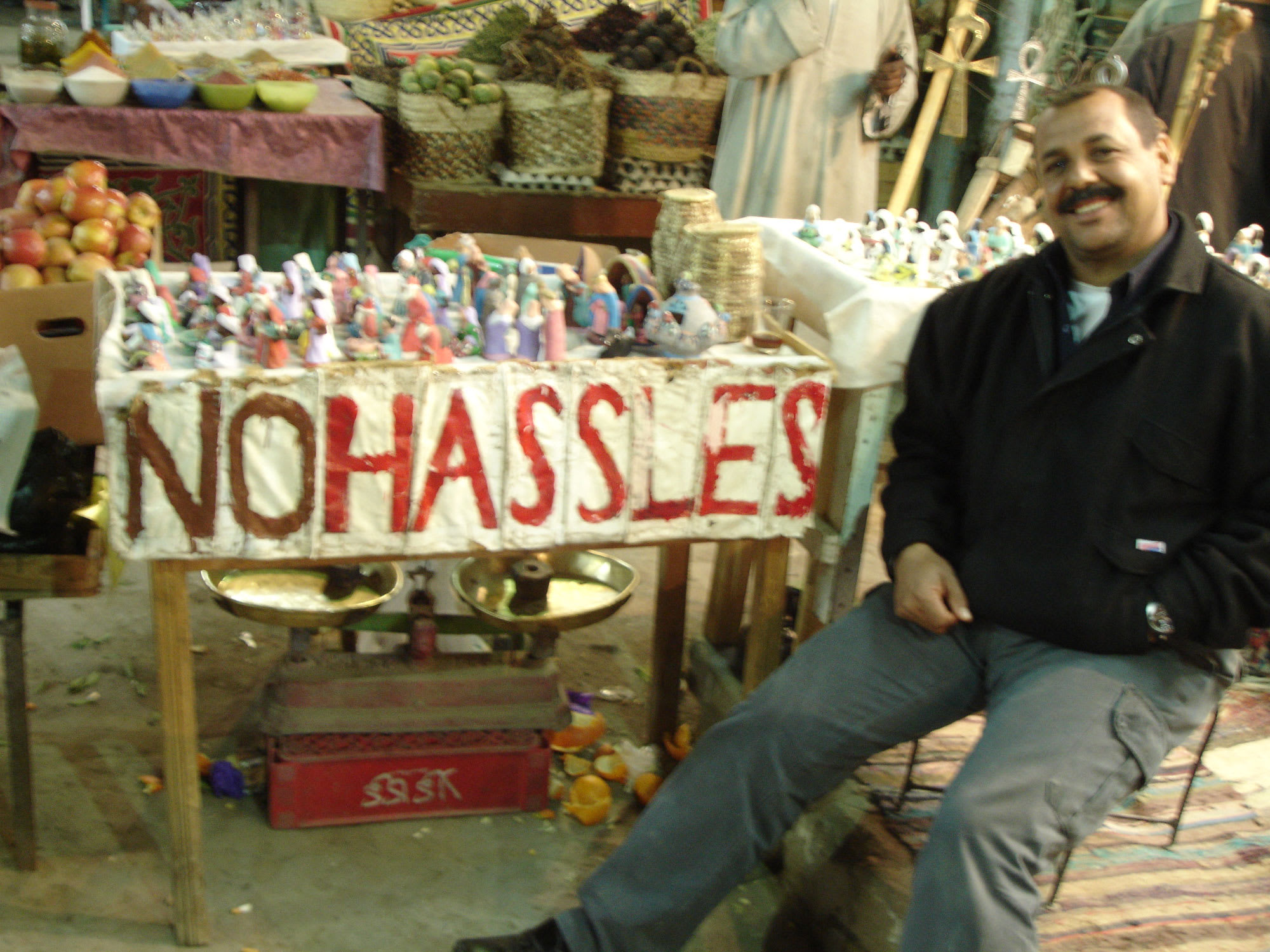
From my own experiences, what strikes me over and over again, is that what we usually expect when we decide to visit a new country, is never what the reality of the experience is. For example, one would expect Tony faced endless dangers. Yet he writes, “Only in Afghanistan and Iraq, was I even slightly concerned for my own safety, and I always ate well, slept comfortably, stayed healthy and as a bonus made some good friends.”
Now that we all have had an unexpected hiatus for two years and are finally moving back to our previous adventurous lives, I thought that this issue of expectations was worth reviewing. Just about all the participants on our tours have comfortable lives, yet they choose to participate on these adventures where the usual comforts, the ones they are used to are simply not there. Most of them accept that and realize that it is part of the adventure, exposing themselves to something new and different. The discomforts, the unknowns, the strangeness, are not a big deal.
But, unfortunately, not to everyone. In such situations, what happens is painful for us, the organizer, both in terms of how to deal with an outburst due to ‘no hot water’ or ‘no running water’, or a noisy air conditioner, or someone having a better room, or waiting a long time for the food they ordered. It is also very painful to watch when some unhappy participants mistreat the locals, ignore local conditions and culture and do not think about the environment and the immense challenges of the places they are in.
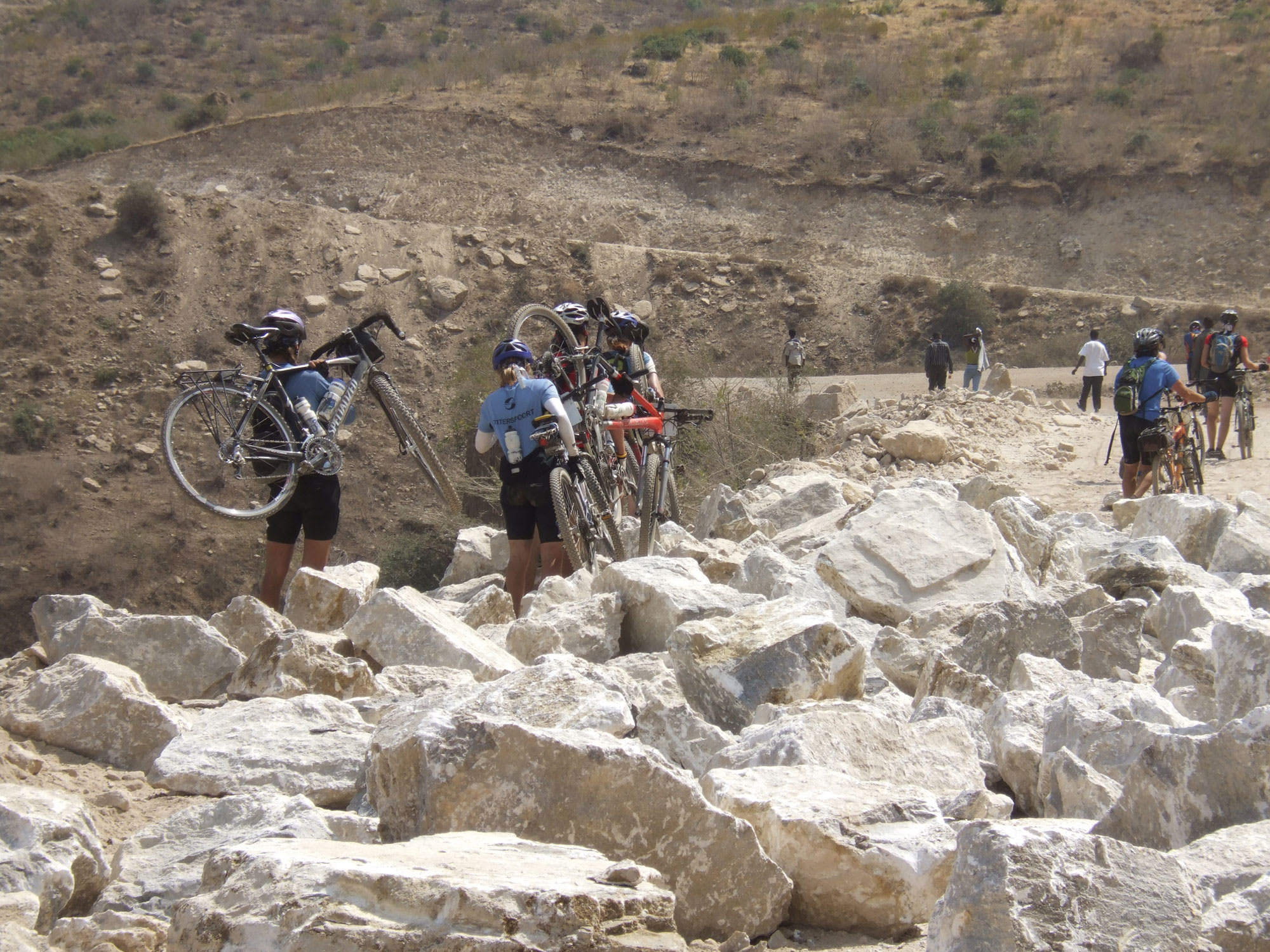
A rough day in Ethiopia
Yes, I understand. The participant just had a rough day on the bicycle, they are not feeling well or have a myriad of other reasons. But such outbursts or worse, when it happens multiple times, not only has a negative effect on the group you are part of but also creates problems for future participants. Frankly, if you write a negative review on the only 3- or 4-star hotel in town, the owner will have no desire to host our group the next time around. More importantly, in case of an emergency, whatever the poor service in the restaurant may have been or that the toilet was leaking, when it comes to unexpected problems, we are all dependent on locals. There were many times it was the kindness of strangers that helped us and saved us from more serious problems. I have written about this lightheartedly few years ago in a series – Reflections on Cycling the World.
Another book I recently came across – The Good American: The Epic Life of Bob Gersony, the U.S. Government’s Greatest Humanitarian – by Robert D. Kaplan, describes how one individual working independently influenced American policies across the world. The Good Reads website writes that it is a “story of the most influential humanitarian you’ve never heard of who spent four decades in crisis zones around the world”. I picked the book because, when looking at the cover, I realized that he and I shared a similar background of being children of Holocaust survivors, but, more interestingly, his work took him to some of the same areas that I had worked and traveled in and talks about some of the people I had met and gotten to know.
What was most remarkable about what Gersony did is the method he used. He would be sent to troubled areas of the world and interview hundreds of local people, listening and writing down their stories, their tragedies and their needs. He then compiled the notes he made during these interviews, which gave him a clearer picture of what was going on. He summarized this in reports and then made recommendations for policy makers including the type off aid that was needed. Apparently, most of the time, his recommendations were right on. This approach reinforces what I knew worked for the NGO I had run many years ago. My interpreters often looked at me suspiciously when I asked the same questions over and over from different people from all levels of society in the same area. Once the answers began to look similar, I knew that I just might be getting the information I needed to implement a successful project.
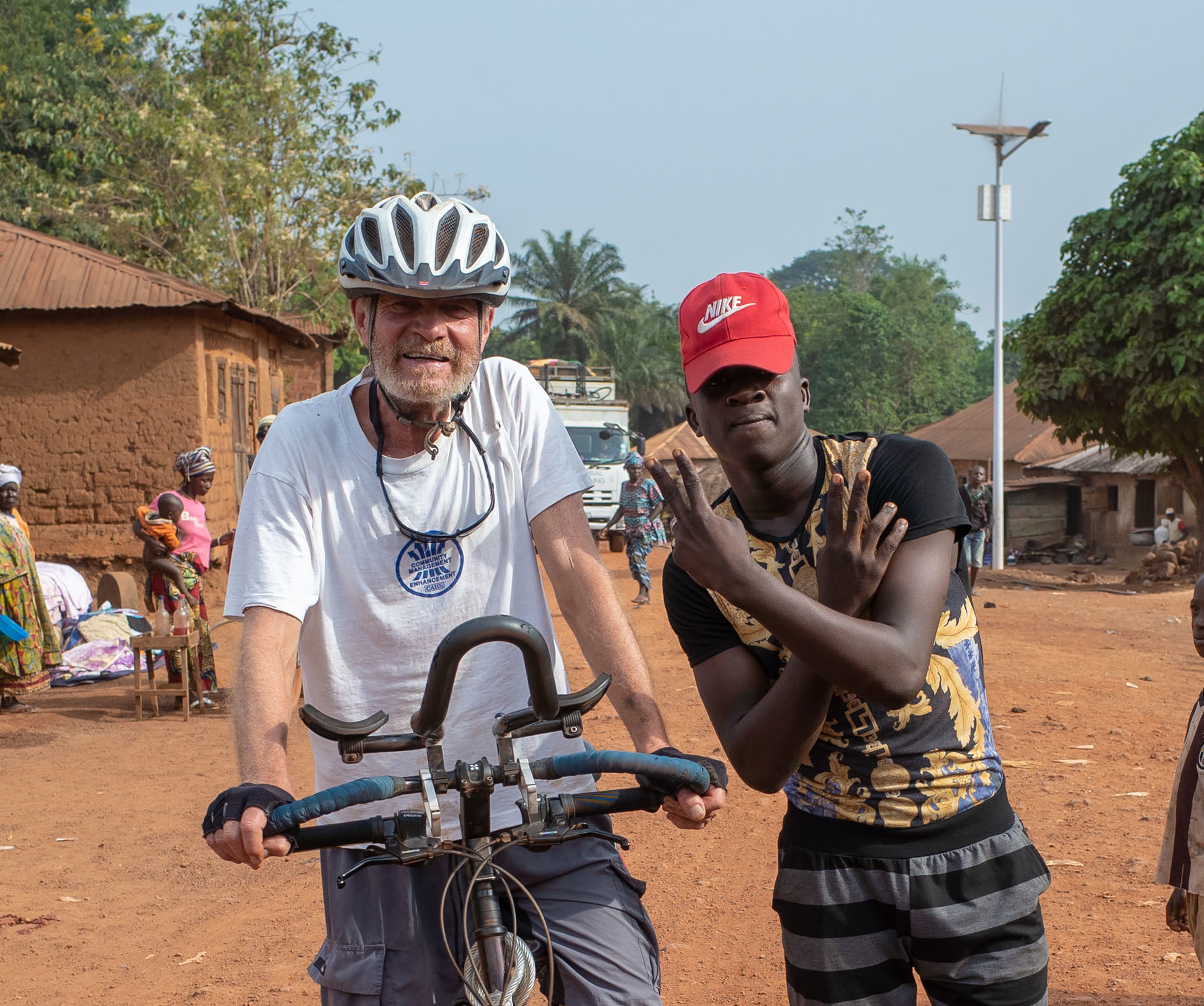
Henry meeting the locals in West Africa
I bring up this story here because, if I have learned anything in my work in conflict areas or in my travels, it is that having direct interaction with locals, having respect for them, their culture and treating them with dignity and empathy, works better than tantrums, insults and bribes.
Getting back to the young Tour d’Afrique rider with whom I began this blog, when I arrived at the Moyale border, I found him and his friend solemn and at a loss for words. All the other riders had crossed the border, but he was told he must go back 800 km to Addis Ababa and get the proper documentation to prove that he had entered the country legally. His friend whispered to me that what was needed was a bribe. I asked him if he has his exit stamp and then pointed him in the direction of Kenya.
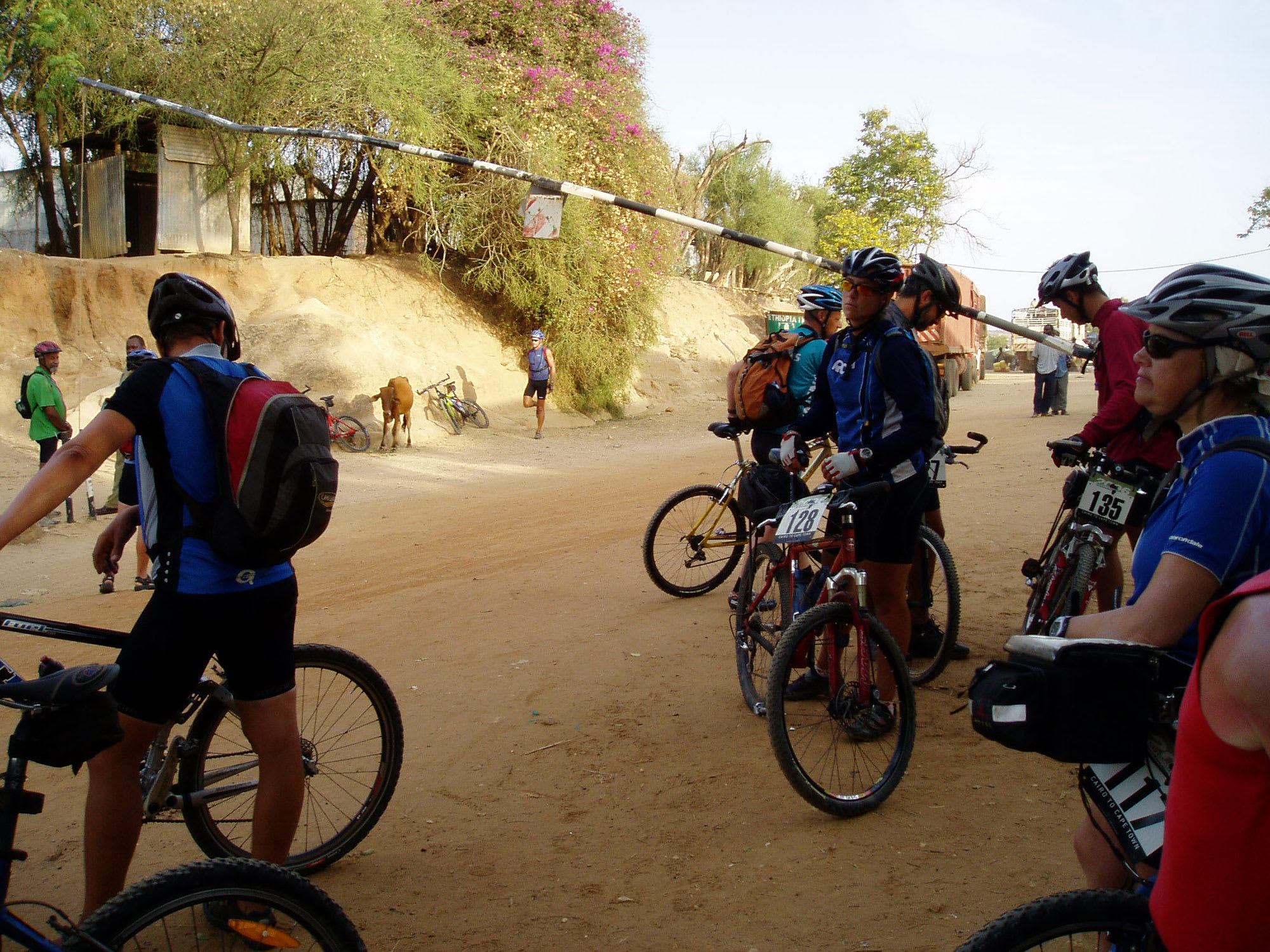
Moyale border crossing
I walked inside to the border official. We chatted for a while but he insisted that there was nothing to be done. I asked him if I could have a few words with his boss. He said that it was possible so we got into a car and drove to his boss’s house. He went in while I waited at the gate. After a few minutes, the boss came out, looked at me and said, ‘Henry, what are you doing here?’
Several years earlier, a wallet – my wallet – went missing at this same border. It was a long rough day and last thing I needed was to lose or have a wallet stolen at a border. I could have gotten angry. I could have thrown a tantrum. I could have made a scene. Instead, I sat down with the man in charge, this very same man. We had talked while drinking several very sweet cups of tea, sharing stories and laughter, establishing a personal link that now came in handy and which solved the immediate problem. A very fortunate outcome for the scatterbrained young man who was now allowed to leave Ethiopia without an official entry stamp. And the wallet? It was never to be seen again. Not that I expected it would.
]]>
It has been a long haul, a very long haul. Two years ago, who knew that we would all experience such incredible feelings of frustration, anxiety, caution, anger and other emotions? So, before I ask you the question in the title, maybe I should explain what I mean by ‘Deep Travel’.
 According to Author Tony Hiss, who wrote about it in his book, In Motion: The Experience of Travel, “Deep Travel is an exhilarating state of mind that travel can evoke, when everything seems suddenly fresh, vivid, intensely interesting, and memorable. Because you focus on what you’re looking at and listening to, Deep Travel is like waking up while already awake; things have a way of seeming emphasized, underlined. Travel can sometimes summon this kind of awareness automatically—we can all remember times when the world came alive unexpectedly—but we can also bring it to vibrant life voluntarily.”
I don’t know about you but I, for one, certainly need to ‘wake up while already awake’. I mean, even if you were fortunate like me and didn’t get COVID, somehow I still suffer plenty of ‘brain fog’. I meditate, I stretch every day, and have tried bringing forth ‘Deep Travel’ voluntarily. I walk three miles there and three more back in order to see my physiotherapist, taking different routes each time. I go skating outdoors once or twice a week. I pick up whatever I need to buy, whether from the supermarket or big box stores two miles from my home, by walking there and back and carrying whatever I buy. It still doesn’t quite seem to work. I obviously feel better by doing these walks, but my ‘brain fog’ persists. My local ‘walkabouts’ certainly don’t bring about ‘Deep Travel’.
Another wave of COVID seems to be winding down and country after country is opening up and declaring that it is time to accept this disease and learn to live it. The scientific world has come up with a long list of remedies and many more are on their way. And if our registrations for upcoming tours are any indication, many of us are ready to take the plunge and do what is necessary to move on.

Henry on the 2018 West Africa en Vélo
Netflix, Apple TV and the internet are simply no substitute for living your life and travelling the world. Why is that? Well-known writer Paul Theroux, author of such books as The Great Railway Bazaar and Dark Star Safari: Overland from Cairo to Cape Town – a route we here at TDA know well as do many participants of the Tour d’Afrique trip – has put it this way, “If the internet were everything it is cracked up to be, we would all stay at home and be brilliantly insightful. Yet with so much contradictory information available, there is more reason to travel than ever before: to look closer, to dig deeper, to sort the authentic from the fake; to verify, to smell, to touch, to taste, to hear and sometimes — importantly — to suffer the effects of this curiosity.” What I like about this quote, beside the obvious points about travel, is the final seven words – ‘to suffer the effects of this curiosity’.

We cyclists generally know that no matter how careful you are, no matter how prepared you think you are, inevitably we will fall. We also know that most falls are minor, that we get up, dust ourselves off and move on. To quote Einstein, “Life is like riding a bicycle. To keep your balance, you must keep moving.” Sometimes the consequences are more serious. In late October, while cycling on TDA’s Great American Roadtrip, I had a terrible crash and that is the reason that, four months later, I am still going for physiotherapy. It is a frustrating long haul, yet not for a minute did I consider not cycling again. In fact, I have registered for our company’s upcoming Morocco tour, and hope to even ride some other tours later this year. So, am I ready for some ‘Deep Travel’ and prepared to take some risks? You bet I am! Risks are part of life. Every aspect of life is a calculated risk, whether we acknowledge it or not. We sometimes calculate the risk and benefits of our own life in incredibly silly ways. So, after all this, are you ready for some ‘Deep Travel’?
]]>
“Imagination is a kind of mental time-travel” – Thomas Suddendorf, University of Queensland
To quote the famous philosopher, Yogi Berra, “It is deja vu all over again”. For the second holiday season in a row, the second new year, we are back to lockdowns, restrictions, hospitals struggling to provide services and a future that feels bleak.
When things start feeling grim, I try imagining alternatives. No wonder that while looking for something interesting to read, my eyes locked in on an essay, Homos Imaginatus. The article explained that the one mental capacity that might truly separate us from other species, “…isn’t exactly a skill at all, but more a quality of mind. We should perhaps have called ourselves instead Homo imaginatus: it could be imagination that makes us human. The more we understand about the minds of other animals, and the more we try (and fail) to build machines that can ‘think’ like us, the clearer it becomes that imagination is a candidate for our most valuable and most distinctive attribute.”
 Over the holidays a friend called and we chatted about having to cancel so many tours over the last 18 months.
“You must be disheartened” he said. “Why”, I asked.
“With what is going on, delaying and cancelling trips you have been planning for so long.”
“No, I just move on. I imagine that sooner or later better times are coming.”
Though I wasn’t aware of it at the time, the article on imagination explained my instinctive reaction, “A mind that can conceive of possibilities beyond its own experience can prepare for the unexpected; better to over anticipate than to be surprised.” As I write this, our company has just cancelled yet another trip. “The task of a mind,” wrote the French poet Paul Valéry, “is to produce the future.” And so, we plan. And the future is ours to imagine and create.
That is not to say that I don’t feel anything when we cancel a tour. The Austrian poet, Rainer Maria Rilke, who I quoted in the final blog of the inaugural South American Epic wrote: “Let everything happen to you: beauty and terror. Just keep going. No feeling is final.”
But cancelling a tour is also not a failure. Samuel West, the curator of the Museum of Failure, is quoted in a CBC Ideas program on failure, “... it’s not so horrible to fail if you’re failing because you’re trying something new. I think a lot of it is because we want something genuine. We want something uncurated,” he said. “And, because failure is something that most people and most companies usually hide, putting failure up on a pedestal and shining a spotlight on it offers that sense of ‘this is real.’”
There you have it. We at TDA imagine, then plan, then execute the plan. Sometimes it doesn’t work. Sometimes it ‘fails’ because we forget to take something into account, sometimes because of geopolitics and sometimes because of externalities beyond anyone’s control, like, say, a pandemic. It is all ‘uncurated and very real’.

On our inaugural South American cycling adventure, a participant on the tour asked me:
“Henry, do you know why your company is successful pulling off these crazy bicycle expeditions one after another when other companies don’t even attempt them?”
“No”, I responded
“Because you are not afraid to fail.”
Well, he was wrong. It is because failure is never a failure. Failure is just another word. To quote Samuel Becket, “Ever tried. Ever failed. No matter. Try Again. Fail again. Fail better”. As the writer of Homos Imaginatus, Philip Ball, writes, “Imagination is the essence of humankind. It’s what our brains do, and in large part it may be what they are for.” We at TDA use our imagination a lot and I hope that during these challenging times, you too can imagine a better future.
So stay tuned for our future tours. Those planned for 2022 and beyond can be found on our calendar page.
]]>
“One day you’re waiting for the sky to fall,
The next you’re dazzled by the beauty of it all”
– Bruce Cockburn
Our Editor in Chief sent me this email a few days ago:
“Do you think you can come up with a blog looking back at the past year? By Friday?”
“By Friday?”
“OK, Monday is fine as well”, he writes back.
“I don’t know. I will try. I need a lead of some kind,” I answer.
“How about a riff on the blog you wrote last December, ‘After a year of taking a break what is on your bucket list?’”
Well Michael, I said to myself, how about changing the name to ‘After two years of taking a break what is on your bucket list? and simply reprinting the blog. The point of the piece, or at least my goal, was to get the reader, in an entertaining way to read the final paragraph. “Now that you have had a good long time to think of what you would like to do, at least when it comes to cycling, once the curtain of COVID-19 rises, what is on your bucket list? If you have not made up your mind, please do check our schedule – this our shot for 2021. These are the tours we have chosen that we believe are most likely to run. Some of these tours may miss, while others we expect to hit their mark. We have lots of reasons to be hopeful for next year. One more thing. There is a Latin Aphorism – ‘Carpe Diem – Seize the Day’. Grab the opportunity when you have it, as none of us knows what the future brings.”

The 2021 Great American Roadtrip finish Line, Savannah, Georgia
Well, 2021 has passed and we all know what happened. From the many trips we had on our menu, finally in September we managed to get two trips off the ground – The Trans Europa and The Great American Roadtrip and another one, the Pura Vida which just finished in Costa Rica. It felt great to see a bunch of riders seizing the opportunity! And now, just as things were looking up, with a couple of more tours set to begin in February (Pura Vida and Tour d’Afrique 2022), it feels as if we all threw the dice, rolled snake eyes and are back to square one. It was Alexander Pope who wrote these memorable words:
“Hope springs eternal in the human breast;
Man never Is, but always To be blest.
The soul, uneasy, and confined from home,
Rests and expatiates in a life to come.”

2021 Trans-Europa riders at the start in Ljubliana, Slovenia
So, what is to come in 2022? Sometime in the middle of this year a headline caught my attention – ‘Cognitive Flexibility’ Is More Important Than IQ for Success. Stories on this subject have since circulated in the media in various forms. The magazine, Conversation, defined Cognitive Flexibility as, “a skill that enables us to switch between different concepts, or to adapt behaviour to achieve goals in a novel or changing environment.” The article went on to say, “Some people remain rigid and stick to the original plan, despite the delay. More flexible people adapt to the unexpected event and problem-solve to find a solution.”

2021 Pura Vida riders at the start in San Jose, Costa Rica
I do not know what the solution to the COVID crisis is but I do know that over the last 20 years many have questioned my, and our company’s, IQ when they saw what we were planning. However, no one has accused us of not having Cognitive Flexibility or perhaps just flexibility. And so, we head into 2022, and our schedule full of great tours…again. Hopefully, some will happen, and yes, some maybe cancelled. However – my advice and this is not a riff – would be the same as a year ago. Grab the opportunity when you have it, as none of us knows what the future brings. On that I am not flexible. To quote the Economist, “as 2022 draws near, it is time to face the world’s predictable unpredictability. The pattern for the rest of the 2020s is not the familiar routine of the pre-covid years, but the turmoil and bewilderment of the pandemic era. The new normal is already here.” And it is up to us to choose how to deal with it.
]]>
It has been great fun once again to go places I have never been before as I wrote about in September. And now with the successful completion of our first tours since Covid hit, the Trans-Europa and the Great American Roadtrip (or ‘GART’ for short), I thought I would revisit a couple of the blogs I wrote at the beginning of the Covid epidemic.
 In a blog written in isolation on March 24th, 2020, called ‘A Few Words From My Basement’, I penned the following: “Yes, currently there are many unknown unknowns but our modus operandi has not changed. We, as always, strive to do the right thing, whether that means taking steps to protect our participants or offer full refunds for our cancelled tours. We also try to see the big picture, keep our wits about us and deal with whatever comes up in a rational way. The coronavirus is a challenge but if you look at the big picture of humanity and the adversity it has overcome, if we all keep our wits about us, soon enough it will be just another virus which humanity has learned to deal with and overcome. We at TDA certainly have no doubts about it. And this one thing is certainly not an unknown fact.”
Four waves of Covid have come and gone and there may be some more to come. Vaccines that didn’t exist at the beginning of the epidemic are now saving lives. New better vaccines are on their way, as are better medicines to help those who get sick. Many now predict that the virus will be endemic as is influenza and other recurring diseases. In the first blog right after cancelling our flagship tour (the Tour d’Afrique) on March 15th, 2020 with the tour only at the halfway mark, I wrote the following: “What I am trying to say here, though I may not be doing a good job, is that all is well here at TDA. I hope that the same applies for our community of riders, supporters and their families. We are dealing with problems as they come up. At the same time, we have not lost our perspectives on the longer term and are not only planning to continue with our planned tours, but also looking at opportunities for new ideas – possible new ‘pop up’ tours and alumni meetings around the world. Of course, all this must wait for the virus to be brought under control, which I feel will happen sooner or later.”

Over the last 20 months we have had a few starts, only to cancel and wait for another opportunity. When we planned the GART, we were convinced that with the successful uptake of the vaccines, Covid will be under control in the United States. By the time we arrived in Los Angeles for the start Covid numbers were exploding in the southern US. Still, we decided to press on, simply because we felt that by making sure everyone was vaccinated and taking some common-sense measures, the tour can go ahead.
Starting on the very same day in Europe was the Trans-Europa cycling adventure (read ‘We’re Back Baby! TDA Global Cycling Returns to Europe‘). Both tours were successful, Covid-free from start to finish and the participants who decided to join us went home tired, healthy (if we discount my bruises from a very nasty fall), and with a great deal of joy and satisfaction. Perhaps we were just very lucky or perhaps the success proves that if you do the right thing – or to quote myself from above “if we all keep our wits about us, soon enough it will be just another virus which humanity has learned to deal with and overcome.”

New tours are on the agenda, some will need to be modified, some may even be cancelled. New Covid strains worse than the ones already around, may surface – one such potential strain is being reported as I write this blog. Participants on future tours will likely need a booster shot. We better get used to having tests as we cross borders. We have all got used to security measures at airports that now require that we show up early for flights. In the old days I even missed a flight or two because I didn’t like waiting at airports. To some, perhaps many, the security checks are a pain in the butt. But we got used to them and we are accepting them because we love to travel. So it will be with Covid. If you want to go to Patagonia or visit your grandma in Italy, you will accept the fact that you need a vaccination and a test. For years all of us who went to Africa, whether for work or pleasure had to have proof of Yellow Fever vaccination. It never crossed my mind not to get it.
As the person who has the final responsibility for giving the go-ahead on a tour, there are always hesitations, questions, and doubts. Potential dangers lurk around the corner. However, in life, no matter what we do, there is a danger. Any cyclist who gets on a road that is shared with drivers is reminded of this every time they get on a bike. The statistics don’t lie. To end these musings, here is another quote from a blog called ‘Rediscovering Freedom‘ written in May 2020: “What there is, is the realization that life goes on and we all need to find a way to move forward. There are all kinds of challenges and unknowns but to quote the remarkable deaf-blind author and political activist Helen Keller, ‘Security is mostly a superstition, it does not exist in nature nor do the children of men as a whole experience it. Avoiding danger is no safer in the long run than outright exposure. Life is either a daring adventure, or nothing.’” And we at TDA believe in that.

“In the middle of the path of our life I found myself in a dark forest, for the straight way was lost.” – Dante Alighieri, The Divine Comedy
After 18 frustrating months of not being able to run tours, on Sunday, September 19th our company will finally start two long distance cycling tours – TDA’s Great American Roadtrip from Santa Monica, California to Savannah, Georgia and the Trans-Europa from Ljubljana, Slovenia to Gibraltar. During these months, I have often felt that I was in a dark forest, lost, trying to gather my coordinates and find a way out. I grew up in a forested area and as a mere child of 11 or 12, I used to go picking wild mushrooms, so forests don’t really scare me. Nevertheless, being lost is no fun.

The Divine Comedy, which I quote above, is an epic poem – just as our trips are epic cycling tours. It is divided into three parts – Inferno, Purgatory and Paradiso and according to Britanica.com, it traces Dante’s journey from darkness to divine light. The title, The Divine Comedy, is not really a comedy in the Hollywood sense, but rather a work in the classical style that begins ‘in misery and confusion and ends in elation or happiness’, though I must admit, watching the news and my surroundings for the last 18 months, the words Divine Comedy in the Hollywood sense has crossed my mind a few too many times.

The Divine Comedy
The poem has often been written about in the recent past. To quote a recent article in The Economist, “Dante was not just a poet of crisis but also a poet of hope. The ‘Divine Comedy’ is that rarest thing, an epic poem with a hopeful ending. It is about getting a second chance—and ultimately finding joy.” And so, on September 19th, we as a company and the riders who have decided to join us in spite of all the uncertainties, are hoping that we are now in the last third of the COVID-19 era and that elation and happiness will follow.
Having said that, one thing I can tell you is that it will not be easy. Each day as we prepare for the tours, we are facing unpredictable events, be it Hurricane Ida in New Orleans (which we plan to visit in early November) or the possible closing of the first few campsites in California, due to the State government’s desire to discourage the use of forests at this time as a result of the wildfire situation.

Handmade ceramics in the style of Wabi Sabi
There is a way of examining this through another prism. The Japanese culture has a way of looking at beauty, what they call Wabi Sabi. Wikipedia defines it as appreciating beauty that is “imperfect, impermanent, and incomplete. Wabi came to connote rustic simplicity, freshness or quietness and can be applied to both natural and human-made objects as an expression of understated elegance. It can also be used to refer to the quirks and anomalies that arise from the process of making something, which are seen to add uniqueness and elegance to the finished object. Sabi refers to the beauty or serenity that comes with age, when the life of the object and its impermanence are evidenced in its patina and wear, or in any visible repairs.”

Henry looking forward to the future
We have already cancelled our new tour in Korea and Japan, the Journey to the East, twice so I and many other riders will have to wait and see and hope that the third attempt scheduled for the Spring of 2022 is successful. In the meantime, I am looking forward to a most likely, somewhat imperfect, tour of the Southern USA with hopefully plenty of Wabi as well as Sabi. I can only hope that the participants on the Trans Europa and Great American Roadtrip feel the same.
RELATED
TOUR
RELATED
TOUR
“Do you come from a land down under,
Where women glow and men plunder.
Can’t you hear, can’t you hear the thunder?
You better run, you better take cover.
I come from a land down under,
Where beer does flow and men chunder.
Can’t you hear, can’t you hear the thunder?
You better run, you better take cover.”
– Men At Work

With much of the western world slowly re-opening, we are gearing up to start running our tours again and confident that at least some cyclists from around the world are preparing to get back on their bikes as well, hopefully riding with us. Unfortunately, that is not the case with our community of riders from Australia and New Zealand.
Australia and New Zealand managed to escape much of the COVID-19 pandemic that badly affected the rest of the world. Good for them and I suppose that is the main reason why the two countries are being extra cautious and not re-opening their borders, except to each other. That is ok and we completely understand. That doesn’t mean, however, that we have forgotten our Aussie and Kiwi riders or that we don’t have the desire to come to Australia and New Zealand to visit and to cycle.

Henry takes break on the Stuart Highway
Take me, for example. With a lifetime of travelling and working overseas, I have visited many countries, but much of Australia and all of New Zealand are unknown territories to me. I participated in our first Trans-Oceania trip in 2014 which took our riders through the islands of Indonesia before we landed in Darwin, Australia. From there we pedalled south along the famous Stuart Highway.

Pretty much every Aussie told us we were mad but we successfully crossed it to Adelaide and had a great adventure along the way. From Adelaide we cycled the scenic Great Ocean Road to Melbourne where I had the pleasure of spending some time with the founder of Lonely Planet, Tony Wheeler who, a few years back, had sponsored two teams of Lonely Planet writers and staff to ride the iconic Tour d’Afrique (they later included this expedition in their book, Epic Rides of the World).
Upon reaching Melbourne, Tony organized a special treat for all our cyclists and had us over for a wonderful lunch in his home. Perhaps after cycling the Stuart Highway, Tony thought we deserved a treat. After all, how many cyclists in the world can say that they cycled across the Outback, “the land down under where the beer flows and men chunder,” in November, the hottest time of the year. From Melbourne, we cycled to the capital city of Canberra and then ended the epic cycle tour, where else, but at the Sydney Opera House.

The end of the ride – 2014 Trans-Oceania cyclists
On our subsequent Trans-Oceania trips, we dropped the Indonesian section and added New Zealand, but we also changed our route in Australia. For the 2020 version, we were planning to start in Adelaide, pedal the Great Ocean Road, circle the island of Tasmania and then cycle onwards to Sydney and the two islands of New Zealand. I was planning to be on it but, of course, we all know what happened.
I don’t know about you, but for me planning and dreaming about cycling the world doesn’t stop – at least as long as I am able to do so. Our team has even created a free series of blogs and videos – How to Prepare for a TDA Tour – that many in our audience have been reading, helping them get inspired for their post-pandemic cycling adventures.
In fact, according to some experts just planning or anticipating your trip can make you happier than actually taking it. Personably, I am not convinced that it makes me happier but, in times like these, I take happiness anywhere I can find it. I will, however, point out that these scientists, as far as I could tell, have not researched any long-distance cyclists. If they had, they would likely have reached a different conclusion.
In any case, as I write this, the most realistic time that we will be allowed to return to Australia and New Zealand and cycle the Trans-Oceania will be the fall of 2022. I am planning to be on that tour and this time, I will be sure to appreciate the wonderful culture, sights and the beer of the two countries even more. At the same time, I hope that all of you ‘down under’ have not given up on the idea of cycling the world. Reach out any time you have questions about any of our future tours. It’s not too early to start registering for tours in 2022 and 2023. In fact, several of you already have.
The world has changed and will continue to change in unpredictable ways. Be that as it may, what I really wanted to say to our community of cyclists down under is that we miss you, are thinking of you and hope that you are cycling a lot and planning to join us once it becomes possible.
]]>
A few months ago, I was listening to a CBC Ideas podcast called ‘Paddle to the Amazon‘ a most fascinating documentary about a man who had a dream of paddling a canoe from Winnipeg – in the middle of Canada where he lived – to the Amazon. The epic trip would stretch nearly 20,000 kilometres and 13 countries. It turns out that the more people told him it was impossible to do, the more he became determined to do it. The podcast raised memories of me telling people that I am preparing an adventure cycling from Cairo to Cape Town.
Months later two things from the documentary stick in my mind that I very much identify with and that are so present in the situation we are in. At one point the man, Don Starkell says that 99% of what you fear never happens. This is an idea I have tried to put across over and over since the day I have decided to create the company and cycle across Africa and subsequently through rest of the world.
The second memorable idea that still reverberates for me for obvious reason is what his partner on the voyage (his teenage son) says about his father. “Knowing my dad the way that I did, his greatest fear was not living life.”

It has been 18 months since Covid-19 has appeared on our consciousness. A lot of things happened, but as I wrote in my first Covid blog “many of you may feel downcast and vulnerable, those of us who have lived long enough, know that every crisis comes to an end and that better days do follow. Sometimes, it takes a bit longer but eventually the sun does come up and we humans are programmed to take advantage of the new day.”
Mankind are an amazing creature, very smart and very resourceful. Vaccines that were initially thought to be years away are here and doing a wonderful job. A new day has arrived. What now?
Yesterday, I came across an article in the National Geographic “Why ‘getting back to normal’ may actually feel terrifying” After a year of anxiety, anger, and burnout, many people are struggling with returning to pre-pandemic behaviors. According to the article, among other things many of us are suffering what European psychologists Marcantonio Spada and Ana Nikčević dubbed “COVID-19 anxiety syndrome.”
“It’s characterized by coping behaviors “that can keep people locked into a state of continuous anxiety and fear,” with people afraid to go out, avoiding people and public places, and worrying constantly about themselves or others contracting the virus, Spada says.” The article goes on to say “Some of us are stuck somewhere in the middle, in a kind of psychological limbo, a state that psychologist Corey Keyes in 2002 characterized as ‘languishing.’ Merriam-Webster defines languishing as ‘to be or become feeble, weak,’ ‘to live in a state of depression or decreasing vitality,’ or ‘to become dispirited.’”
So what is the best way to get out of this anxiety syndrome and from languishing? In an article in the NY Times on April 19th, 2021, psychologist Adam Grant suggests “A concept called ‘flow’ may be an antidote to languishing. Flow is that elusive state of absorption in a meaningful challenge or a momentary bond, where your sense of time, place and self melts away.”
 For me, I believe what Don Starkell said; 99% of what you fear never happens but more importantly and something that has motivated me from quitting my engineering job decades ago and that is “the fear of not living my life”.
My advice to all is do not wait for 100% guarantees. There are none. Get into the ‘flow’, grab the opportunity when it’s there and live your life. Whatever you have been putting off for years, now is the time to commit yourself. As has been said by others, I do not regret things I have done. I regret those which I haven’t done.
In the Paddle to the Amazon documentary Dana Starkell, the teenage son accompanying his father on the 13 countries epic canoeing adventure, said this about his father and their trip. “… I think in his mind he figured, you know, of course there’s dangers ahead. But maybe if we use our brains and … treat people right, we can come through this unscathed somehow.”
Yes, we will!
]]>
As I tried curling myself into fetal position, with my face being grounded into the soil, I heard my helmet cracking. ‘This is interesting’, I thought, ‘what happens next’. There were no pictures of my life passing, no sparkling lights at the end of a tunnel reported by people who apparently been on the other side, no fear – just curiosity about what happens next.
Today marks ten years since I found myself being crushed by an adult elephant and, as with all anniversaries, this one to needs to be noted and celebrated, particularly now during COVID. I was lucky that day, extremely lucky! One could say I won the most precious lottery in life – life itself. A day after a surgery, sitting in my bed with laptop on my legs and typing with only a finger on my right hand, I learned that, on average, each year 400 people are killed in India by elephants, mostly farmers trying to protect their fields. I was not protecting anything.

Henry on the 2011 Indian Adventure Cycling Expedition about 1/2 hour before the attack
All I was doing was cycling on a quiet road winding through a forest, when I saw the charging elephant breaking through the trees branches. I suppose I was an innocent bystander in the millennia long war between wildlife and mankind, a war that elephants and wildlife have been losing at an exponential rate. As we humans disturb and take over their habitats, they lash out. In that sense I was not an innocent bystander. I, for better or worse represent my kind, homo sapiens. Except that I was only a few kilometres from a town and I had no idea that there were any elephants in the forest.

After surgery that evening, the doctor reported on a long list of bones broken and fractured, “but considering” he said “you are actually in good shape. You will be able to get on a bike in six weeks.” Lying in bed in the hospital gave me the opportunity to ponder my life, on the choices I had made and on the most important one – now that I have been given this most precious gift – how to live the rest of my life.

Henry after the elephant attack
Six weeks quickly turned to 18 months but not for one moment did I lose the feeling of having been given a gift and I appreciated all aspects of my life. Ten years later, as I ponder my anniversary in the middle of an ongoing pandemic, I contemplate what, if anything, is the advice I can share. The obvious thing, of course, is that life is very precious and if you can, take a moment each day, look around you, take a deep breath and smile. You are alive, part of the mystical creation in this vast universe, without much knowledge of how and why, but you are breathing and playing your bit, whatever that may be.

Henry offering support to Tour d’Afrique riders in Zambia
Close your eyes and when you open them, look around you and smile again. Acknowledge that everything else around you is also playing its bit in this universe, also not knowing much but still, they are all here, the living things as well as the inanimate. Close your eyes again and when you open them, try to remember that whatever is making you feel sad and frustrated, it does so only because you are alive. As one old man, an uncle of a friend, who was over a hundred years old used to say, “pain is good, it means things are still working.”
>>Related Blog: Benefits Of Expanding Your Comfort Zone
We are all in some capacity part of and impacted by COVID and it isn’t easy – not on the young ones stuck in their homes in front of their screens, not on the old ones isolated from their families, friends and the community and certainly not for those who are sick or those who have lost their loved ones. However, whatever is happening is part of the miracle called life, and we are all actors in that play. We are confused, we suffer, we are frustrated but periodically we should remind ourselves that each and everyone us is part of that miracle and live our lives accordingly. That is the only choice we have – how we decide to live our lives.

Henry testing his broken bones on the 2012 Doomsday Ride in Central America, his first outing since the attack
Whatever you decide, remember, as I did after 18 months of healing my broken bones, life is much better when you are on a bike – even if you only ride it for a few minutes each day. In a blog written a week after the elephant attack, after my first walk outside, I wrote “The colours felt sharper, the trees across the street more glorious, the leaves an intense greener. I feel have been given a new gift, new eyes to look at the world.” Try to think of COVID as an opportunity to look at things with new eyes. Looking back over the last decade, I can report that my encounter with the elephant has certainly given me a new way of looking at the world.
]]>
At first, it looked like the COVID-19 pandemic was a sprint and that it would soon be over. Then it looked like a middle-distance run but, soon enough, it became a marathon, actually an ultra-marathon. Our company runs what one would define as ultra-marathon cycling expeditions so, how are we adapting? How is our community of cyclists doing? Did our tours better prepare us and the participants to deal with this stressful situation?

In a recent video, my colleague Shanny interviewed an alumni of several TDA tours, Ruth Storm, who a few years ago skied from the coast of Antarctica to the South Pole. Ruth explains, that “the hardships and challenges experienced on these adventures teaches you skills that you can use for the rest of your life”. She goes on to explain how these trips help you to put perspective on your own life and what matters and what doesn’t.
The COVID-19 situation we are in cannot be compared to one of our long cycling adventures. Yet, there are similarities. Each day you have a goal but you do not have any idea what awaits you. You know you have to take care of yourself, do what you have to do for the day, but do not know the outcome. You know that each day can bring serious problems and you brace yourself for them.
During COVID times you often face unknown and unpleasant situations as sometimes you do on a tour. You know this marathon has an end, you just do not know when. So you get up each morning and, just as on tour, you get going and ‘cycle’ on with life. And you know that just like on a long trip, it is a mind game. You have to play the long game and be tough.
This is what Ruth Storm is referring to regarding long distance tours. It is those rough times that you remember the most and that help you again and again when you find yourself in rough seas. And you think to yourself, I can deal with this and you move on.
A Really Shitty Day

At least I do. Perhaps the toughest day I ever had on the Tour d’Afrique, one that just about did me in, was the stage leaving Bahir Dar in Ethiopia. Two days prior, just a few kilometres outside of the town, I got a little playful and decided to cycle between two rocks that were blocking the access to a new road under construction. My foot got caught on one of the rocks and I fell with my ribcage landing on the rock. I sat on the ground, in pain and taking shallow breaths. Minutes later, with no one around to help, I got back on the bike and made it to Bahir Dar – and thankfully a rest day.
I went directly to a nearby hotel and rented a room, a bed being easier to get up from then the floor of the tent. Thirty six hours later, my ribs were still hurting. I was leading our group of 30 plus cyclists, accompanied by support vehicles, for about 15 km, to a point where we had to make a left turn onto a dirt road. I was the only person in our group who knew where the turn-off was. As we were getting closer, I experienced terrible cramps and needed badly to relieve myself but I knew the turn off wasn’t very far. We had a long and hard day ahead of us on a rough road and I didn’t want to delay anyone. As soon as we reached the intersection, I pointed the way and ran into the bushes.
Off the riders went, all of them, including the trucks. My affliction turned out to be no ordinary diarrhea. I squatted for half an hour or maybe more in agony. Once done, completely drained, I sat by the road hoping for a ride. Regrettably, the dirt road we were on had almost no traffic. Half an hour later, feeling a little bit better, I decided I might as well start cycling to shorten the distance for the lunch truck, when it came back to look for me. As I rode, bit-by-bit, I felt better and few hours later, by the time the lunch truck showed up, I had decided that I wanted to continue cycling. Soon, however, the sun was beginning to set and there was no sight of our camp.

A military vehicle that was keeping an eye on our group came by and offered me a lift. Erroneously, as it turned out, I was convinced the camp was nearby. After the struggle I had just experienced, it had became a point of pride to finish the day’s ride. Half an hour later, with the sun having set, I found myself struggling up a steep hill, searching for the lights that would indicate our campsite. The military men came back again, this time insisting that there were hyenas around and that it was very dangerous to keep on riding. But even though it was against the tour rules not to ride in the dark, I had become so obsessed with finishing the day on a bike that I just kept on pedalling.
Once I finally reached our camp the day wasn’t over. Angry riders, who were worried not only about losing their tour leader but who were also upset because of what they perceived of a double standard regarding the rules, started taking a piece out of me. After a quick meal, I set up my tent and crawled in. I was tired but the events of the day played themselves in my mind over and over. I had made several errors in judgement but I also felt good about my ability to recover and cycle the distance.
Nowadays, when I am hurting, physically or mentally, I think of that day. I think of sitting by the road, devoid of any energy and praying for a car to come by. I think of the slow long ride all day long and the desire just to be in camp in my sleeping bag. I think of the anger of the cyclists awaiting me. But I also think of the stubborn determination that kept telling me ‘you can do this, you will get there’. And I smile to myself. I venture to say that many of the participants on our tours have similar stories and they too, silently smile when no one is looking. And because of that silent smile, they are capable of dealing with COVID-19 and the many challenges it throws their way.
]]>
It was a stunning work of art, and more so as I had no idea it even existed! Called Muisca Raft, it is 10 inches long and depicts an indigenous chief on a raft, surrounded by oarsmen and shamans. It weighs 287 g or about 10 oz and is made of 80% gold.

Muisca Boat – Credit: Pedro Szekely, CC 2.0
It was a rest day in Bogota, Colombia, on our first South American Epic Expedition and I was visiting the remarkable Gold Museum of pre conquest indigenous cultures of the Americas. This work of art made such a strong impression on me that I sat down and wrote a note to myself, that I used in writing a blog – For The Sake of a Single Verse – at the finish of the first SAE in 2015. It also made me realize how little I know, how little we all know about life in South as well as North America.

The year was 1491. If you were alive then – perhaps like being around in November 2019 – neither you nor anyone else had any idea what was coming. And by that I do not mean simply a sailing trip to find a short cut to China by one called Cristobal Colon, nowadays remembered as Christopher Columbus. One of the benefits of COVID-19 for me has been the enjoyment that I experience from reading books that put context to almost my 20 years of cycling the world.
Two books were by an American author, Charles Mann. The 1491 book, subtitled ‘New Revelations of the Americas Before Columbus’, is “a fascinating and addictively readable tour through the New World before discovery.” The second tome, 1493, subtitled “Uncovering the new World Columbus Created’, explains “how the ecological collision of Europe and Americas transformed virtually every aspect of human history.”

When you choose to cycle with TDA, you will certainly bike to places that will dazzle you, baffle you, and reveal things that you may have not been aware of; Machu Picchu, the amazing Pyramids of Teotihuacan in Mexico City, viruses and bacteria, greed and God, slavery and plagues, Inca roads and central planning, the impact of horses, pigs and turkeys, potatoes, corn, peppers, tomatoes and much, much more. There are so many experiences that it is often simply incomprehensible, particularly on a cycling tour where you average over 100km per day. That doesn’t leave much time for contemplation, reading, and learning.
So you take in what you can, store of it as much as your brain can accept and let it lie there until it resurfaces, for one reason or another. Unknowingly for me, when I started reading these books, memories and forgotten thoughts just started pouring out. That is what happens when you cycle all over the world. Everything is interrelated, but how?

The book, 1491, deals with what has been discovered over the proceeding few decades. The findings often completely contradict the accepted knowledge of what life was like in the Americas before Columbus landed in Hispaniola. His second book, 1493, deals with the impact on the world when everything that existed in one part of the world, met and collided with everything existing in the other. The results were beyond anyone’s imagination: from the horror of one fifth of humanity dying from diseases that they were not exposed to previously such as small pox and malaria, to the fact that native American plants such as potatoes and corn fed starving Europeans peasants and allowed Europe to develop. Not to mention the infinity of greed, glory, survival and supreme rationalizations we all create to justify our actions.
As I made my way through the two books, whether the writer was describing the shipment of silver through the Panama isthmus, the collapse of the Mayan civilizations or the context of how Cortez managed to defeat what was then arguably the largest, richest and perhaps even most developed empire on earth, I had moments of revelations about things I saw and pondered when I was cycling through these places. And I am not only talking about the Americas. The discovery of the ‘new world’ had an immense impact on China and the rest of the world. I recall walking into a Hakka museum in Mezhou in Guangdong Province on the Bamboo Road tour, reading for the first time in my life about the mountainous Hakka people, who all of a sudden appeared in the 1493 book. They apparently played a pivotal role in the changes and outcomes in China and correspondingly in Europe as a result of the trade in silver and plants brought to Asia from South America.

It is a cliché we hear all the time – that the world is an interconnected place – and even more so with COVID-19. Reading these books brought to life the places I have seen and experienced on our bicycle tours: the people we have met, the food we tasted and the common and often tragic adventures, we are continuously pursuing. None of us know where that adventure leads, but I can guarantee you, COVID or no COVID, cycling across continents will not cease. Our DNA is programmed for life and life means, eating, laughing, moving, sharing, exploring and pedalling. If you want to get a few more insights about the world and humanity, I humbly suggest that you read these books. It will enrich your life and your enjoyment of cycling tours, past and future.
]]>
In mid-March I wrote a blog on having to stop the 2020 Tour d’Afrique in the middle of the tour due to COVID-19. Since then I have been writing more pieces that in one way or another have been about how the pandemic is affecting the world and our community in particular and how to make the best out of the situation.
In my own way, from the first blog which started with “To paraphrase a famous quote, it is not the best of times but it is also not the worst of times” to one titled – The Light at the End of the Tunnel – I have tried to keep a perspective on the situation and focus our activities on what we can control. All of us working full time for TDA, and some of the part-timers as well, have stayed busy with projects such as our new series – How to prepare for a tour – or planning new tours that would be feasible and realistic for 2021. But planning right now, as I have written, is not a simple matter. But plan we do.
>>Related Post: Announcing Our Exciting 2021 Tour Calendar
Forty years ago, at the beginning of my professional career, I worked for a company here in Toronto, where our working week ended on Friday at 2:30 pm. By 3 pm many of us were in nearby arena playing hockey. Now, I was not a very good player and, in fact, I may have been the worst, but, man, I loved playing hockey. The games were friendly and the only competition was that of a bunch of colleagues playing against each other. Still, scoring a goal felt mighty good but I hardly scored anything. One of my colleagues from the engineering department which I managed, would periodically come by and tell me: “Henry, if you are not going to shoot, you are not going to score”.

The most famous living hockey player, a hero to many Canadians and the most prolific scorer in NHL history, Wayne Gretzky, apparently agreed. He used to say, “You miss 100% of shots you don’t take”. I relate this story simply to point out that the 2020 cycling tours were, as everyone knows, a wipe out but now it is time for a new season. In the December issue of the Canadian Cycling Magazine, the editor Mathew Pioro, writes that this past summer he spoke to an event organizer who was planning for 2021 and Mr. Pioro thought “Who can even plan for 2 months from now, let alone more than a year? Is that border line foolishness.”

He then went on to explain: “In a way a breakaway at a road race has much in common with new-normal planning. The odds of a breakaway making it to the finish usually aren’t good. Yet breakaways go. Some with more conviction than others. But they go. They are acts of optimism mixed with some fatalism. Sometimes they even succeed.”
In the blog mentioned above, I ended by saying, “All of this is to tell you that neither I, nor the TDA staff, nor anyone else out there, know for sure what is coming, but to quote another old man with wild white hair, Albert Einstein, “we try to learn from yesterday, live for today and hope for tomorrow.” And we hope to see you on your bikes, sooner rather than later.”

Now that you have had a good long time to think of what you would like to do, at least when it comes to cycling, once the curtain of COVID-19 rises, what is on your bucket list? If you have not made up your mind, please do check our schedule – this our shot for 2021. These are the tours we have chosen that we believe are most likely to run. Some of these tours may miss, while others we expect to hit their mark. We have lots of reasons to be hopeful for next year. One more thing. There is a Latin Aphorism – ‘Carpe Diem – Seize the Day’. Grab the opportunity when you have it, as none of us knows what the future brings.
]]>