Whoever thought that the last and final section of the Oh, Canada! Cycling Expedition, the Acadian Way, would be a breeze was completely misguided. The ‘breeze’ was, in fact, howling winds often accompanied by heavy rain! The weather didn’t plague the entire three-week section but the variability in conditions throughout the section was characteristic of the entire tour. Locals stated that it has been the wettest summer in years but that they have been waiting for rain after a long dry spell. Weather aside, the final few weeks were jam packed with beautiful scenery and rich Acadian history.
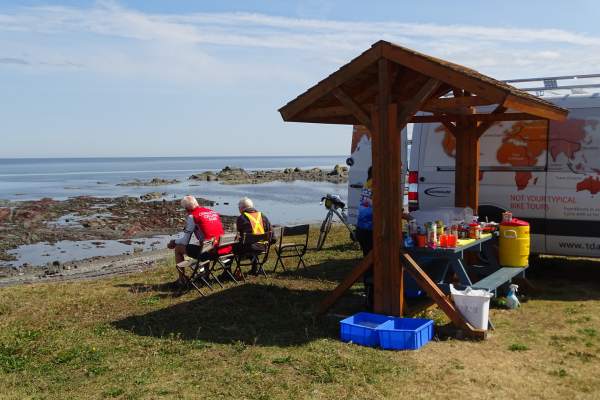
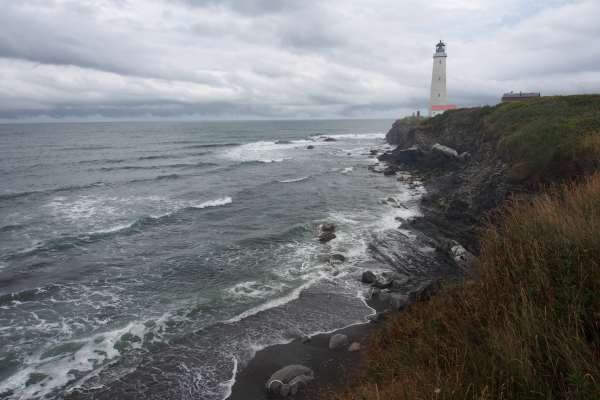
While the weather could be a challenge, in many ways it added to the total experience. Leaving Québec City and cycling around the Gaspé Peninsula in a mix of sun, cloud and rain gave us a taste for what this area of the coast could be like in really bad weather, or in the winter for that matter. Pedalling along the Gaspé Peninsula we rode along beautiful coastal roads through fishing villages dotted with precariously placed, brightly coloured houses consistent with the style of the area. I’m not entirely sure the reason for this, maybe to lighten the mood in the darker winter months? With some steep climbs and thrilling descents along the stunning coastal route the riders were all tested as we made our way to the town of Gaspé, passing by the Cap de Rosier’s lighthouse, the tallest in Canada. The town of Gaspé is where Jacques Cartier allegedly claimed the land for France in 1534. It would have been unfortunate to arrive back then and not have the luxury of sampling the local shrimp poutine that many of the Oh, Canada cyclists enjoyed!
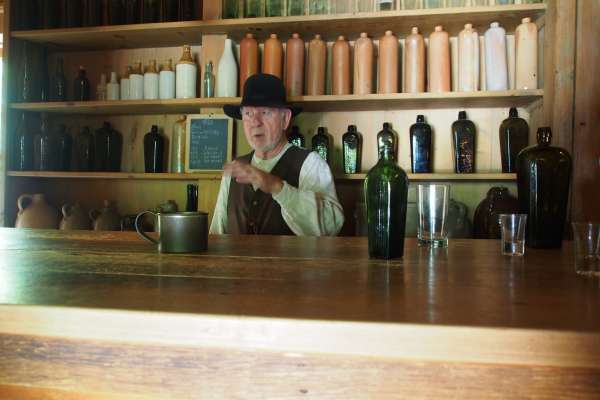
Ever since leaving Québec City we had been seeing the Acadian Flag. Canadian flags are common, as are their Québec cousins but there is no doubt that, in Acadia, the Acadian flag rules. It was visible everywhere you looked and projected a strong message of pride in the local culture. After we crossed into the province of New Brunswick and arrived in the Acadian capital of Caraquet, a quick visit to the historic Acadian Village on the rest day provided the riders with many insights into the plight of the Acadian People. The Acadians were the first French settlers in the area and when the British took control, 14,000 Acadians were deported for not swearing allegiance to the English Queen. They were exiled to Louisiana, other parts of Canada and even back to Europe. Many never returned and it is remarkable how well the present day Acadians have maintained their culture. For the French speakers amongst us, the Acadian accent was very noticeable and it was interesting to observe the variations given the small distances between their communities.
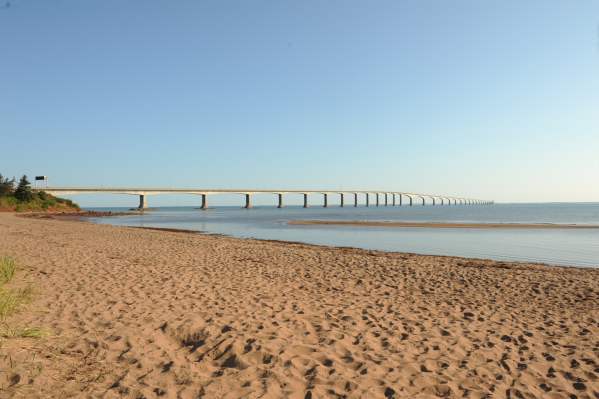
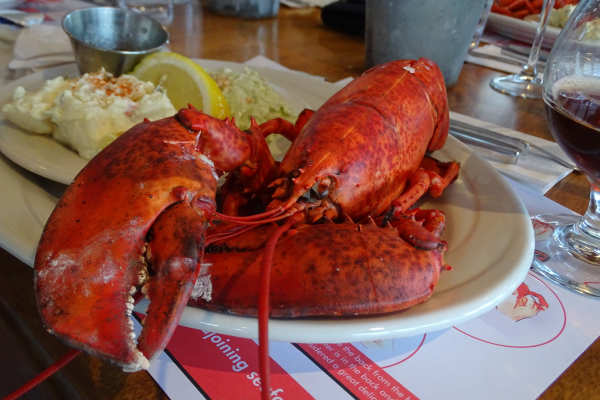
Shortly after leaving Caraquet we encountered the Confederation Bridge, the longest in the world to cross over ice-covered waters, leading us onto Prince Edward Island. Unfortunately, cyclists aren’t allowed on the bridge so instead we enjoyed the spectacular views from a shuttle bus. We then rode the scenic Confederation Trail, a former railway line, passing through the heart of the island before spinning into the provincial capital of Charlottetown. This city is the birthplace of Confederation. As our guide described it on the walking tour of the city, it was where politicians from throughout the British North American colonies met in 1864 to get to know each other and to discuss the details of a possible country. Evidently they did more of the getting to know each other and consumed a fortune’s worth of imported champagne! However, from this first meeting, a group of British colonies became the Dominion of Canada in 1867. To celebrate the country’s 150th anniversary in true Prince Edward Island style, we enjoyed a delicious heritage meal of lobster at the waterfront!
A ferry ride to the next province of Nova Scotia had us all realizing that the end of the tour was just around the corner. And it was. There were just a few days riding around Cape Breton Island on the famous Cabot Trail and then a ferry to Newfoundland left to go. The Cabot Trail was named after John Cabot, an Italian sailing under the British Flag, who was the first European to sail these areas in 1497. His reports of plentiful cod influenced the arrival of fishing fleets from around the world for years to come. Cycling around the rugged Cape Breton coastline involved some significant climbs and amazing descents! When we reached the town of Cheticamp the weather deteriorated so badly overnight that we were forced to cancel the next day’s riding. Experiencing winds of over 80km/hr and heavy rain on exposed winding hilly roads would have been a disaster. With everyone grateful for an unexpected day off, we made it to Ingonish where we enjoyed a rest day before boarding the final ferry to Newfoundland.
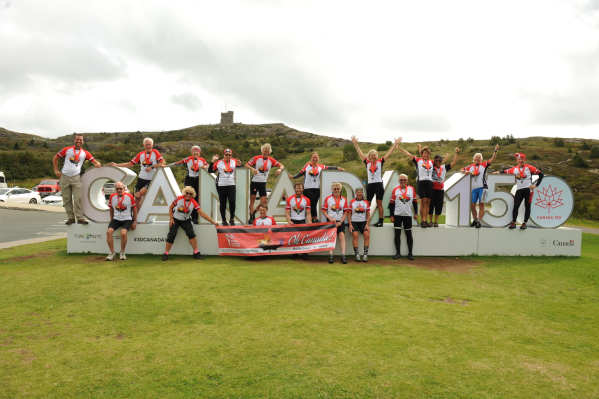
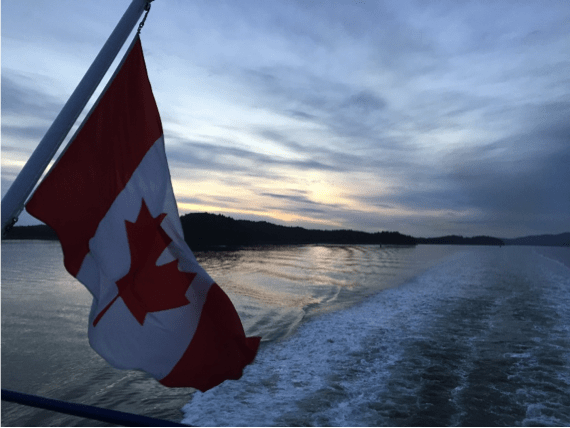
The 16-hour ferry crossing from North Sydney to Argentia was thankfully smooth and we had our last opportunity of the trip to watch Robert jump up on stage and perform with the ship’s musicians. We then had two ‘nice’ days pedalling into St John’s in, you guessed it, rain and wind. The conditions eased briefly in order for us to get a few group photos at Historic Signal Hill. It seemed fitting to end the tour on the extreme coast of a continent in the rain and wind, just as we begun in Haida Gwaii, British Columbia over 3 months earlier! The start of this incredible journey now seems like a lifetime ago but we all agreed that the variation in scenery – mountains, seas, prairies, lakes and coastlines – meant that we really did experience the great country that is Canada, celebrating its 150th birthday in the best way possible!
To visit Canada, the eastern provinces in particular, you really do need to know a little of the European history of this vast country to understand the people and culture that you will encounter. While the First Nations have lived in North America for up to 15,000 years, Europeans have occupied Canada for just over 400 years. Our experiences during the fourth section of the tour from Toronto to Quebec City showed how the French & British history in Canada has shaped the culture today.
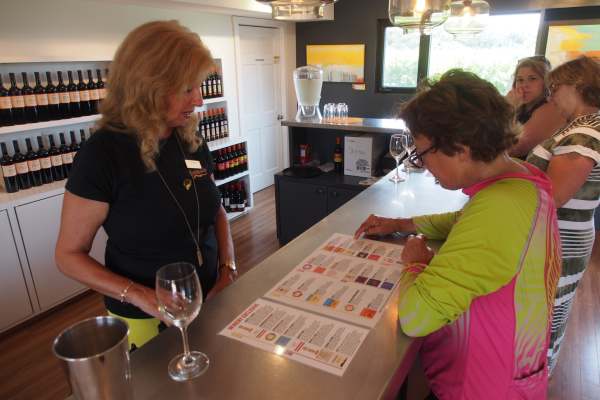
The section name – Upper and Lower Canada – refers to the distance along the St Lawrence River and as we moved eastwards towards Lower Canada from Toronto, the riding days passed through picturesque countryside along the St Lawrence River. This had us passing through Prince Edward County Wine Region that while very young is producing some good quality Pinot Noir & Chardonnay amongst many others varieties. I find it fascinating that vines are buried to survive the well below freezing temperatures of winter!
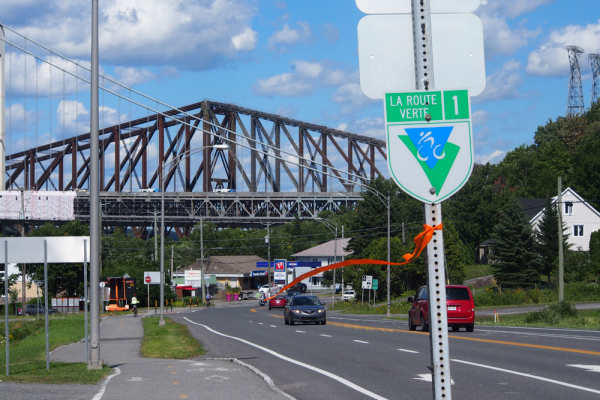
With scheduled rest days in the big cities of Ottawa, Montreal & Quebec City, this section was going to be busy both in terms of the cycling environment and also the endless opportunities for sightseeing! With the big cities came traffic and thankfully, as full tour rider Maureen stated in her blog, “Bike paths! Through most of Ontario and Quebec, our route was about 90% on bike paths. Such an extensive network is mind boggling! It would be wonderful if other provinces would take up the challenge and emulate their example. “Most of the paths are extremely well maintained, and – since entering Quebec, they include rest stops (called “halte”), toilet facilities, signage for distances to next rest stops and towns – including what facilities the rest stop has. As many of the trails are converted railway lines, they have even transformed the old railway stations into cafes and facilities for cyclists/pedestrians. It is so amazing and would make anyone want to bike/hike tour!”
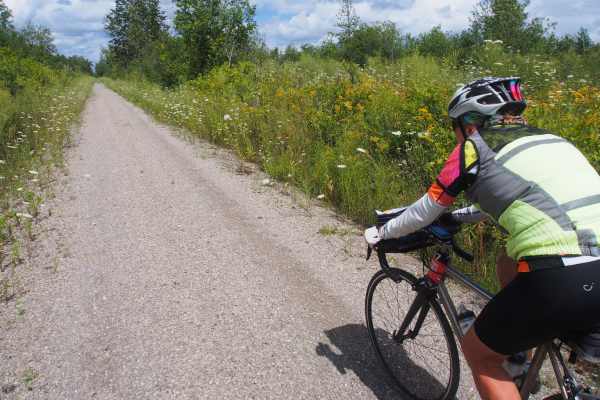
As I cycled along the trails I passed runners, cyclists, rollerbladers and saw signs for snowmobiles & cross country skiers! While we cycled on many trails, we spent the most time on the La Route Verte 1 or The Green Route, a 5000km+ network of Trails throughout the province. Its fair to say that Quebec is miles ahead of the other provinces in this regard!
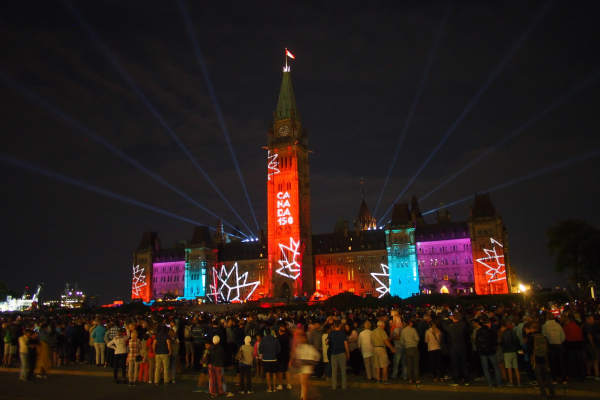
As we quickly reached Ottawa, Canada’s capital city, I immediately thought of Canberra in Australia. Decided upon as Australia’s Capital city as a compromise between Sydney and Melbourne, Ottawa was the compromise between Toronto & Montreal and is a pleasant city featuring a beautiful downtown with many sights to see that are easily reached via the extensive network of cycle trails. Many riders visited the impressive Northern Lights sound and light show at Parliament Hill Building and dined in the at one of the many restaurants in Byward Market.
Crossing into Quebec province evoked many feelings throughout the group, with Maureen stating: “Quebec! Quebec! La belle province, and where I grew up. Such a sense of coming home as soon as we crossed the border. The sound of the French language. The unique homes, food, habits and customs, and the French culture. And, of course, the ocean and the smell of the ocean air. It is truly unique in Canada, and I still miss it after 45 years away.”
To attempt to understand or explain the French & British history of North America today, from the perspective of a foreigner is unrealistic and crossing into Quebec it became immediately apparent that ‘Je me souviens’ or ‘I remember’, the official motto of Quebec that is displayed on vehicle registration plates, accurately reflects the culture and attitudes of many locals. The original meaning of this motto is described as “to remember the history of Québec and its renowned historic figures” and refers to not only the notable Quebecers of the past such as Jacques Cartier whose names are enshrined throughout the province, but also the memories of past conflict with the British and struggles for French Canadian autonomy in the centuries that followed.
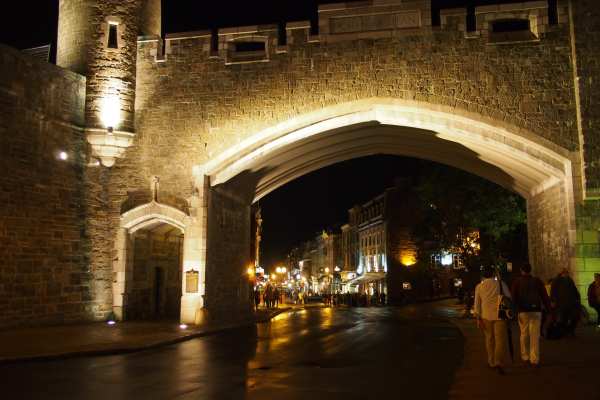
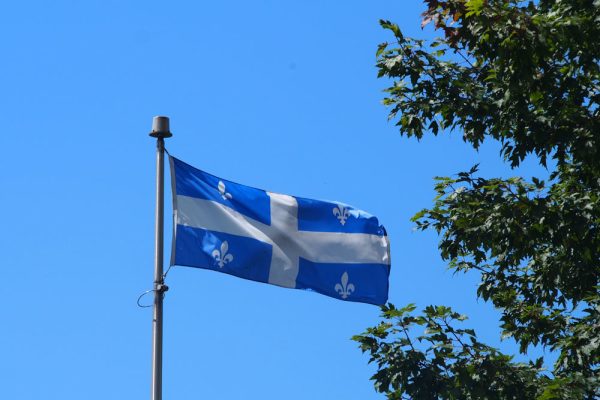
With French being the only official language in Quebec, the sound of the unique French Canadian language heard and seen everywhere in conversation, on street signs, newspaper was refreshing. As a traveller, English is definitely the most widely spoken language and it surprised most of us that so many of the people we encountered had little or no English. While this was usually in middle aged to older people I found this fascinating in a country such as Canada with majority English speaking population. English & French tourist signs were common in the rest of Canada but in Quebec seeing an English translation was much less common. Sometimes I wondered who these signs were intended for! Unsurprisingly, as tourists, we managed to get by and with the help of Tour Leader Max & some of the French speaking Canadians on the trip the language became more of a point of interest. During the trip so far we have seen many Canadian flags and Canada 150 flags. However these were replaced almost immediately with the flag of Quebec after we entered the province.
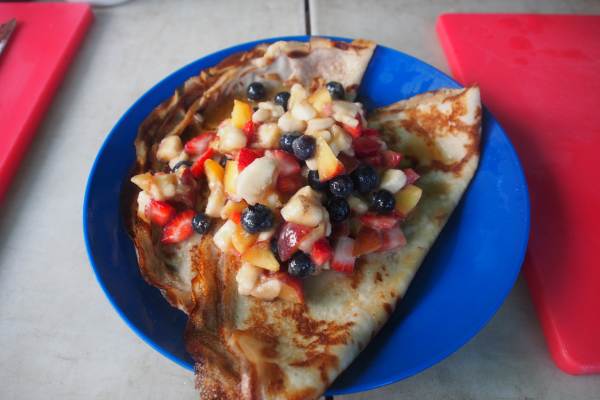
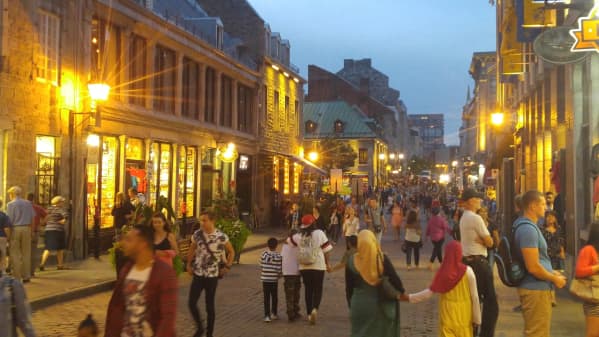
A highlight for the section was visiting Montreal & Quebec City. Shortly after arriving in Montreal we were enjoying our best heritage meal yet at Gus Restaurant. While Quebec is the world maple syrup capital, home to the love it or hate it poutine, we were instead treated to a wide range of delicious courses that aptly reflected their Gourmet French dishes with a Tex Mex Twist! Montreal lived up to expectation of a diverse, culture rich city, filled with high quality restaurants and cafes with the world famous Montreal bagels that had me seeing many similarities with Melbourne. Views the of the innumerable Nationals Historic Sites of were best seen from Mont Royal that offered amazing views for those that made the effort to walk or cycle to the top. Highlights of Quebec City were strolling through the cobblestoned streets of the Old City, visiting the Citadel, or visiting the Plains of Abraham to mention a few.
Having seen the stark contrast between Quebec & other parts of Canada, the French Culture of “La Belle province” was the highlight of the trip for almost all of us and as we leave Quebec City for the Gaspe Peninsula, many of us are already planning a return trip!
]]>
Why cycle Canada?
It was on the bucket list
Have you completed many cycle trips in the past?
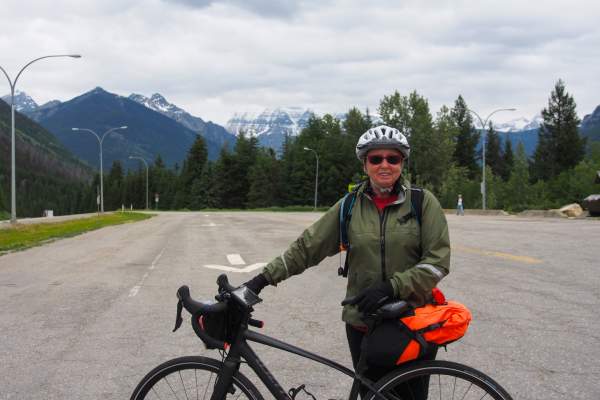
Yes, Spain and Scotland 2010, Silk Route 2012, Around Australia 2015 and Southeast Asia in 2016. I like long distance rides and try to do one each year. TDA runs some interesting trips, many of which I’d love to do.
What do you like about cycle touring compared to other modes of travel?
Cycling almost every day into new territory, Fresh air, like-minded company.
What, if anything, were you anxious about leading into the trip? Have these concerns been well-founded?
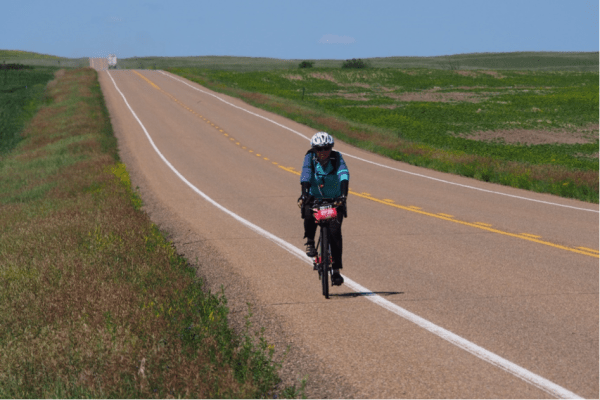
Concerned that I wouldn’t be able to keep up with everyone. I did put in a fair amount of training prior to the ride, just to get some kilometres into my legs. On my previous trip with TDA there were some very quick cyclists who got to camp very early. I was not one of them! I did not want to be in the situation again where I was one of the last into camp at night, so I did a bit of distance and strength training. I’ll never be a speedy cyclist, but consistent and strong is good enough.
Tell us a bit about your background, where you grew up and lived and what it’s like there.
I grew up in a small country town in Western Australia at a time when roast chicken was a treat served only on special occasions. I always wanted a bicycle, but my parents never had enough left over to buy me the fabulous pink girls bike displayed in the local hardware store window. I must have walked by that window every day for weeks on the way home from school. One day it was gone…. bought by someone else I suppose. I now have 5 bikes and 2 project bikes (part-bikes that sit in the garage waiting for me to fix them up)….so the memory has scarred me for life!
Can you give me a brief overview of what did/do in your work?
I spent a good deal of my working life in the remote Kimberley region of Western Australia and Arnhem land in the Northern Territory, working for, mainly, Indigenous organizations, although I did work for various Education Departments for some time too. I was involved in project work related to Indigenous language recording and promotion, community stores operations and adult education.
Did you have any life-changing experiences that put you on the path that led you here?
The Silk Route in 2012 was pretty life changing!
What have been/are the most difficult or challenging parts of the tour? What did you do to deal with these challenges?
Most challenging activity is cycling on difficult roads in heavy traffic. If it gets too bad, I deal with it by getting in the van.
Which aspect of this tour do you only realize when you’re on it?
How slowly I cycle uphill.
What has been the highlight/most rewarding part of the trip?
Meeting and interacting with the other participants and crew.
Do you have any recommendations for future riders/lessons learned?
Make sure to do a bit of training before you start and take a spare derailleur hanger!
What life lessons has cycling taught you?
Getting to the finish is within your control. Finishing something is 90% mental and 10% physical. If your head says you’ll finish, you will.
If you could give one piece of advice to someone going on their first tour with TDA what would it be?
Do some training.
Do you have plans for future trips?
All sorts – supported and self- supported.
How did you hear about TDA?
Internet search many years ago.
Is there anything you would like to add?
There seem to be lots of people who don’t like cycling. I don’t pretend to understand them. Many of them can ride a bicycle. Of those who can’t ride a bicycle, I’ve often heard them express a wish that they could learn, but feel they’re too old, too unfit, too fat, too lacking balance/coordination…any excuse not to try…as I said, doing anything is 90% mental attitude. Coming back from a long trip friends and relatives always say ‘you’re amazing’, I’m not. I’m just doing something I enjoy.
]]>As we crossed into Eastern Ontario, a couple of days out of Toronto, I was accompanying Christiane through the beautiful Prince Edward County wine region. While chatting to a staff member at Harwood Estate Vineyards about various non alcoholic options for a sweep rider, the topic of maple syrup came up. I was well aware that the delicious, world famous maple syrup came from the eastern portion of Canada and I wanted to learn about and, of course, taste some of the local produce. As it turned out maple syrup is also very important in Prince Edward County and one of the farms happened to be just around the corner from our campsite.
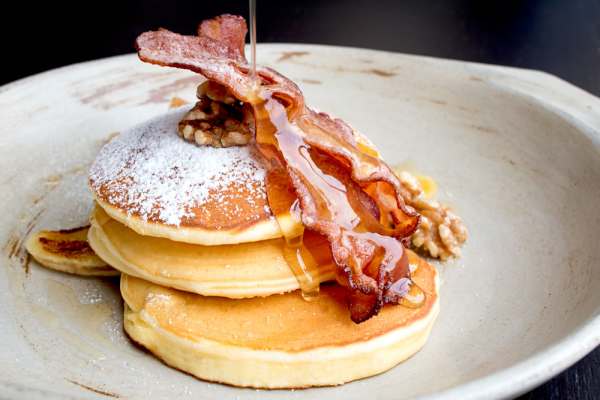
Maple syrup had been enjoyed by the First Nation’s of North America long before the arrival of Europeans. They would use the sweet unrefined water obtained from the maple trees to cook venison, beginning the tradition of maple cured meats. It was most likely picked up by the French settlers who carried the tradition forward to this day in what is now a multi million dollar industry.
After dinner, a few of the staff cycled down the road to Vader’s Maple Syrup. Although it was well after 7pm, we were greeted by Mary Vader, whose family history in the area dates back to 1910. Not long after arriving, we were introduced to some other members of her family involved in the company. Her son Gary was kind enough to give us a tour of their “sugar bush”, a common name for a maple syrup farm, and explained the process of collecting the syrup and a bit about the industry itself.
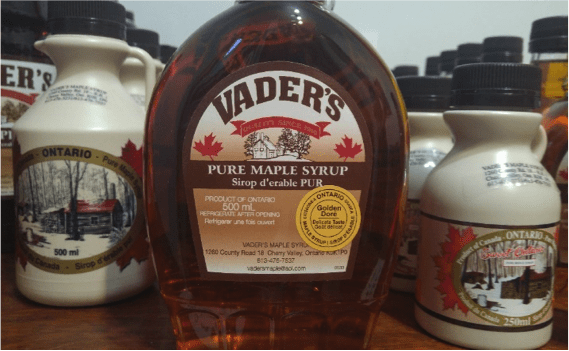
While there are numerous types of maple trees throughout Canada and the US, maple syrup is only derived from the sweet sap of the Sugar Maple (‘Acer Saccharum’). The distribution of these trees across what is known as the Maple Belt includes the midwestern US, Ontario, Quebec & the Maritime provinces of Canada. Approximately 80% of the world’s maple syrup comes from Canada and 90% of that originates in the province of Quebec.
Collecting the sap is accomplished by one of two methods. Traditionally, it was done by drilling a hole in the trunk of the tree and then letting the sap drain into a wooden bucket. Today, a newer vacuum tubing system transfers the sap directly from the trees to a storage facility. I have seen a numerous examples of the black and blue tubing running throughout the maple trees on the side of the road or alongside the bike paths. The tubing was hard to miss, especially when passing through Plessiville on our way to Quebec City. The town claims to be the Maple Capital of the world and has hosted an annual Maple Festival since 1958!
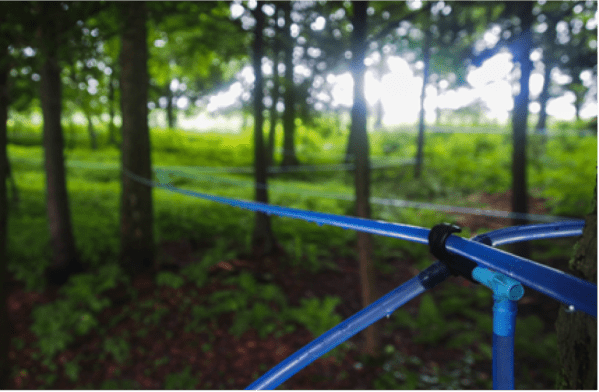
The flow of sap occurs naturally only when weather conditions are favourable. This usually occurs in early spring when temperatures rise above freezing in the daytime then return to below freezing overnight, creating a positive pressure gradient. There can obviously be large variations in the length of the season. This was documented by a table on the wall showing the length of each year’s season – anywhere from a couple of weeks to nearly two months.
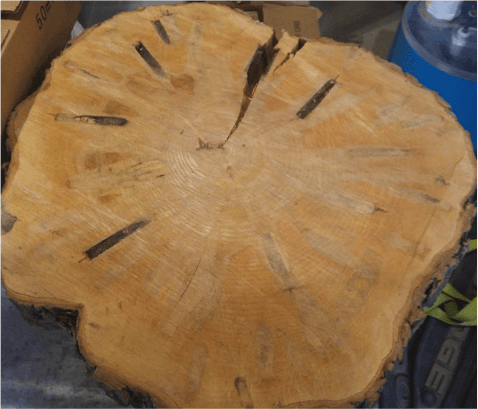
We were also shown a cross section of a maple tree that illustrated how a tree recovers over time from the sap drilling, the process of collecting the syrup is thus not detrimental to the life of the tree. Studies have also shown that the removing approximately 7% of a tree’s sap each year does no long term damage to the tree.
The sap that is collected from the trees is briefly stored. It then undergoes a series of processes including reverse osmosis and evaporation. This concentrates the syrup from the 2-5% sugar content when it leaves the tree to the 66-67% that is the legal requirement for it to be sold as maple syrup. You may laugh that there are strict regulations concerning the purity of maple syrup but when you consider that it takes approximately 40L of maple sap to produce 1L of maple syrup, it is not surprising that it needs to be regulated!
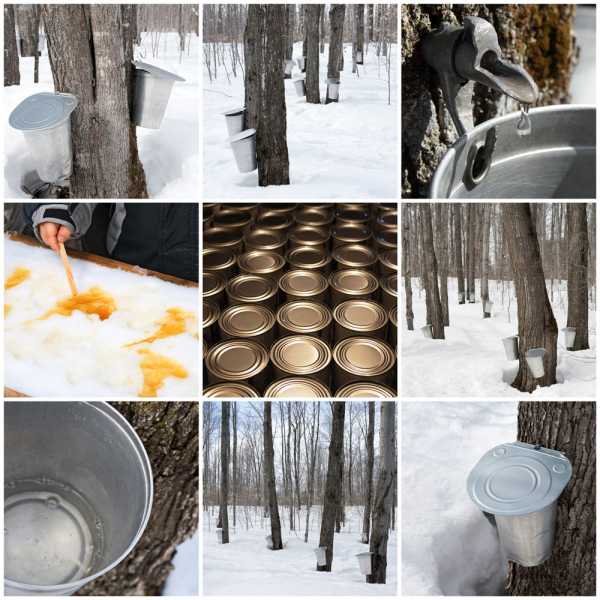
As with many other plant-based products such as wine, the final product varies greatly between regions and producers. Distinct differences in taste can be noticeable over very short geographical distances and it was a pity I didn’t have time to sample a few other syrups from the region. Fortunately, the area has Maple in the County festival in March and that might provide an opportune time to return!
The maple leaf itself has been considered Canada’s national symbol for almost two centuries and the current 11-point leaf was granted official national-symbol status and went on the flag in 1965. It is also visible on Air Canada planes, national hockey team jerseys, in the military and also on the Oh, Canada rider’s cycling kit!
You simply cannot visit Canada and not try some real, local maple syrup. Not only does maple syrup taste delicious it is a rare natural sweetener that contains essential minerals like potassium, magnesium, phosphorus, manganese, iron zinc and calcium, all in quantities much higher than honey!
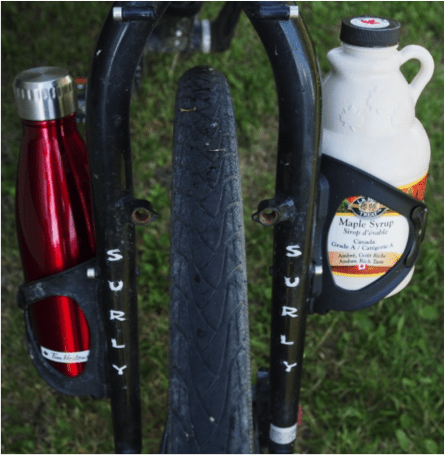
We have been enjoying maple syrup since day 1 on the Oh, Canada Tour and will continue to do so as we cycle through Quebec. Staff members Vilma & Peter have already bought a wide selection of maple syrup, from original to amber and dark, that they intend to take back to Slovakia to give as gifts to friends!!
Further Reading:
]]>Leading on from Henry’s blog First Meetings on Oh Canada featuring some of the male riders of this year’s Oh, Canada Tour, this is the first of a series of rider profiles featuring some of the female cyclists. The following profiles will introduce the diverse & inspiring group of women that have chosen to cycle across Canada!
Desyree Lotter, 36 & hailing from South Africa, is one of five female full tour riders who are completing the journey from Haida Gwaii to St. John’s!
TDA: Have you completed many cycle trips in the past?
Desyree: I haven’t completed any cycle trips before this one…come to think of it, it’s the first time I have been on a bike since I was 10 years old, probably.
TDA: Tell us a bit about your background, and where you live and work.
Desyree: I was born and raised in South Africa. I grew up in the 80s and 90s so that was a super interesting time in South Africa. Half my life was spent in the apartheid era and the other half in our democracy. I come from a family of activist women who did their bit to help people before we achieved our democracy. So no surprise that I ended up working with non-profits. Currently, I live in Johannesburg – not quite a farm, but some call it a zoo :).
I work for myself. I run/own a development consultancy called Metta. Its been going for about 3 years now. Its based in Johannesburg, but we do work throughout Africa. The hope is to expand into other countries/continents one day. We work with donor agencies, international development organizations, universities and non-profits. We provide project management services mostly. I also have my own non-profit project going at the moment as a… I guess hobby…it started at the beginning of 2017. It’s called Revolution Respect.
TDA: What do you like about cycle touring compared to other modes of travel?
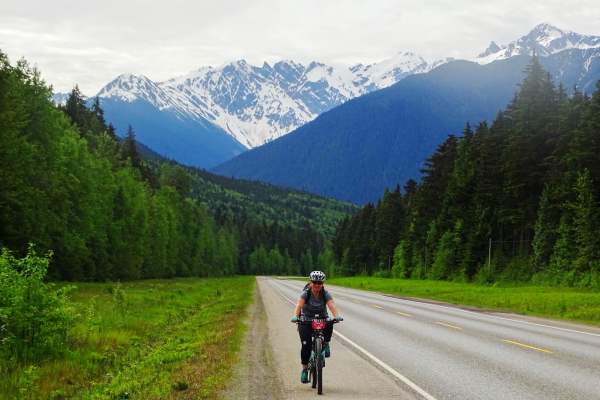
Desyree: You see a country in a completely different way. You meet people in places you wouldn’t necessarily be able to, if you were driving for instance. More often than not, in a car, you would stop for food in a town, or you would go to a touristy place and then be on your way. You remain focused on the people you are travelling with. On a bike, you spend a lot of the day by yourself. This opens you up because there isn’t a friend to hide behind. People approach you. The bike is a good conversation starter. You connect with random people and hear about their lives, and their town. You learn that the kindness of strangers is a real thing. You see interesting little places you are more willing to go I to and explore. On this trip there have been a lot of people that have offered a coffee or water or a washroom to us as we cycle through.
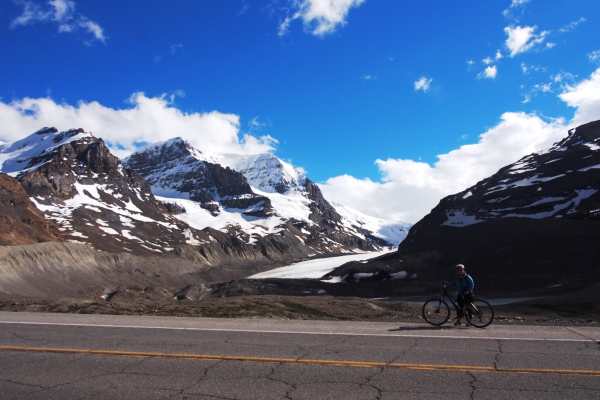
I like that you are part of the fabric of the places you cycle through. When you are in nature, you are really in nature. On this trip through Canada, the bears and gophers and deer and birds and trees and grass and ponds and lakes are right there. The glaciers are RIGHT there. The snow capped mountains surround you. The canola fields through the prairies are at your finger tips. You feel the air. You can hear and smell and touch everything. You aren’t flying past it in a car or a bus. When the sun is out you feel it.
When it’s raining you are in it (don’t love that part too much). When the wind blows you know it. You get the idea.
TDA: What if anything were you anxious about leading into the trip? Have these concerns been well founded?
Desyree: Ha ha…I laugh now. Ignorance is bliss… I think my only concern was not having put in the time on an actual bike. I wasn’t sure if I would be able to stay on a bike for 6 to 8, sometimes 10 hours a day over a three-month period, but figured, ‘you are in it now’. I didn’t take into account drastic weather changes. My fears felt like they had come true over the course of the first 2 weeks. It was much more difficult than I imagined. I wasn’t prepared for the cold, windy and wet weather. I almost quit a couple of times…I somehow didn’t think the camping thing through either. I like camping…I just haven’t done it for 3 months straight…
In addition, while I love my bike and it’s comfortable now, it also needed some tweaking…like changing out my tyres. TDA was awesome in this regard though. The crew help you out. They advise you and support you without judgment on how much experience you have. My fears dissipated pretty quickly. I don’t think you can be 100% prepared for this.
TDA: What have been/are the most difficult or challenging parts of the tour? What did you do to deal with these challenges?
Desyree: The most difficult part of the tour for me was feeling inadequate. I knew I was determined so I would get up a hill or 6. I could will myself to keep pedalling for hours. I was excited about what I was going to see along the way, so the trip itself wasn’t scary.
The comparison to others got into my head and I struggled in the beginning. When I arrived and saw all these cyclists with all this great equipment; and I listened to their stories of other cross country trips they have done…gosh…I thought I don’t belong here.
8 weeks into the trip, and now having gotten to know a few people, I have learned that the others also thought that. Ha ha. A few of the cyclists have told me how they looked at the calibre of everyone and thought, wow I don’t know if I belong here, will I keep up? It seems fairly common that at times, we make ourselves the least. We assume someone is better than we are. My way of overcoming this was being vocal about what I thought was my weaknesses. I was upfront about my cycling ability. It seemed to help those who felt the same to open up and feel less afraid, and it allowed those who are stronger to take on a support role.
TDA: Which aspect of this tour do you only realise when you’re on it?
Desyree: The information sent to riders clearly states the outline of the tour. The idea of camping for 3 straight months just didn’t register with me (yes I packed a tent and sleeping bag) but for some reason, it only sank in the first night – when I was cold and exhausted. I thought to myself OH GOD…I am living in this blue bubble (my tent is blue and round) for 3 months WTF, sleeping on the floor, in a sack, wet, dry, warm or cold…FOR 3 MONTHS!!! Talk about reality check. Interestingly, my tent has become something I love to be in. It’s a very cool private space.
TDA: What has been the highlights/most rewarding parts of the trip?
Desyree: On my gosh. Too many things to mention. Thus far, this is in my top 5 most beautiful countries. It’s just stunning. I can’t decide what was more beautiful, the snow capped mountains, the glaciers, the canola fields or the vast amount of lakes. Swimming in Lake Superior was a highlight…I also love how nice Canadians are. People are very helpful and considerate I guess the most rewarding part of the trip is just doing the trip. Some of the cycle days are hard and when you get through the day, you feel good. I think I need to complete the trip to fully answer this!
TDA: What life lessons has cycling taught you?
Desyree: Cycling is indicative of life. Some days you feel awesome, you are cycling at a good pace, the road is good; and for some reason the next day can be completely different. Nothing has changed really but the day just isn’t working out for you. Maybe you aren’t in a good frame of mind, or the day feels long and difficult, pedalling feels like work. Things change randomly, much like life. Each day is its own. You need to take each day as it comes. On this trip I am really learning so much more about myself. There have been so many moments on this trip when I thought, ‘I can’t do this!’…whether it was just keeping up with other cyclists, getting through a day, heading into busy city traffic, taking on the hills…but every time you know there is no other way around it.
I haven’t got much experience in cycle touring, I feel like this is a cool combination of travelling, challenging yourself and doing something unique.
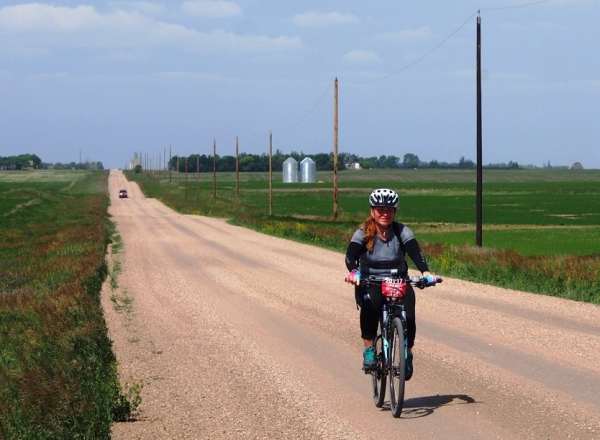
TDA: If you could give one piece of advice to someone going on their first tour with TDA what would it be?
Desyree: My advice is, don’t over think it. If its your first trip, you wont have anything to compare this to. You will be presented with things you can’t plan for. Just go with it, you will be fine. You will figure it out. Make sure you have a bike you are comfortable on. Try and get in as much saddle time as you can before the trip (highly recommend this). Double your spending budget :). The rest will sort itself out…just don’t over think it.
TDA: Do you have plans for future trips?
Desyree: For sure. Now that I know I can do it, why not do more. It will probably be another spontaneous trip. So I can’t say when or where at the moment. Europe and West Africa stands out for me at the moment. I guess its all about when the money/time stars align.
]]>If you mention to someone that you will be riding across Canada, their will be a brief few moments of confusion, bewilderment and wonder that then leads into a comment somewhere along the lines of “Oh, you will enjoy crossing the Prairies” in a sarcastic tone. They go on and on, are flat with and with nothing to see! The winds will do your head in and drive you crazy! The ‘Prairies’ are the flat, central western regions of Canada that comprise Saskatchewan, Manitoba and a small portion of Alberta. Known for their uninterrupted fields of wheat and changeable weather that can feature high temperatures and strong winds, this section would prove to be challenging on the bike.
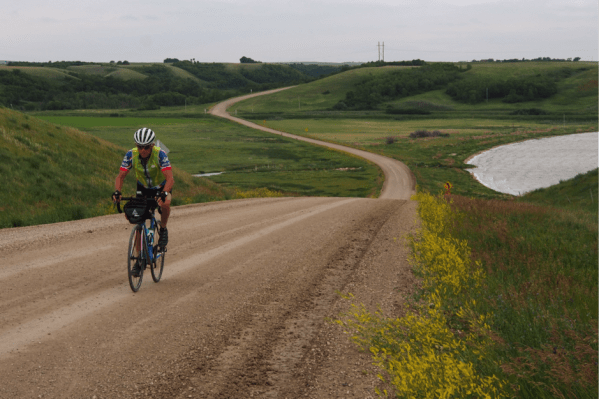
Prior to crossing the prairies these sentiments played on my mind and my thoughts drifted to a familiar place back home, Outback Australia. On first impression, Australia’s interior gives a feeling of a vast nothingness stretching from north to south and east to west with not much in the middle but desert. Having lived in Alice Springs I have learnt that these assumptions are commonly misguided and I was curious to discover what the Prairies had to offer. Here are a few observations I made during our two weeks of riding between Calgary and Regina.
The prairies aren’t flat.
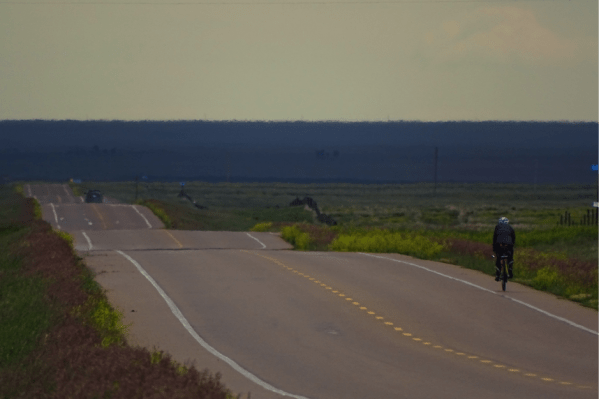
The GPS elevation profiles from our tour manual gave the impression of long flat riding days. It didn’t take us long to realize that the climbs in the prairies don’t have the gentle gradients experienced in British Columbia and generally have more of a bite to them. The roads themselves are much rougher and sometimes it is necessary to climb a few vertical metres out of a depression or “pothole” in the road, an exercise that saps energy over the course of a long day. Saskatchewan points these particularly bad sections out with a sign that reads “Loose stones” that we have learnt may mean the road condition deteriorates immediately or anytime in the next 200km! Australian rider Jane Lodge reflects on her time in Saskatchewan: “Saskatchewan is a prairie province with fields of wheat and canola running alongside terrible, patched, lumpy roads. Saskatchewan has hills. Long, rolling hills that have false summits. Saskatchewan hills go up but never come down. Saskatchewan should be the highest province in Canada, or the world for that matter. It should be higher than Everest. It’s not. There’s something odd going on in Saskatchewan.”
It’s not all about wheat.

Not long after leaving Calgary the crops spanned as far as the horizon on both sides of the road, and it comes as no surprise that approximately 80% of Canada’s farmland is located in the prairie provinces. Yes, wheat occupies a significant portion of the crops and generates 11 billion dollars of annual revenue to the Canadian economy each year, but it isn’t the only crop! The most eye catching were the fields of Canola, a sea of yellow stretching as far as the eye can see creating a beautiful contrast to the mostly blue skies we encountered! Lyn a friendly local from the small town of Dinsmore, stated that lentils and other crops were becoming more prominent in recent years and I later discovered that over 90% of Canada’s lentil crops come from Saskatchewan and 70% of all Canada’s mustard! I am yet to confirm if the mustard we are spreading on our daily sandwiches does in fact come from Saskatchewan.
Prairie folks are extremely friendly!
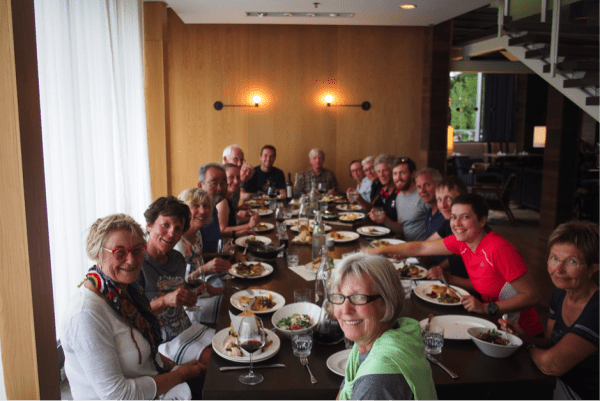
This became apparent shortly after crossing into Saskatchewan. Almost all of the local drivers waved to us as they passed when heading in the opposite direction or while overtaking us safely and giving us the entire lane! If only cyclists received the same reception everywhere! The friendliness went beyond the road. Local farmers frequently stopped to chat at lunch, curious to learn about our journey and wish us well. Erin, a local from the small town of Eston was kind enough to bring us some fresh organic vegetables to restock our supplies and in true Canadian spirit we were gifted with enough organic home made french fries to feed the whole group from a generous couple on Canada Day!
Drumheller may be the ‘Dinosaur Capital of the World’
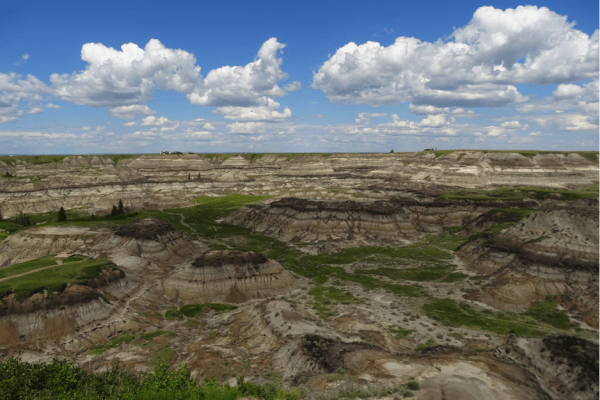
Dinosaur’s once roamed the Prairies in large numbers. On descending into the Red Deer to the town of Drumheller it was immediately obvious that dinosaurs give this place meaning. Everywhere you look there was a dinosaur or something dinosaur themed with ‘the largest dinosaur in the world’, a large T-Rex in the centre of town getting most attention. Founded on coal mining, the region now thrives on tourism generated from the rich supply of dinosaur fossils discovered throughout the region that some riders had the chance to learn about at the The Royal Tyrell Museum, Canada’s leading palaeontology museum. The nearby dinosaur provincial park, a UNESCO World Heritage Site, has the highest concentration of dinosaur remains in the world.
The Prairies have rich First Nations Heritage
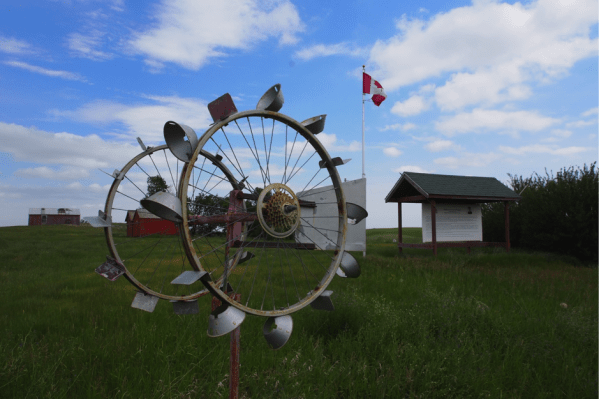
The Wheat Kings section of the Oh, Canada Tour passed through the traditional territories of many First Nations bands. These include the Cree, Assiniboine, Blackfoot, Ktunaxa and the Metis peoples. Following European colonisation various treaties were made between the Europeans and the First Nations. Fort Qu’Appelle, Saskatchewan, a historic town that we passed through en route to Round Lake, was where Treaty 4 between the Cree & Salteaux First Nations bands and the British occurred in 1874. Treaty 4 is significant because it is the only indigenous treaty in Canada that had a corresponding indigenous interpretation. A pictograph made by one of the Cree Chiefs, Chief Paskwa, was on display at the The Regina Museum along with many other displays in the First Nations Gallery that described the lifestyles of the first Nations before and after the arrival of Europeans
Saskatchewan has more roads than any other province
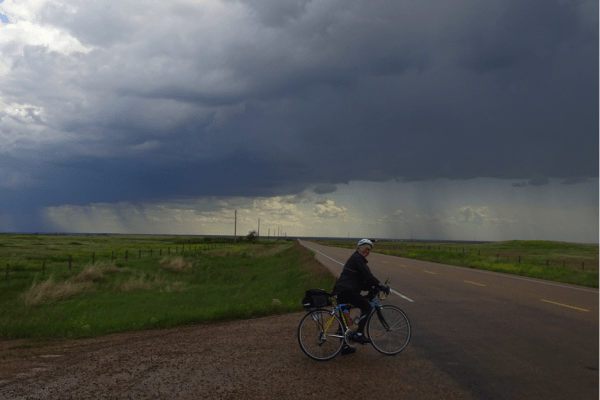
Saskatchewan has more roads than any other province in Canada, about 160,000km of road surface according to the Government of Saskatchewan. We discovered that more roads do not mean better roads and it came as a surprise that only two of the roads on our Saskatchewan provincial map were marked as ‘gravel.’ Staying true to our TDA roots we felt obliged to include one of these roads in our route and the 28km gravel stretch from Dinsmore to Macrorie turned out to be a favourite for most of the riders. A quiet, narrow, flowing road of hard pack gravel was a welcome break from the uneven, potholed Saskatchewan pavement and unreliable shoulder on the bigger roads.
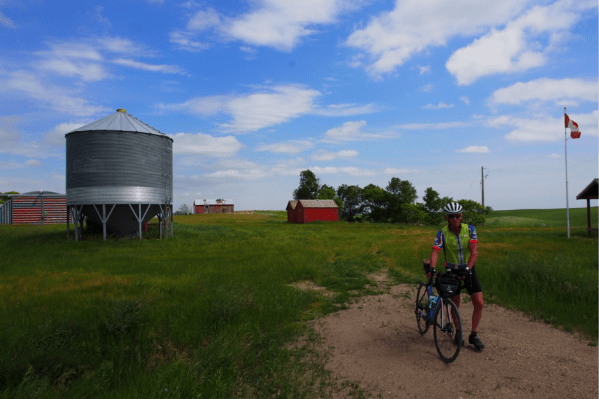
Crossing the unique Canadian prairies by bicycle is something I will not forget anytime soon and as we begin the Great Lakes section I’ll finish with the following quote from Australian Rider Stirling Lee.
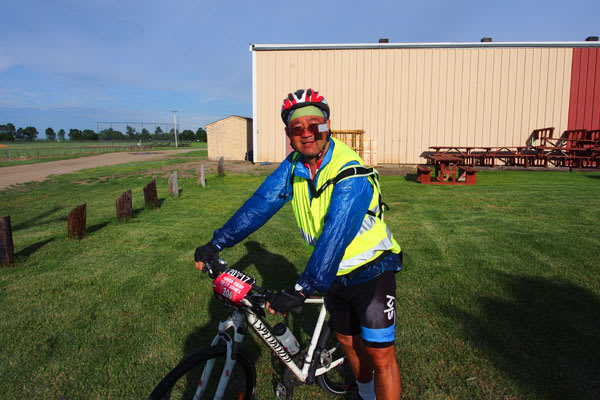
“I didn’t know why they called this section Wheat Kings. It’s not like the prairies in the USA with their GM corn and wheat browning in identical multi acre squares. Veer off the road and you would get lost and die of thirst in these identical lots, only to be discovered in the harvest when your decomposing body would add to the protein content of our daily bread. No, the Canadian prairie is green and lush, speckled with lakes and undulating hills. Go back in time as you cycle in the gravel. See the thousands of bison that once grazed the grass and hills. The First Nation Aboriginals who followed the great bison hunt and held pow-wows in places like Waywayseecappo and Neepawa. Followed by the French trappers at Fort Qu’Appelle and Portage La Prairie. Then the wagon trains of European migrants who settled in places like Lemberg, Stokholm & Esterhazy. And finally the English, with the RCMP and railway tracks and the Kings I suppose.”
Further Reading
The Royal Tyrell Museum – Drumheller
It’s #Canada15,000 not #Canada150- Celebrating First Nations Heritage in Canada
]]>One of the great things for me when I join a new tour is meeting people I have never met, especially those whose names I have seen listed for some of our other rides. What is particularly enjoyable is when you have a chance to sit with these people and hear about their lives, the things they do and have done. This creates a bond that will last a lot longer than the few days we spent together on the Oh, Canada tour.
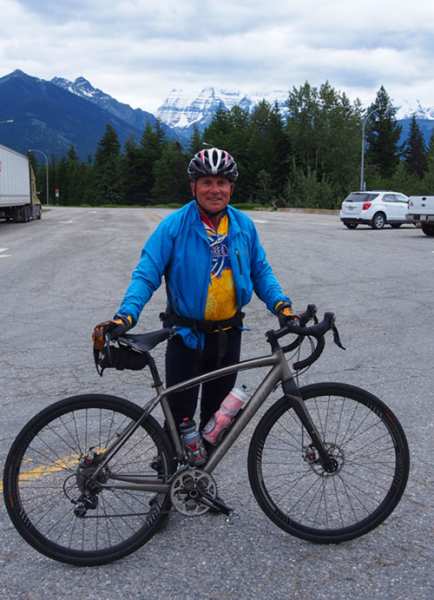
Mike Gemus is a first timer with TDA tours and joined the group from Haida Gwaii to Winnipeg. He is a former auto worker who was given a retirement deal ‘he could not refuse’. When I asked what he has been doing Mike surprised me with stories about crewing sailboats around the world – something I always thought I would like to try. Not only does Mike sail the world, he has even written a book called ‘Ocean Passages’ and yes, you can buy it on Amazon.
When I asked him why he is cycling only to Winnipeg, Mike said he had a previous commitment. He is piloting a blind friend on an eight day bike tour. I asked Mike if he thought I was too old to start crewing a sail boat. He responded by giving me all kinds of information of how to do it. So if you do not hear from me in the future, do not worry. I am somewhere in the middle of the ocean.
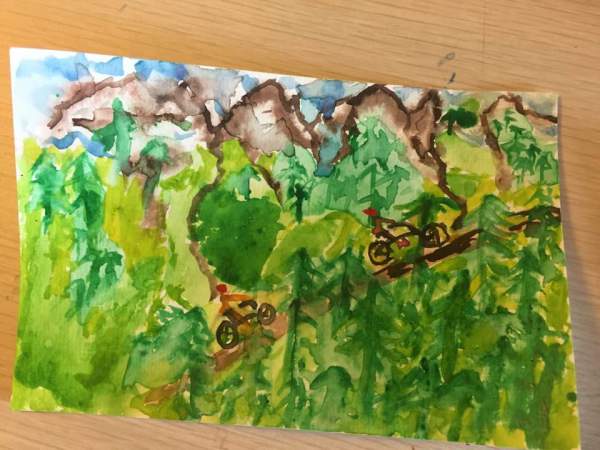
Robert Rowley’s unique voice I recognized instantaneously from a couple of very brief phone conversations. Robert has already participated on several TDA tours but I had yet to have the pleasure of meeting him. Robert made some successful financial investments and now likes to cycle, paint everything he sees, play his harmonica, act in films and do improvisations. He had to do some heavy improvisation one day. When looking at the sky in the morning he left all his rain gear in the vehicles but by the time he made it to lunch he realized that Northern BC is not Texas. He was damn cold and wet. We had some fun conversations and I hope to see him again soon on one of our tours.
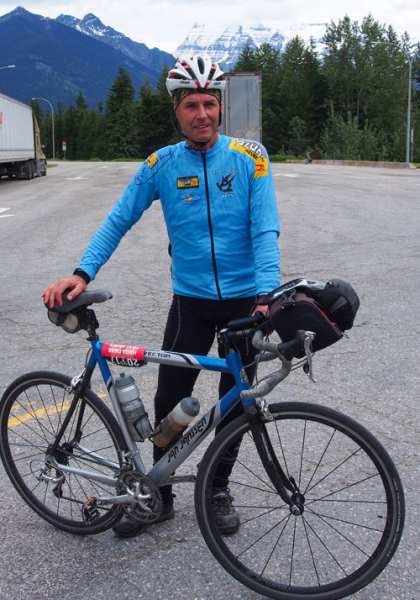
Paul ten Brummelhuis is another TDA alumni. He did the African tour over three years and on the Silk Route we really had no opportunity to meet as he left in Almaty, Kazakhstan just as I arrived. Paul joined the Oh Canada tour so he could cycle with his wonderful daughter (one of four kids he raised) who is a professor in Vancouver. Paul is a retired lawyer who, at the age of 71, cycles like a 40 year old. On a rest day in Prince George he and Robert went to play golf and when I asked Robert after how it went, he said Paul shot one under par. He turned out to be one of those smiling and gracious individuals but if I could play golf and cycle the same way as he does, maybe I would be smiling and gracious all day, every day, as well.
I will leave it to Will, our communications officer, to write about all the other riders and staff on the Oh Canada tour but I will tell you one thing now. I had a wonderful time cycling beautiful British Columbian and I enjoyed it immensely.
]]>Over the course of the past few weeks, the Oh, Canada riders have shared their pre trip thoughts and expectations for the first section Haida Gwaii & the Rockies. Regardless of whether it was the first time to Canada or not, it seemed the general consensus, myself included, indicated that the first couple of weeks heading towards the Rocky Mountains would feature plush paved roads, glistening in the late spring sunshine, a few gentle undulations and definitely no significant mountains to climb. Perfect conditions to rack up some kilometres in the saddle for the mountains to come!
How wrong we all were. As it turned out the first section was not quite the idyllic warm up many of us had imagined. Departing Haida Gwaii the cycling days immediately increased to 140km and the strong headwinds continued making for challenging riding. The seven day stretch from Prince Rupert to Prince George would turn out to be much more difficult than expected with long periods of rain that had one cheerful Haida local asking “how are you all enjoying this liquid sunshine?” As the days passed it became more of a question of when the rain would fall and how much as opposed to if it would fall. Riders became accustomed to starting out the day in full rain gear to avoid the possibility of a brief ‘shower’ that would completely saturate every piece of clothing.
But challenges aside, the first week had many highlights. Following the mighty Skeena River out of Prince Rupert, we were fortunate enough to learn about the Gitxsan people who have lived alongside the river for thousands of years and who depend on the health of the river to sustain their lifestyle. Europeans arrived in considerable number in search for Gold in the 1860’s and used the river as a route into the interior to the town of Hazelton, where we would spend our second night out from Prince Rupert at the nearby Ksan Campground. Camping in the Ksan campground allowed riders to explore the historic township and enjoy the stunning mountain views in all directions.
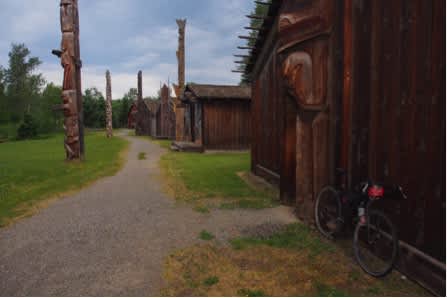
After a well deserved rest in Prince George it was time to push on to the mountains. The increasing frequency of wildlife warning signs was a bit of a shock to some riders initially, “Caution Wildlife Corridor” & “Moose next 15km” were viewed multiple time throughout the day and while a few deer and black bears were spotted, the elusive Moose evaded us all, for now.
The day before Jasper we arrived in Mount Robson Town, with Mount Robson itself towering precipitously above us. The highest mountain in the Canadian Rockies at 3954m, with its snow capped peak hidden high up in the clouds, brought a realization that we were heading into the mountains, and the climbing would soon begin. A group of riders and staff went for a hike after dinner to the beautiful glacial carved Kinney Lake directly below Mount Robson Peak. The blue green colour of the water adding to the beauty of the lake, however unsurprisingly the rain began shortly after our arrival and we retreated downhill back to the campsite. We bid farewell to British Columbia, the first of ten provinces of the trip, as we made our way into Jasper, Alberta for the second rest day.
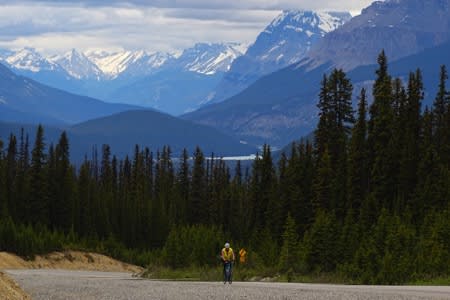
Jasper Town, the little Brother of Banff is a quaint town nestled between impressive mountains and rivers. Jasper town was initially a fur trading post in the region for the North West Company in the early 1800’s but much has changed since then with the surrounding area being granted National Park status in 1930. The Jasper National Park is now the largest national park in the Canadian Rockies and as is the case with all national parks in Canada’s 150th Anniversary, park entry is free! Entering Jasper, it was immediately clear that it is a tourism hotspot with travellers from all over the world flocking to the area to hit the slopes in winter or hike the trails and see the impressive wildlife in summer. Jasper was an ideal place for a rest day and gifted with beautiful weather there were numerous opportunities for hiking, cycling and sightseeing.
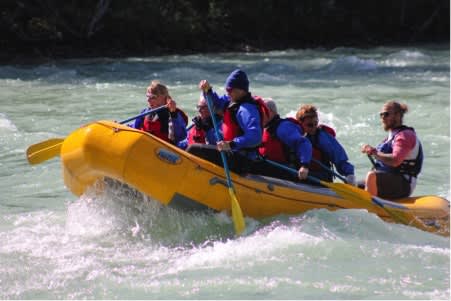
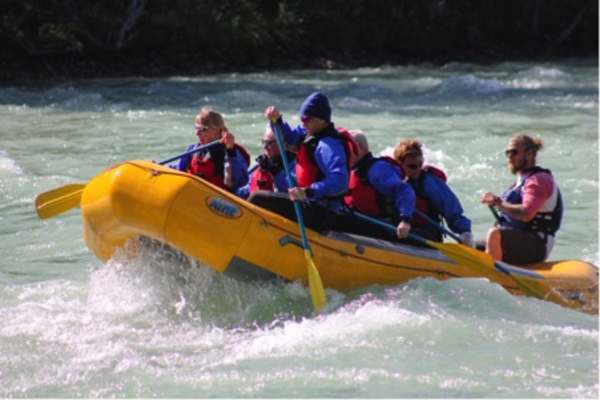
As one of our tours included rest day activities, riders had the opportunity to spend the morning White Water Rafting the Athabasca River, the major river running through the valley. Glacier fed its icy 3-4 degree Celsius temperatures and aqua colour, produced a stunning contrast to the pine trees and massive snow covered mountains visible in all directions. Rafting grade 1-2 rapids, we were not scared for our lives and could take in the views while learning about the river, the mountains and the trees from our knowledgeable Guide. As we drifted down the river it was interesting to learn about and observe the effects of the Mountain Pine Beetle that has been killing off large tracts of forests here and throughout British Columbia and parts of the US. It was obvious to see the change in the landscape on the mountainside and to wonder how this unique area may look in the future.
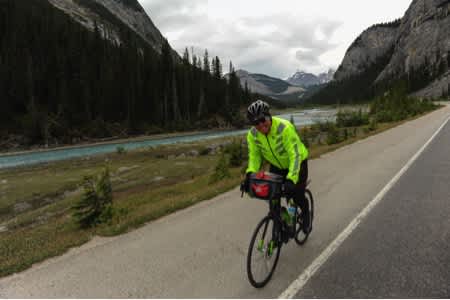
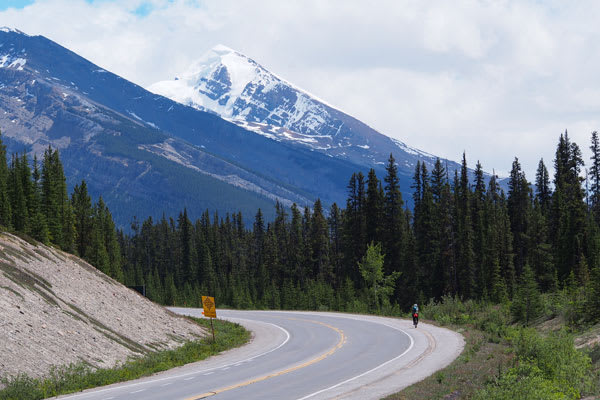
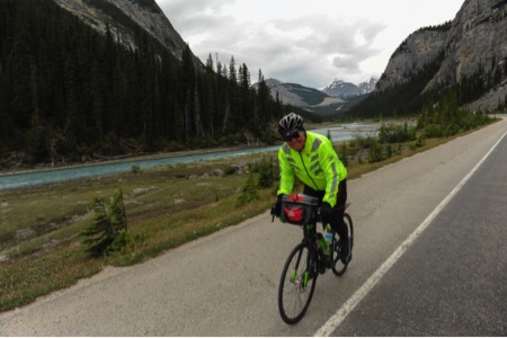
The Icefields Parkway is one of the worlds most spectacular roads and featured endless mountains, glaciers, rivers, lakes & wildlife. The 230km route is a cyclist’s paradise and with great road conditions and many rest stops it was always going be a highlight of the trip. Leaving Jasper, the weather conditions at Wilcox Campground, our campsite for the night at the Columbia Icefield was a balmy -4 degrees Celsius. Undeterred we headed off for the light rain and patchy cloud that provided atmospheric views of the surrounding peaks with Mount Edith Cavell prominent. The weather improved at our camp for the night and riders enjoyed mountain vistas in all directions, wildlife sightings and a visit to the Athabasca Glacier.
Unfortunately, our time in the Rocky Mountains was brief, and as we enjoyed a succession of thrilling descents and breathtaking views towards our second Icefields Parkway there was a slight feeling of sadness with the knowledge that we would have to say goodbye to the mountains. Mosquito Creek, our hostel for the night, was a cosy, semi- remote wilderness lodge and what it lacked in electricity, showers and WIFI it made up for in beauty and an unexpected wood heated sauna. While the riders made their way into camp and relaxed in the common area around the fire, visited the sauna or took a nap, the staff began dinner preparations. Given the success of our traditional salmon meal in Haida Gwaii, to reward riders for their hard work climbing the mountains and as a sweetener on the lack of showers for the past two days, Salmon was on the menu!
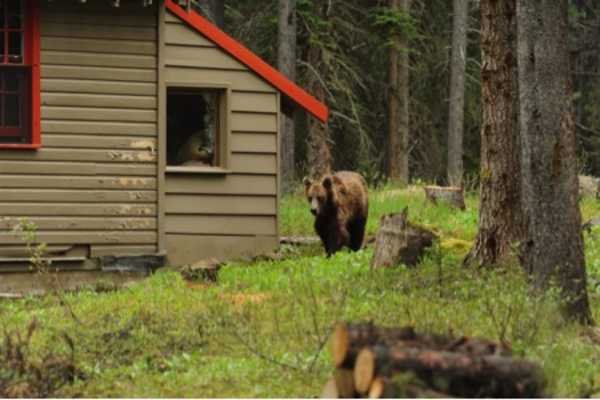
As dinnertime approached I was reviewing the tour manual in the dinner truck in preparation for the rider meeting. Vilma the chef was about to cook the salmon in the outdoor TDA kitchen nearby. As I stepped from the truck I gazed into the woods ahead and directly in my line of sight 30m away was a GRIZZLY BEAR slowly making its way around the side of the manager’s cabin towards us!! A young male he was not particularly large by Grizzly bear standards, but for good reason he was extremely intimidating nonetheless.
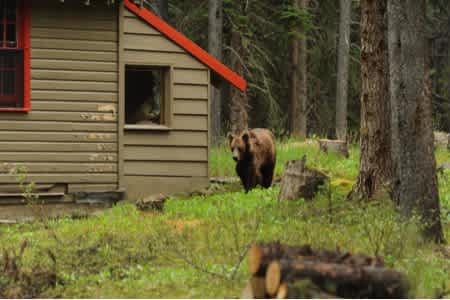
My initial reaction was a combination of shock, fear and excitement and I acted on these feelings in the same way I have in all wildlife sightings on the tour to date, let Vilma know immediately so she can retrieve her SLR camera and appropriate lenses. Vilma & Peter ran over from the kitchen for a look, and then ran back to the cabin to get their cameras and to notify the manager. Conveniently for us there was a Ranger in the campsite armed with a gun of some sort and bear spray. He had arrived from the adjacent campsite to ensure a black bear, yes another bear nearby, did not make its way towards the campers.
By the time Vilma had returned with her camera, the Ranger and a group of other riders had turned up, some half asleep, some with a cup of tea, others wearing nothing but swimsuits as they had hurriedly made an exit from the sauna when hearing the commotion. The bear had seen us and stopped briefly to size us up and deliver what we took as a chilling glare before making his way slowly to the front of the cabin, a mere 20m from us. The ranger yelled at the bear to grab its attention and started walking towards it to shoo in the other direction, as he strode out his gun swayed with his body movement and as he reached to stabilize it he bumped the can of bear spray on his hip. The bear sprays safety clip must have been removed previously as the spray was discharged onto his arm and the spray floated up into his face and eyes.
A brief second or two later he was in extreme pain and on his hands and knees! We quickly retrieved water and he began to wash his eyes out, a process that would take over half an hour. Thankfully for us the bear was frightened by all the commotion and ran off in the other direction!! As the ranger recovered there was a shared feeling of relief amongst the group, the ranger was ok, we were all ok, our Salmon dinner was nearly ready and was not property of Mr Bear and most of all we were lucky enough to be sleeping inside tonight in the shared cabins. Our final night in mountains turned out to be more eventful than planned and made me reflect upon the fact that although the Icefields Parkway sees many thousands of tourists a year, the area is still extremely wild and control lies in the hands of the animals, the grizzly bear being one of them!
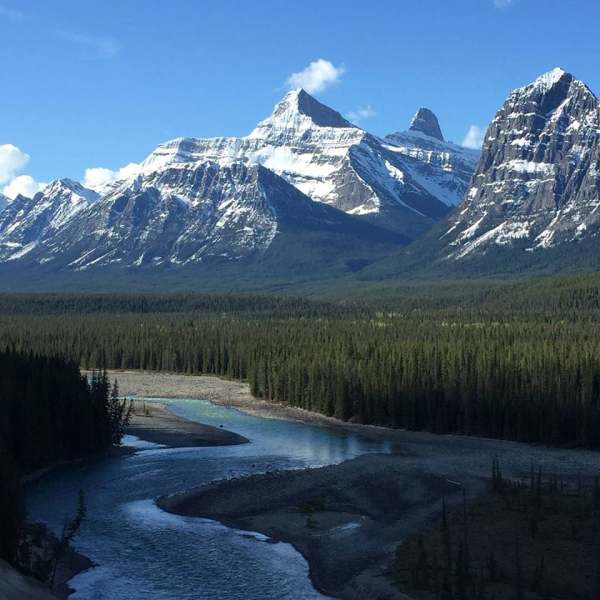
Our excitement died down quickly and our attention turned to the next day’s adventures that included a visit to the iconic Lake Louise and an enjoyable cycle along the Bow Valley Parkway, touted as one of the best cycling routes in the area it sure lived up to its reputation of featuring flowing road and with many interesting side trips. Taking the Banff Legacy Trail into Banff town was a highlight and will have us all returning to the area in the future.
As the name suggests, the TDA Global Cycling family is a loyal bunch that attracts riders and followers from all over the world. This came to mind as we cycled into Burns Lake in the first week where TDA chef April lives and works. She visited up briefly for a quick catch up and donated some local rhubarb that went extremely well with our breakfast the following day. We were also lucky enough to have a delicious roadside morning tea of cookies prepared by Trish & Wayne, TDA alumni and residents of Exshaw, 40km out of Banff and at a good midway point to the day’s lunch stop.
With the first section coming to an end we bid farewell to sectional riders Paul, Lieke, Alex & Lani and also TDA founder Henry who joined us for the first couple of weeks. As we make our way towards the prairies we welcome Australian rider Stirling Lee and hope for some warmer dryer and not too windy conditions!
]]>
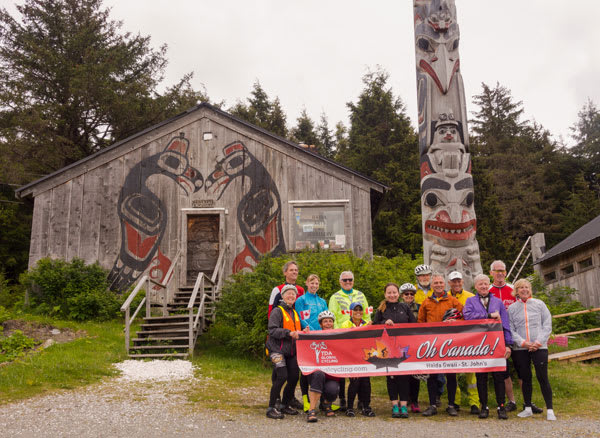
The Oh, Canada Tour commenced on Haida Gwaii, British Columbia on June 3 and is heading East through all ten of Canada’s Provinces to its final destination St John’s, Newfoundland on September 8. A group of 18 intrepid cyclists set off from the town of Old Masset in northern Haida Gwaii in wet, windy and cold conditions. To mark the occasion a number of the riders took the opportunity to ceremoniously dip their rear wheel in the Pacific Ocean at mile O of the TransCanada Highway, something they will repeat at the end of the road in St John’s!
While there have been a few TDA tours that have passed through Canada in previous years, none have been a purely Canadian West coast to East coast cross continental adventure. The Oh, Canada ride will therefore be the first of its kind, and coinciding with the 150th year since Canadian Confederation it promises to be one big birthday party.
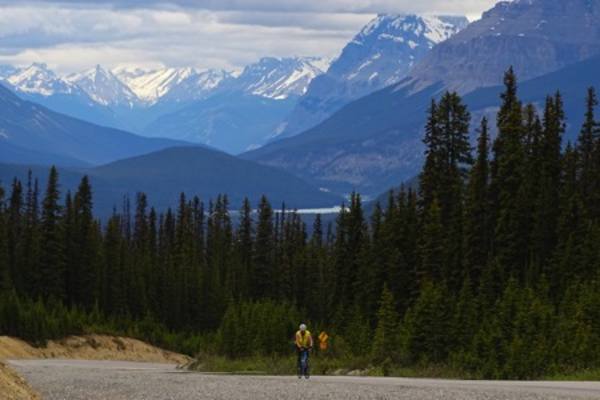
Canada is a country of endless natural beauty from stunning Coastal scenery, Mountains, lakes, underrated Prairie landscapes and abundant wildlife. Canada is the second largest country in the world and its low population density exudes an eerie feeling of being insignificant and at mercy to the forces of nature. These feelings make you feel somewhat humble and I find myself wondering if this has in some way helped shape the overly friendly, accommodating and quietly spoken nature of the Canadian people. It comes as no surprise to me that Canada is Lonely Planets #1 Country to visit in 2017.
Canada has been home to The First Nations long before Europeans arrived in the 16th century. It is estimated that the First nations can be traced back to 15,000 years ago, maybe more, many of who’s traditional homelands we will pass through on our three-month adventure. With the tour beginning in Haida Gwaii, we have had the chance to learn about and appreciate the Haida Nations culture.
Haida Gwaii is a group of islands that sits 80km off the north west coast of British Columbia. Along this tooth shaped Archipelago, the islands feature a diverse array of pristine beaches, sand dunes, lowlands, hot springs, temperate rainforests and snow capped mountains. As a result of the varied environments and the mild and wet climate, these islands are home to a multitude of unique flora and fauna that has resulted in it being termed the Galapagos of the North. An example of this diversity is that the subspecies of black bear found here is the largest species of black bear in North America and having spotted many bears from the comfort and safety of the tour vehicle I admit I did feel extremely vulnerable when sighting not one but 4 bears in the space 10 kilometres of riding!!! Some riders have been lucky enough to spot a whale or a Bald Eagle but according to the locals this is common and nothing to get excited about!
The Haida Nation have been living on Haida Gwaii for many thousands of years before the arrival of Europeans. Haida Gwaii translates to “People of the Islands” and this association with the ocean aptly described their traditional way of life that involves fishing for local Salmon and Halibut (flatfish) both of which I have had the opportunity to enjoy! As one of the Canadian Heritage Meals riders will enjoy throughout the tour, TDA staff made a largely successful attempt at cooking Salmon in one of the traditional Haida techniques. After discussions with the local information centre and a number of local Haida people, we obtained planks of Cedar wood from a local artist and Totem Pole Carver. The cedar was then soaked in water overnight and locally sourced Chinook salmon was cooked on the plank over the fire the following day. The scent of cedar and smoke resulted in delicious melt-in- your mouth salmon that was enjoyed by all after a unexpectedly tough first day riding from Masset to Tlell in rain and strong winds.
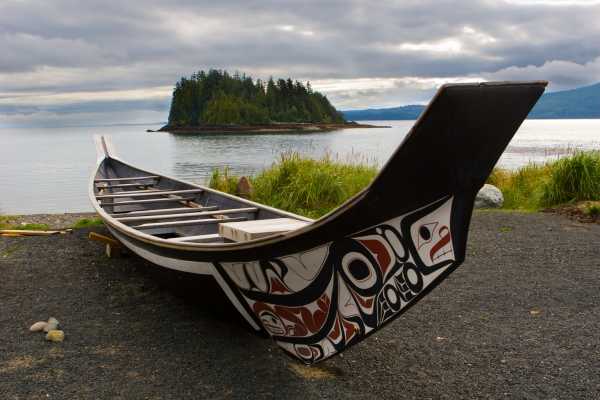
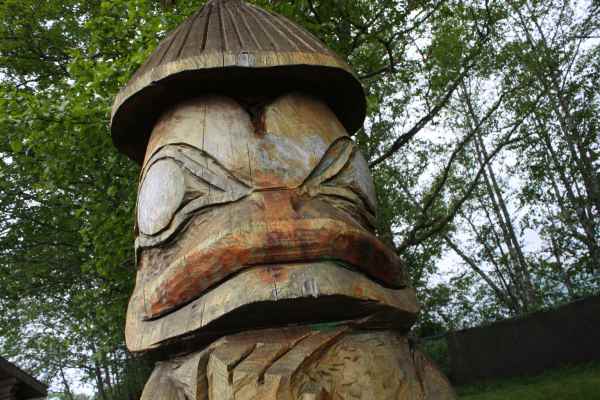
The Haida people are well known for their elaborate wood carving that forms a large part of the Haida culture both in day to day life and artistic expression. In early times Haida people would travel between islands and the mainland in canoes carved from large Western Red Cedar Trees. These trees are also used for building the traditional longhouses that utilize massive cedar beams and vertical planks to form imposing yet beautiful structures that were hard to miss. They would also carve impressive Haida Totem Poles that are visible all over the island. Their sheer size and weight makes you wonder how they managed to erect them in the past. Some of the riders were lucky enough to visit an art gallery where a Pole is currently being carved which will be erected this year on Aboriginal day this year.
As part of the first day of the tour, the group visited the Haida Heritage Centre for a private tour. Our knowledgeable Haida Guide Alex shared with us a number of different Haida Poles and explained the meaning of each Crest and how they commonly share a story about family history that forms an important symbol of heritage and prestige for Haida people.
Following the Tour we had time to explore the museum at our leisure. Upon setting foot into the museum we soon realized that the visible signs of a thriving Haida culture in some ways conceals a troubled past.
There were estimated to be up to 10,000 Haida people living on the islands prior to the arrival of Europeans. Trade in sea otter pelts introduced many infectious diseases, conflict and alcohol all of which has catastrophic effects on the Haida whose population reduced to an estimated 800 people in 1885. During the 20th century pressure from Missionaries and the Indian Act placed a ban on Potlatches (essential Haida social events), Totem poles were destroyed and Haida songs, stories and dances were silenced. During this period many children were removed from their families to the mainland. Growing up in Australia and having a spent two years working in Alice Springs in central Australia with Aboriginal Australians, I can see many parallels between the treatment of Haida people and that of Aboriginal Australians.
Thankfully the Haida have recovered and a resurgence of their culture is visible throughout the island. A large contributor to this was the Lyell Island Forestry Protests in 1985. Forestry has long been an important industry for Haida Gwaii, employing many local Haida people however it was being conducted in an unsustainable way with widespread clear felling of Old Growth Cedar, Hemlock and Spruce. The Haida together with environmentalists had concerns about sustainability and the effects this was having to the surrounding ecosystem and following 10 years of failed land use planning negotiations the island was still being logged.
The protests at Lyell Island 1985 resulted in 72 Haida being arrested, many in traditional dress. These protests eventually saved the forests of Lyell island but were even more significant in that they started a movement towards more sustainable logging practices and increased recognition of aboriginal rights. In the following years Gwaii Haanas National Park (Islands of Wonder) was created soon after that includes almost half of Haida Gwaii. Sgang Gwaay, an ancient Haida Village on remote Anthony island within the National Park was designated a UNESCO World Heritage site in 1981.
During our brief stay on Haida Gwaii it was incredible to see and hear about many young people who are passionately involved in their culture through artwork, tourism, programs to revive the traditional Haida language and to protect the Gwaii Haanas National Park.
As we depart Haida Gwaii on the ferry to Prince Rupert and continue our 8,800km journey to St John’s, I think it is important to acknowledge that Canada’s history goes back a lot longer than 150 years. The remarkable Haida are one of many First Nations people whose traditional lands we will pass through on trip. As with all TDA expeditions it is the journey that makes the experience unforgettable and if these first few days on Haida Gwaii are anything to go by this cycling adventure will be the trip of a lifetime!
]]>One of the perks of working in the TDA office is that upon occasion you get to scout a portion of the route for a new or revamped tour. And so it was 10 days ago that I fled the record rainfalls and unseasonably cool temps that Toronto was experiencing to research the twists and turns, and the highlights and challenges, of the middle 3000 km stretch of our upcoming Oh Canada! cross country expedition.
While scouting is mostly fun, the devil is always in the details, as we strive to find the pathways that best combine a scenic and safe ride for our clients, together with cultural and historic highlights, decent campsite and hotel/motel accommodations, and efficiency in terms of the time it will take to cycle each stage of the massive distance from British Columbia to Newfoundland.
Landing in Regina my wife – who took the stage notes while I drove and “dictated” – and I were welcomed by sunny skies and warm temps, and after stocking up on food supplies and surveying our route out of Saskatchewan’s capital, we hit the road.
Among the highlights of our journey, that our intrepid clients will soon enjoy, were:
– The First Nations lands of the Qu’Appelle river valley that winds for 200 km and breaks up the flat lands of the Prairies
– The quiet back roads through the farmlands and villages of rural Saskatchewan and Manitoba
– The riverside bike path through Assiniboine Park in Winnipeg
– The change from Prairie to the Canadian Shield rocks and lakes entering northwestern Ontario
– The Provincial park campsites along the shoreline of Lake Superior, greatest of the Great Lakes
– The ride along the winding concession roads and rolling hills leaving Sault Ste Marie
– The ferry ride from Manitoulin Island to the Bruce Peninsula, where we were treated to an incredible sunset
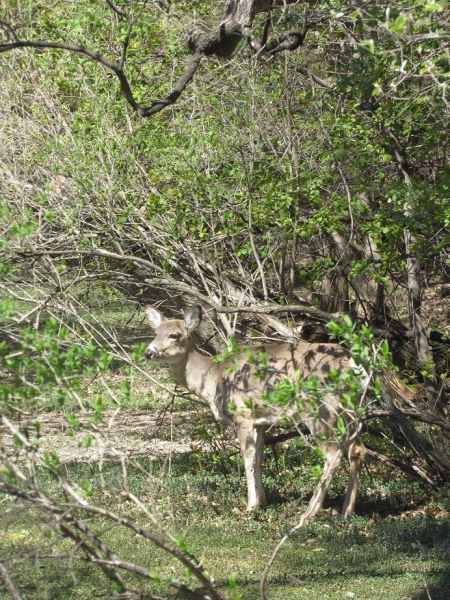
– sightings of moose, deer, black bear, osprey & pileated woodpecker
Of course there were also challenges encountered, including the several times when a planned route proved to be less than ideal, for example when we ran into 38 km of construction and no shoulder on the Trans-Canada east of Winnipeg, and had to double back to find a better alternative.
Not surprisingly the worst weather and the heaviest traffic we encountered was in approaching and entering our home town metropolis of Toronto. However it will be mid summer when the cyclists arrive here, and instead of dealing with jams on the city’s expressways they will be spinning along the serene Humber River trails and bike lanes into downtown.
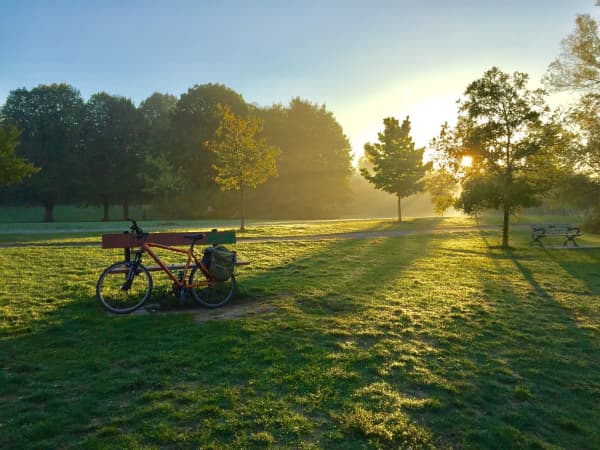
After 24 hours in the comfort of our home on Toronto Island we are now about to embark on the 2nd leg of our journey across Upper and Lower Canada to historic Kingston, our nation’s capital Ottawa, and onwards to Francophone Montreal and Quebec City. Stay tuned to learn of our discoveries there which we will share with you soon.
]]>Canada as a nation state is 150 years old this year. The hashtag #Canada150 is making the rounds on social media and marketers (like me!) are on a blitz promoting our vast country and the many ways to celebrate the anniversary. As a result Canada is topping all the lists of 2017 travel destinations.
Not surprisingly, there are countless events being planned to mark the occasion. One crazy company (that’s us!) was inspired to launch an amazing 3 month, 8,800 km coast to coast cycle tour. That said, I’ve been to bars in Europe that are hundreds of years older than Canada. Surely some people must be rolling their eyes at this young nation’s ‘big birthday.’
#Canada15000
But First Nations people of Canada must really cringe at the birthday celebration. The truth is that the story of our nation – its people and how we all got here – started long before July 1, 1867. Every few years archaeologists unearth artifacts dating further back in time that confirm their presence on this continent millennia before the arrival of the first Europeans – another such site on Canada’s east coast was discovered earlier this month. So far, from what I’ve read, the oldest artifacts discovered date back 15,500 years.
So it’s cute to say we are 150 years old this year and Canadians certainly need little urging to throw a party (have you heard of May Two-Four weekend?), but its also crucial that we not get ahead of ourselves, and lose sight of the historical truths. Perhaps #Canada15000 is a little more accurate…
“It’s not #canada150, it’s #canada15000–get with the times” cc @shazlin_r @InspiritFdn @anemtin https://t.co/4hQAs9NMrX
— Rudayna (@Rudayna_B) April 5, 2017
Amazing thread. Know your history. #Canada150 #Canada15000 https://t.co/dw8NcSXWIh
— Danielle Parish (@danielleparish_) April 10, 2017
Recognizing Traditional Territories of the First Nations
So let’s take a moment to acknowledge some of the ancestral land that our cycle tour will cross thru as we pedal our vast (and very young) nation. Our cycle tour covers some 8,800 km and every one of those kilometers is connected to the First Nations of our country.
I have tried to be precise and to properly acknowledge lands using online resources such as Native-Land.ca and other websites, but my efforts here have likely fallen short of the mark. Proper appreciation of these vast territories requires an understanding of an entirely different way of looking at maps, and land, and ownership. I am reminded not only of how enormous this country is, but how important it is for us to recognize all our peoples whose ancestors trace their lineage much further back on this land than my heritage does.
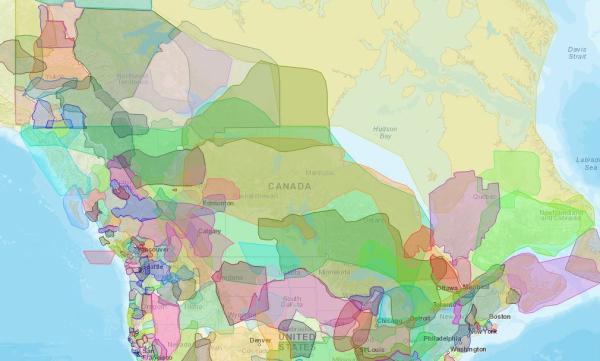
With all that in mind, we would like to not only acknowledge the following First Nations territories, but celebrate each of their cultures with respect throughout our bicycle journey…
Traditional Territories in the Haida Gwaii & the Rockies section:
The lands on which we will be cycling are the traditional territories of the Haida, Tsimshian, Gitxsan, Wet’suwet’en, Dakelh, Stoney, Aseniwuche Winewak (Rocky Mountain), Tsuu T’ina, Blackfoot, Kelly Lake Metis Settlement Society, and Ktunaxa peoples.
Traditional Territories in the Wheat Kings section:
The lands on which we will be cycling are the traditional territories of the Tsuu T’ina, Assiniboine, Blackfoot, Ktunaxa, and Métis peoples.
Traditional Territories in the Great Lakes section:
The lands on which we will be cycling are the traditional territories of the Métis, Ojibway/Chippewa, Mississaugas of the New Credit, Cree, Anishinabek, Huron-Wendat, and Haudenosaunee (Iroquois) peoples.
Traditional Territories in the Upper & Lower Canada section:
The lands on which we will be cycling are the traditional territories of the Ojibway/Chippewa, Mississaugas of the New Credit, Cree, Anishinabek, Huron-Wendat, Algonquin, Abenaki / Abénaquis, Malécites, Haudenosaunee (Iroquois), and Haudenosaunee (St Lawrence Iroquois) peoples.
Traditional Territories in the Acadian Way section:
The lands on which we will be cycling are the traditional territories of the Abenaki / Abénaquis, Malécites, Mi’kmaq, Wabanaki Confederacy, Haudenosaunee (St Lawrence Iroquois), and Beothuk peoples.
Our Contribution to the Truth and Reconciliation Centre
So with respect to the original inhabitants of Turtle Island (did you know North America is known as Turtle Island to many native people), and in recognition of the many ways Canada has failed them, the TDA Foundation is happy to make a significant donation to the National Truth and Reconciliation Centre (located on our Oh, Canada! cycling route in Winnipeg, Manitoba).
>>Consider making a donation here
We encourage each of you and all the participants on this tour to consider doing the same in honour of the land that has been shared by Canada’s First Nations with settlers and immigrants from Europe and around the world.
Further Reading
Interactive Map of First Nations Territories, Treaties, and Languages
CBC – New maps to depict pre-colonial ‘Turtle Island’ Canada
PBS – Prehistoric Hunt Suggest Humans Arrived in North America Earlier
Smithsonian magazine – When did humans come the the Americas
Toronto Star – Indigenous people are not ghosts of history
University of Toronto – Canada 150 or Canada 15000
]]>
2017 is a milestone for Canada and Canadians as it marks 150 years since Confederation. In celebration of this historic event, TDA Global Cycling is offering its clients a cross-Canada cycling tour that will highlight some of the country’s most amazing sites. Of all the planned #Canada150 events, the Oh, Canada! Cycling Expedition from Haida Gwaii to St. John’s is perhaps the most ambitious and challenging. Canada plans to celebrate its 150th birthday by offering countless events all over the country. Although many of these are happening throughout the year, we have attempted to select the best ones in order to help you plan your own personal celebration.
Canada 150 Events in March
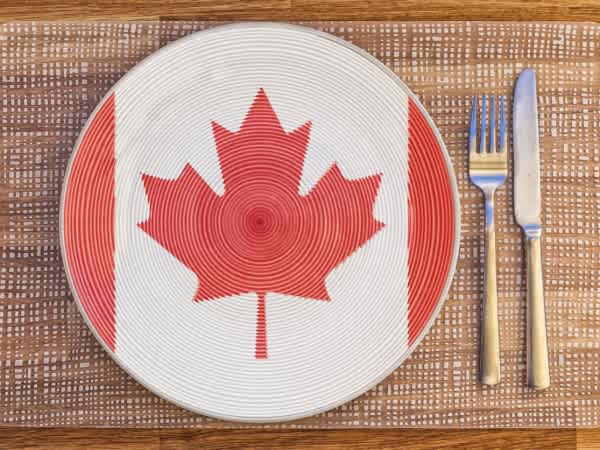
Toronto’s St. Lawrence Market hopes to bring all the foodies from around the country and even the world together by offering a culture-spanning food tour of the world-renowned market. It’s an opportunity to taste the city’s modern-day “demographics.” What better way to kick off your Canadian celebration than by experimenting with food!
Canada 150 Events in May
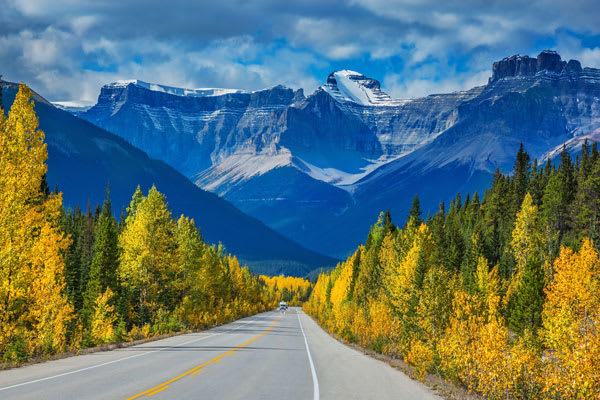
The month of May in Canada has a lot to offer and temperatures are perfect for outdoor activities. You should use this opportunity to visit as many of the national parks and historic sites as you can from Aulavik to Yoho, all of which are free for the entire year. Book well ahead and visit them before the busy summer months. Order your free Parks Canada Discover Pass at parksorders.ca and enjoy these amazing locations.
While you’re in Toronto check out the Art Gallery of Ontario’s permanent Canadian collection. The gallery is filled with some of the most stunning collections of First Nations art as well as classic works by various Canadian artists.
Ontario is not the only province offering shows for art lovers. The Winnipeg Art Gallery will feature Pitaloosie Salia – a Cape Dorset artist active since 1968 and the sole remaining artist from the earliest years of printmaking in her northern community – in her first solo exhibition running from May 13th to October 17th. A remarkable body of work and something definitely not to miss!
Canada 150 Events in June
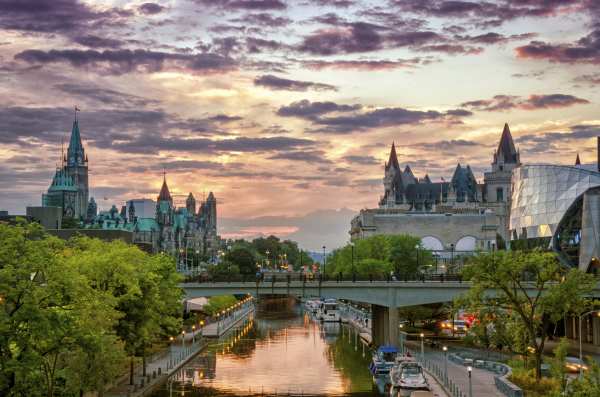
Ottawa, the Canadian capital, is the centre of this year-long celebration. The National Gallery of Canada will use this occasion to unveil the largest display of Canadian art in the world – Canada’s Masterpieces: Canadian Stories. The new galleries are scheduled to open June 14th with more than 1,000 artworks. To finish the month off, Calgary, the ‘Heart of the new west’ has an independent offering that’s already making waves. From June 21st to 25th, the city will allow you to participate in “one of Canada’s best kept festival secrets”: The A.V. Club Sled Island Music and Arts Festival, featuring a long list of guest curators that include Godspeed You! Black Emperor, Andrew W.K., and Peaches.
Canada 150 Events in July
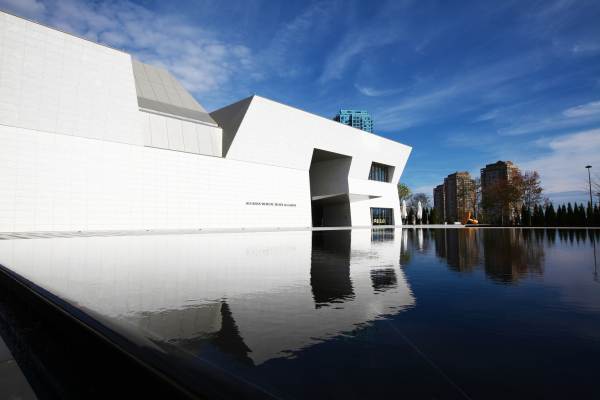
Canada is a well-known nation for its diversity and will use the 2017 celebrations to promote its multiculturalism. The Aga Khan Museum will present Conversation Nation, a yearlong celebration integrating Canadian artists and performers from many cultural backgrounds. This event will have an emphasis on Muslim Canadians which, given the current rise of Islamaphobia, is much needed.
Toronto is the ideal city to visit for the Caribbean Carnival, a festival held every summer to celebrate Caribbean culture and traditions. Another popular event happening in July is Afro-fest, an annual African music festival that takes place on the weekend right after Canada Day.
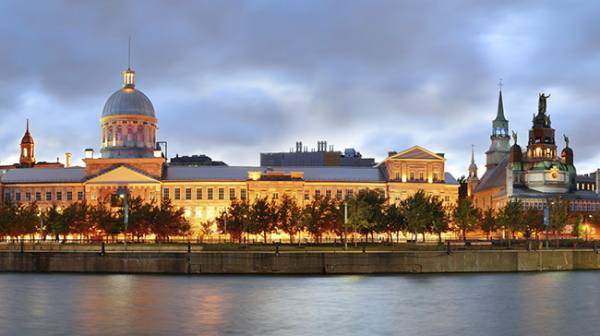
Another must-visit city is Montreal which celebrates its own birthday, turning 375! That makes Canada feel young in comparison.
Join in Canada’s 150th birthday celebration by taking part in some of the amazing events happening all over Canada. However, if you want to have the most unique and thorough exposure to Canadian culture and the great outdoors, consider riding the Oh, Canada! Cycling Expedition with us. Have no fear, you don’t have to cycle the entire distance…unless you want to. There are also many 2 and 3-week options available for all of you who wish to take on this challenge.
]]>Have you ever considered joining one of our cycle tours but couldn’t find the time or felt intimidated by the scale of our trips? Well, you aren’t alone. Not everyone can make the leap from reading a blog post to signing up for a 4 month cycling odyssey. That’s why we created Guest Rider Days.
Last year we organized several Guest Rider Days in North America and Australia/New Zealand and several people took up the challenge (see their testimonials at the bottom).
Join Our Guest Rider Days in 2017
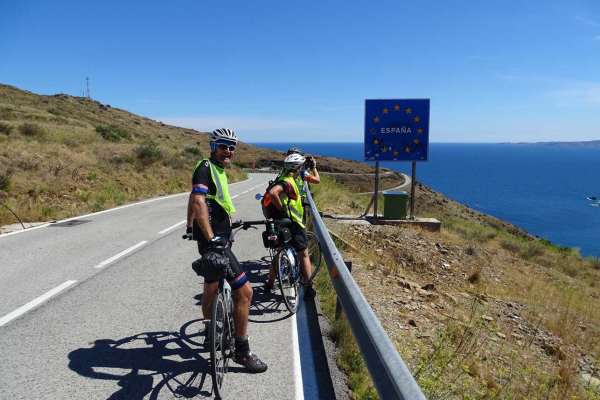
We would love to introduce you to what we do and prove to you that this is not only for uber-athletes or experienced adventurers. It’s for anyone willing to try something a little different, to take on a real challenge and be rewarded with tired legs and a deep sense of accomplishment.
Learn the joys of camp life, meet new cycling friends and experience the new routines that make our tours a memorable and unique experience.
>>Email us to work out the details
The following are three options, but if you live (or will be travelling) in or near other cities along our various routes around the world, let us know and we can see if we can accommodate you.

1. Paris to Troyes (part of Orient Express ride)
2 cycling days, covering 181 km
July 9 and 10, 2017
There are several trains a day from Troyes to Paris that will take you and your bike (approx. 1.5 hours).
2. Frieburg to Ulm (part of Orient Express ride)
3 cycling days, covering 257 km
July 17 – 19, 2017
There are many transportation options between these cities and nearby Munich.
>>Learn more of the 2017 Orient Express
3. Toronto to Kingston (part of Oh, Canada! ride)
3 cycling days, covering 314 km
August 2 – 4, 2017
There is train and bus service between the two cities.
>>Learn more about the 2017 Oh, Canada! ride
What We Cover, What You Cover
We will carry your bags on our support vehicles and feed you most meals (breakfast, lunch, dinner) during the ride. We will also cover your camping fee. Transportation to meet us and hotel costs are at your own expense and you will need to come with your own bike and camping gear.
>>Email us to work out the details
What Riders Said About Guest Rider Days…
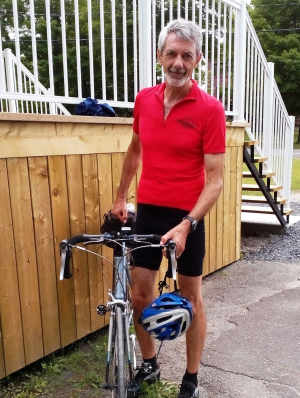 Ray from Ottawa, Canada
“It was a physically challenging three days but very rewarding…I have always been tempted by the rides offered by TDA and I appreciated the opportunity to get a taste of them. Am I prepared to sign up for a two month ride? Probably not, but a 1-2 week section could be in the cards.”
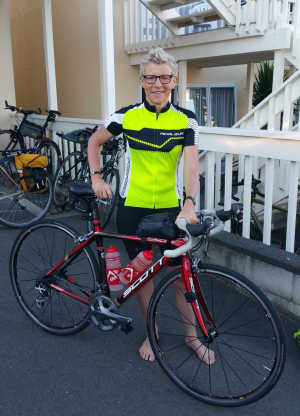 Veronica from Wellington, New Zealand
“It was such a pleasure to join your ride from Napier to Wellington as a guest. Wonderful company superb support and a privilege to enjoy the TDA family for a bit. You have quite a package I have to say. Once again thanks for you wonderful generosity in adding me to your trip. I hope I will get to do more with you.”
]]>
Canada seems to be having a moment, some have said. Whether it’s our new Prime Minister’s popularity, or our welcome embrace of more than 25,000 Syrian refugees this year, Canada is increasingly being seen for its liberalism and even its exceptionalism in the wake of nationalist movements in Europe and the US. Our small Canadian cycle tour company is feeling very patriotic these days, and recently announced our own coast to coast cycle tour across Canada for 2017.
Travellers in general, and cyclists in particular, have been criss-crossing our country for decades. There has always been so much to offer a visitor in a safe and welcoming environment. So why might 2017 be the year for you to decide to take it on? I have identified both some practical reasons and some more philosophical/nonsensical reasons why 2017 might be the year for you to join us in cycling across the ‘Great White North’.
1. Canada is Turning 150, National Parks are Free
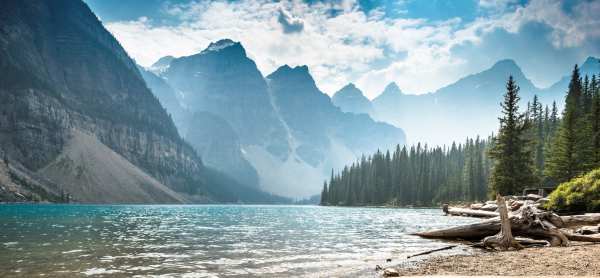
Canada became a nation on July 1, 1867. For our sesquicentennial (say that 5 times fast!), we are throwing a big bash and you are all invited, especially you cyclists. The Canadian government announced that entry fees to all the National Parks will be waived for 2017. What a great opportunity to explore the wilderness that so many associate with Canada – lakes and coniferous forests filled with moose, owls, beavers and canoe-riding Canadians.
2. Winnipeg. (Winnipeg?)
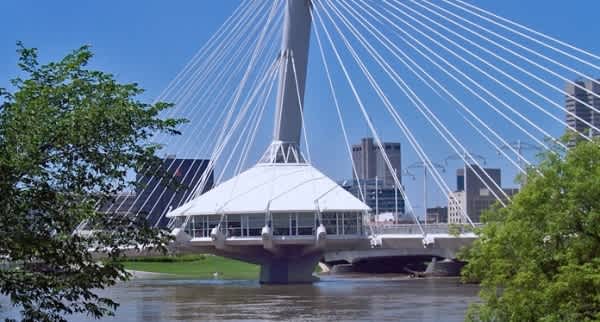
Yes, Winnipeg. Fondly known here as ‘Winterpeg’, the frosty capital city of the province of Manitoba is in the limelight these days – having it’s own moment, if you will. Boosted by a strong economy and investments in the city, it recently caught the attention of Vogue and Elle magazine. For cyclists crossing the country you can’t really avoid Winnipeg, but you will be glad you stopped here for a night or two. From the recently completed National Human Rights museum, to a lively local music scene it is increasingly eclectic in what it has to offer.
As Lonely Planet puts it (with a bit of hyperbole perhaps), Winnipeg is “cultured, confident and captivating, it’s more than just a pit stop on the Trans-Canada haul, but a destination in its own right.”
3. Chance to Spot a Shirtless Trudeau in the Wild
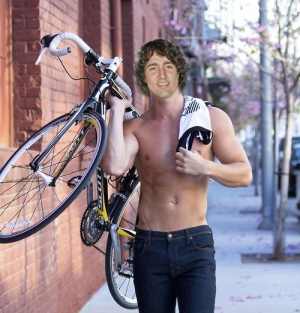 Last summer, while the US primaries were getting ugly down south, Canadian media was busy with more relevant news – multiple sightings of our shirtless Prime Minister on vacation with his family.
Besides spotting moose, grizzlies, beavers, and the Canada Goose you now need to watch closely for the elusive shirtless-Trudeau. Experts expect sightings only to increase in 2017.
4. Completion of the Great Trail
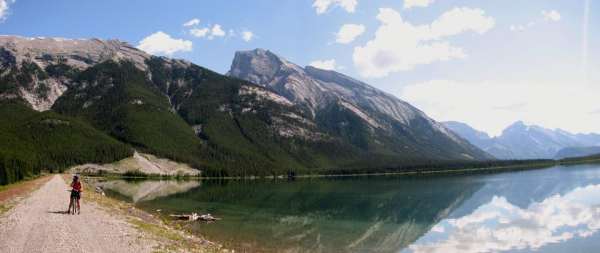
Coinciding with Canada’s birthday bash, the Trans-Canada trail (a.k.a. the Great Trail) is due to be completed in 2017. It will offer an astounding 22,000 km (13,500 miles) of trails, making it the world’s longest trail network. A great deal of these trails are appropriate for bikes and over 30% of the trail system utilizes public roads marked for cyclists. This will allow touring cyclists many more options for crossing the country and avoiding the dreaded Trans-Canada highway.
5. Canada is Topping All the Travel Lists
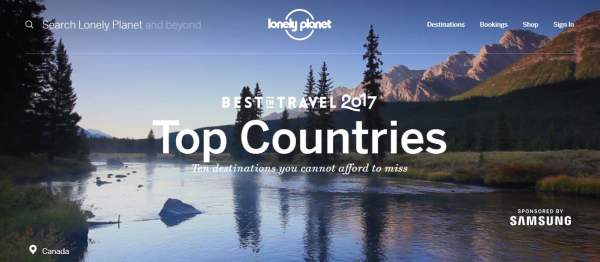
The first big announcement came from Lonely Planet who chose Canada as its top country to visit in the ‘Best in Travel’ list for 2017. Following that up, it also topped Wanderlust’s ‘Hot List’ for 2017.
Travel + Leisure had Montreal on its ‘Best Places to Travel‘ list. And National Geographic had Banff on its list of Best Trips for 2017. We could go on… you get the point. There is a reason these travel experts are talking so much about Canada. There is so much to discover, and being the 150th year, there so many communities, clubs, and government organizations planning exciting events.
6. Exchange Rate is in Your Favour

We Canadians remember a few years ago when our colourful money was on par with the US greenback. Those were the days. These days it is sitting at around $1.32 Canadian to $1 US. And for those of you living in Europe its at $1.42 Canadian to €1. So what might be painful for us travelling abroad, is a benefit for our foreign guests.
7. Multiculturalism and our Native Cultures
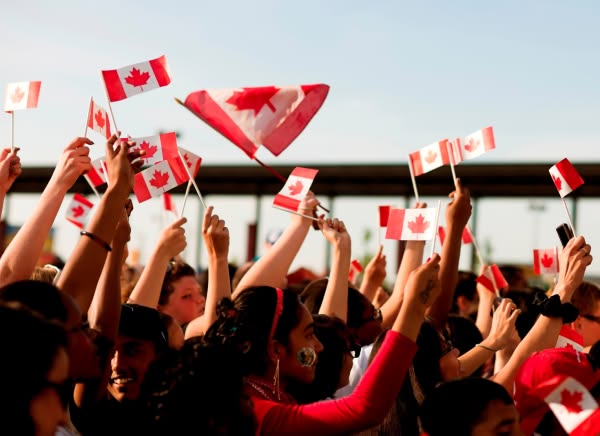
Multiculturalism isn’t just a nice idea, it’s official Canadian policy – and we were the first nation to take such a step. Though in practice we have a long way to go for true equality in our country, it is an idea that we hold dear.
Where Canada (and Canadians) have fallen short is in the history of our treatment and relationships with the native communities and their cultures across our country. But attitudes are changing and slow progress is being made to better the lives of the original inhabitants of this land. Learn about some of that progress being made in Winnipeg at the National Centre for Truth and Reconciliation which was created to preserve the shameful history of Canada’s infamous Residential School system. Or check out this amazing multimedia project called the Secret Path by Gord Downie (a Canadian music legend) with all proceeds going to the National Centre for Truth and Reconciliation.
8. A Reprieve from Trump’s America

Half-jokingly, a Cape Breton radio DJ launched a website to help encourage Americans to move to lovely Cape Breton (on Canada’s east coast) in the event of a Trump election. Local tourism officials have seen a spike in visitors to the island which they now refer to as the Trump Bump.
So to our American friends, we know it has crossed your mind (our immigration site crashed on US election night). Although you don’t necessarily need to move here (though you would be most welcome), you should certainly come and experience how things are done north of the border next year.
9. Food Diversity

We are running our own coast to coast tour across Canada next summer and we recently wrote about some of the Local Heritage meals our participants will get to experience along the way. Canada is not just bacon and maple syrup, you know.
Multiculturalism means that we have food influences from all over the world. Smoked salmon on the west coast, steak in Calgary, Ethiopian cuisine in Toronto, sushi in Montreal, lobster boils on the east coast – there is something for every taste.
10. Music Diversity

Canadian musicians have, for decades, made it big – both at home and abroad. From Leonard Cohen, and Celine Dion, to modern acts like Drake, and Bieber – our talent runs the gambit. We play instruments as common as the electric guitar to oddball ones like the ‘Newfoundland Ugly Stick.’
From Native drum circles, to Scottish bagpipes, to indy rock bands in the clubs of Winnipeg, Toronto, and Montreal, to Celtic inspired music on the east coast, there is a amazingly diverse array of music talent in Canada just waiting to be heard.
]]>Cycling across Canada creates plenty of opportunities to sample the local cuisine along the way. During our Oh, Canada! tour we’ll cycle through vast areas of wilderness with little population, and here our camp kitchen will be the focal point for our appetites. There will also be many rest days in busy cities where you can feel free to choose from an array of local eateries. What is unique about this tour, from a culinary perspective, is something that we’ve never done at TDA before. We are organizing 5 restaurant dinners along our ride that we hope will give everyone on the tour a taste of what makes each respective city or town special from a culinary perspective. We will also be doing one culturally rich dinner ourselves, in Haida Gwaii in our very first campsite of the trip.
Salmon Cooked on the Beach on Haida Gwaii
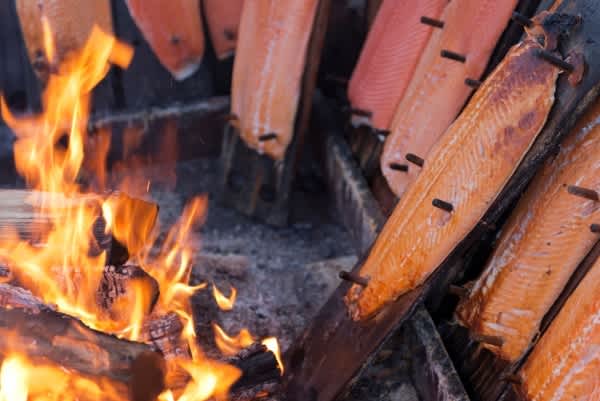
We feel incredibly lucky that we can start our tour in Haida Gwaii. It is an archipelago that many have dreamed about visiting but few get the chance. It is also an incredible opportunity to experience the Haida culture, and a fitting place to give perspective when celebrating Canada’s 150th birthday, knowing that the Haida have been on this land for over 17,000 years.
Salmon has always been a central part of the Haida culinary culture. The seasonal bounty of the salmon would see the Haida moving to river camps when the salmon would arrive. Fishing with nets, and smoking the excess catch, which would hopefully last them through the winter. To this day the salmon is greatly respected in Haida culture, and we feel again lucky to be able to cook salmon on our first camp night of the tour, over an open fire. Let us all hope for no rain☺
There is More to Calgary than Steak
Our first night out will be in Calgary. It’s a city that the person writing this blog grew up in, and during the 80’s and early 90’s everything about food in Calgary was about steak. I actually remember in the late 80’s there was supposed to be a “Vegetable Day” in the city, not Vegetarian Day, just a day to celebrate Vegetables as part of our diet. It had to be cancelled after the beef industry got upset.
This is no longer the city I grew up in though. The food scene in Calgary exploded in a positive way in the late 90’s and never looked back. Innovative Chefs with a liking for local food producers started creating some of the best new restaurants in the country. It didn’t hurt that the petroleum industry was hitting new heights and there was money to be spent on dining out. Some of the most exciting new restaurants started up in restored heritage buildings in the heart of the city. The cuisine also expanded, with an eclectic array of tastes and a blend of culinary backgrounds taking hold. While the thought of Calgary still brings to mind the taste of a fat juicy steak to many, we will look to introduce you to a contemporary take on the culinary scene.
Winnipeg: A City with Growing Diversity
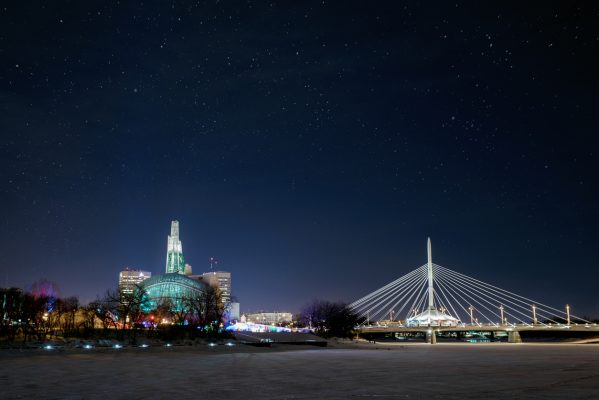
Winnipeg is a city that’s always been known for its winter, which runs on the colder side of things. Happily though it’s also a city known for a growing diversity in its’ population, and this diversity brings a whole new spectrum to the local cuisine.
From the original First Nations inhabitants, to the early settlers from Britain, France, Iceland, Poland, Germany, Ukraine, and newer settlers from countries such as the Philippines and Nigeria, the food choices are ever growing.
We plan to introduce you to this scene and sample a taste of both the new and old Winnipeg.
Market Based Cuisine in Montreal
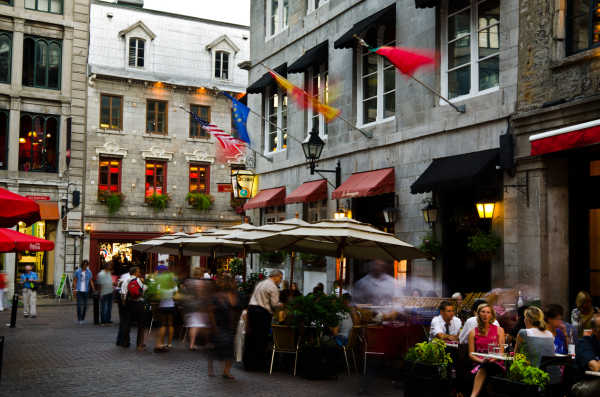
Montreal is the second largest French-speaking city in the world, after Paris, and has the second most restaurants per capita in North America. So if you’re looking for an amazing French inspired meal, you don’t have to walk far.
This is another city that I can add some personal information too. I was fortunate to work for some of the best chefs in Montreal a little over ten years ago. Some of whom are still working in the city today. From that experience I know that at the heart of the restaurant scene is a market based cuisine, that sees farmers, mushroom pickers, honey producers and more coming together with chefs to provide the freshest, tastiest meals.
We’ll try and hook up with some of my old chef work mates to bring you a taste of contemporary Montreal.
Lobster Feast in Charlottetown
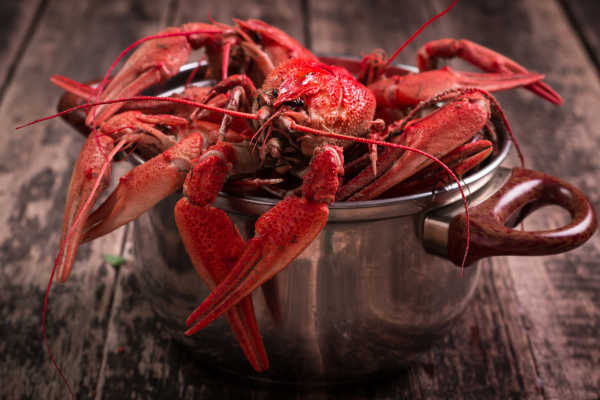
OK, this is another place that I have some history with. I attended the Culinary Institute of Canada in Charlottetown many years ago. During that time I was lucky enough to witness a growing sophistication in the local restaurant scene, with many chef’s graduating from the Culinary Institute.
It’s a childhood memory of mine though that will point us towards our culinary experience in Charlottetown… Envision long wooden tables that seat locals and tourists from around the world. A bib to go around your neck. Butter and biscuits on the table, and then the lobsters start arriving. It’s a lobster fest and I’d say it’s a bit gluttonous, but after nearly cycling your way across Canada, I think you will have earned the right to indulge.
Our Big Celebration in St. John’s
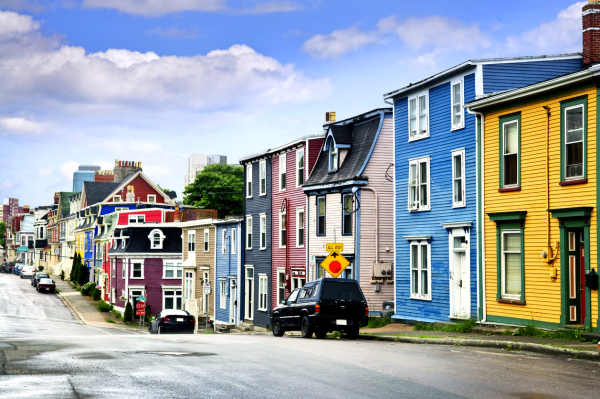
Our final meal together of the trip will take place in a city that was raised on Cod and wild edibles. Not blessed with abundant agriculture Newfoundland always relied on the native plants that grew and the fish that swam in the Oceans near and far. On those cold winter nights another mainstay was Screech Rum from Jamaica that was traded to Newfoundland in exchange for Salt Cod.
We will break bread together in a warm and sheltered venue not far from the Atlantic’s expanse, and celebrate St. John’s culinary traditions and our achievement of crossing Canada by bike.
Check out some other unique features on the Oh, Canada! Cycling Expedition.
]]>Over the 15 years we have been running cycling tours – now in over 60 countries around the globe – we have developed a certain style. All cycle tours are a little different, and each group of cyclists has a different culture. But we wanted to list the unique features that our company brings to cycle touring and specifically what is unique and different about our brand new route across Canada (see our official announcement here and full list of what’s included is found here).
To get the full details including price, dates, and distances, click here.
1. Starts in Haida Gwaii
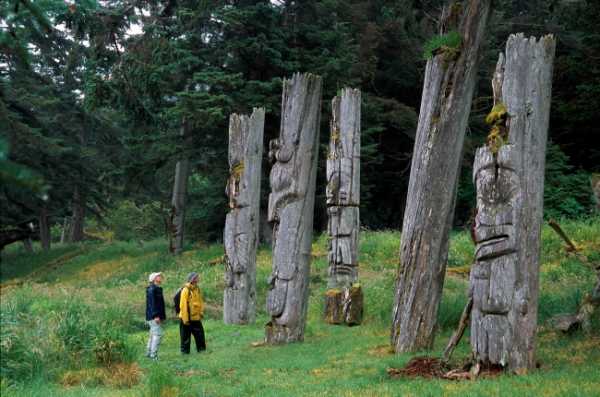
photo credit: Destination BC/Tom Ryan
Most cross Canada cyclists, whether solo or with a group, start their journey in Victoria or Vancouver. We chose Haida Gwaii because of its First Nations culture and it’s stunning forests and coastline. It’s a rare chance to visit the archipelago, often called Canada’s Galapagos, but it’s only getting more popular, so come with us to see it in all its pristine beauty.
Flights to Haida Gwaii depart daily from Vancouver and Prince Rupert.
2. Using over 1,000 km of the Trans-Canada Trail
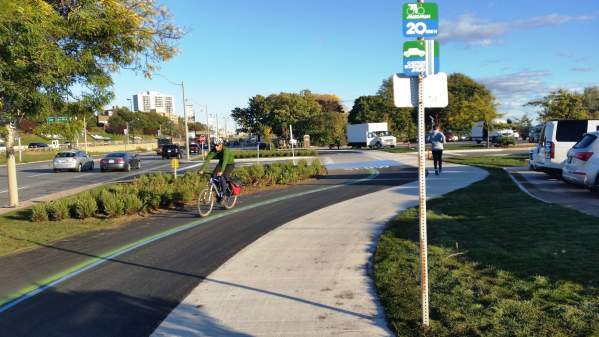
Timed to be completed for Canada’s 150th birthday, the Trans-Canada Trail is the longest trail network in the world. We will utilize this whenever it is most feasible and the trail is paved or well groomed and maintained. But on the sections more suited for hikers, we opt for paved public roads instead.
3. Thirty Eight nights in Hotels
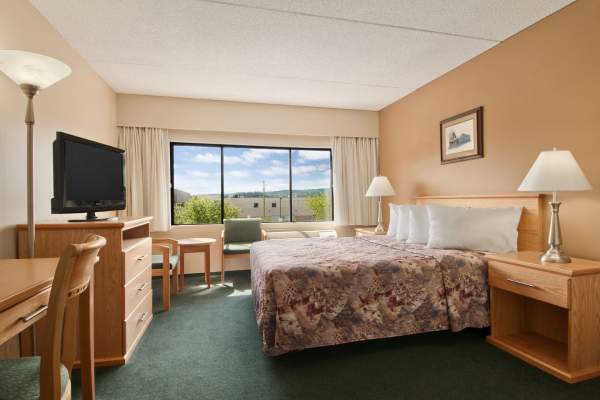
The Canadian outdoors is well suited to camping. No doubt about that. But we all love a warm shower and a soft bed after a few nights in our tents. Every night of our rest days are in hotels with hotel breakfasts included. We also start and finish the tour with hotels in Haida Gwaii and St. John’s.
We chose clean, simple 2 and 3 star hotels that are as close to our route as possible. These range from unique, locally run inns, to well known chain hotels.
(Based on double occupancy rooms, single supplement price available).
4. Experienced Expedition Chef
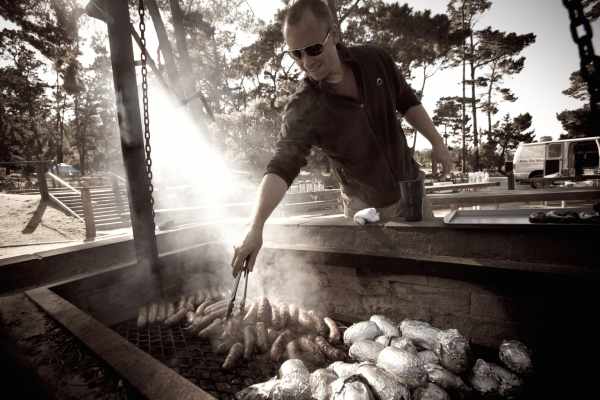
“Great places, wonderful scenery and awesome food everyday.” – past participant Rinda Hunt-Davis (South Africa)
On all our cycling tours we pride ourselves in preparing fresh, and above average food for our hungry cyclists. This tour is no exception. We can accommodate a whole range of dietary restrictions, and hire either professional chefs or highly experienced expedition cooks.
We serve nutritious, delicious food in portions that suit the appetites of hungry cyclists.
5. The Benefit of a Skilled Bike Mechanic
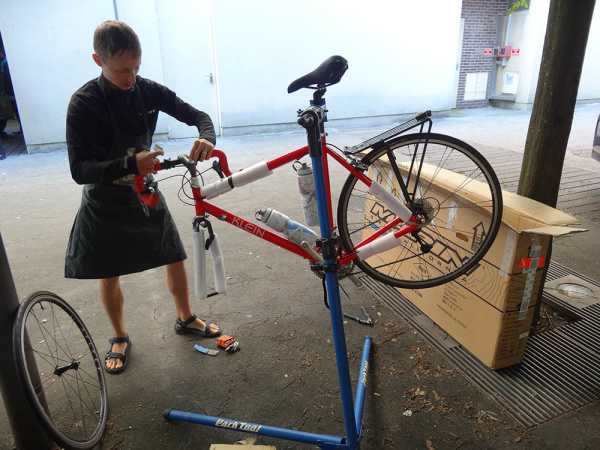
From your first day assembling your bicycle, to emergency repairs, and routine adjustments, the bike mechanic is always one of the most popular people on our tours. Each evening after your ride they will have ‘bike shop hours’ to care for your mysterious bike noises, and make any other needed adjustments.
6. Detailed Direction and a Marked Route
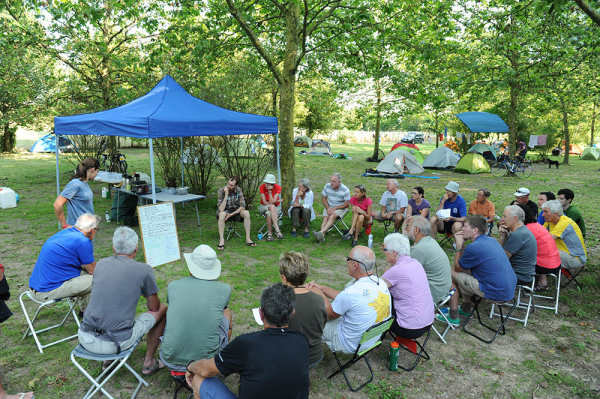
Your tour leader will have a briefing with all the riders each evening to review the next day’s route. The turn by turn directions are written on a whiteboard for you to note down. The next day he or she will mark the route with bright flagging tape (biodegradable of course) at key intersections to ensure you find your way.
7. Roadside Lunches
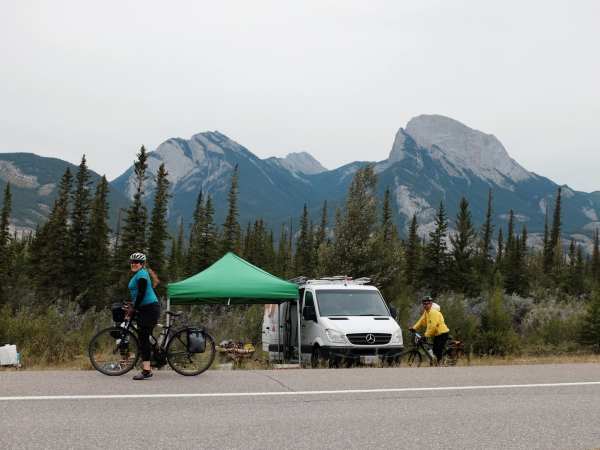
Each riding day, just past the midway point of the day’s distance, you will find our van roadside. Sandwiches, fruit, and water to refill your bottles await. It’s also a chance to sit on a chair a little larger than your bike seat and review the challenges of that morning’s ride with your fellow riders.
8. Sweep Rider, and Vehicle Support
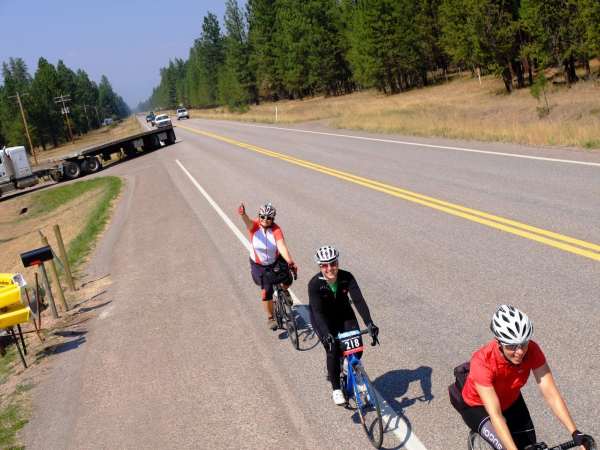
You can ride at your own pace, safe in the knowledge that there is a staff on a bike riding somewhere behind you. Our ‘sweep’ rider is there to make sure all the riders stay on track and to alert the vehicles if someone is too tired to continue.
9. Scenic Roads, Safety First
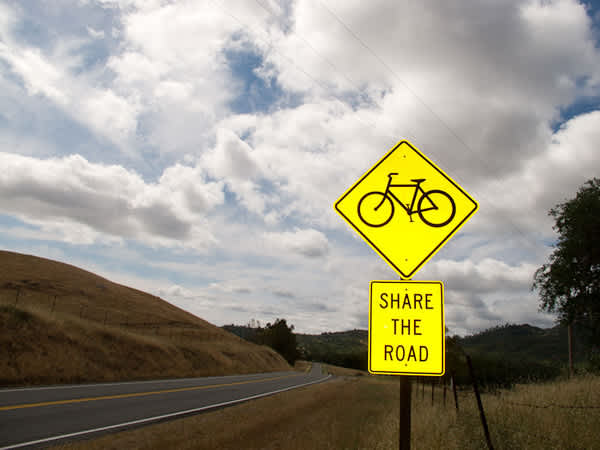
We are spending the months before the tour starts doing a thorough review of the route. We will send a team to scout the route and record turn by turn directions. We always err on the side of safety, and so wherever possible we limit the amount of time spent on the Trans-Canada Highway, and more time spent on the Trans-Canada Trails and other secondary roads.
10. A Challenging, but Doable Daily Distance
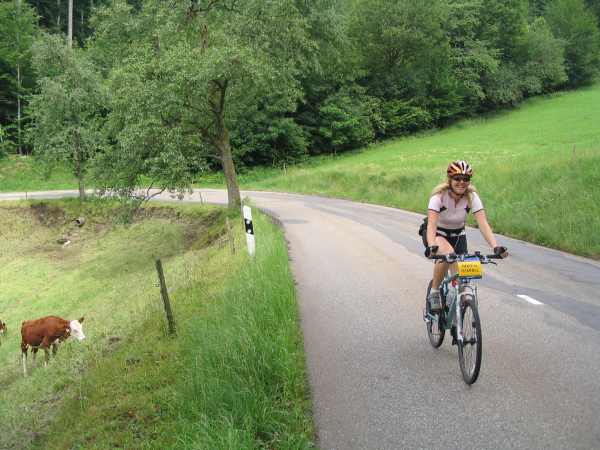
Similar to our tours in Europe, we set the average daily distance so that on many days you will roll into camp with lots of time to relax, clean up, and explore the surrounding towns and scenery. We average 110 km each day – allowing time to relax and explore after your riding day is done. Our longest stage is 175 km in the flat and well paved Prairies.
11. Coastal Loop of the Stunning Gaspé Peninsula
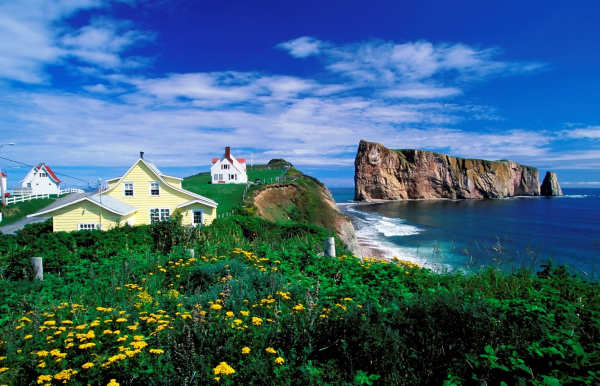
Though less of a direct route, this arc around the Gaspé Peninsula allows us to avoid the main New Brunswick route. Gaspé is rugged and wild but the hospitality and home cooking of the region’s small villages will make you feel at home. You can explore Canada’s tallest lighthouse at Cap des Rosiers, or do some birding at Forillon National Park.
Further along the peninsula will take us to Percé and one of the country’s iconic sights – Percé Rock pictured above.
12. Renowned Cabot Trail route around Cape Breton Island
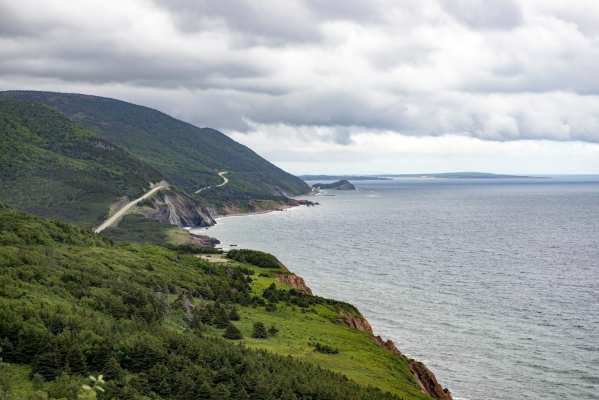
Not to be missed, the Cabot Trail has been routinely listed as a top destination for cycle tourists. It would be a shame to cycle across Canada and miss out on one of its most iconic rides.
13. Local Heritage Celebration Meals Included
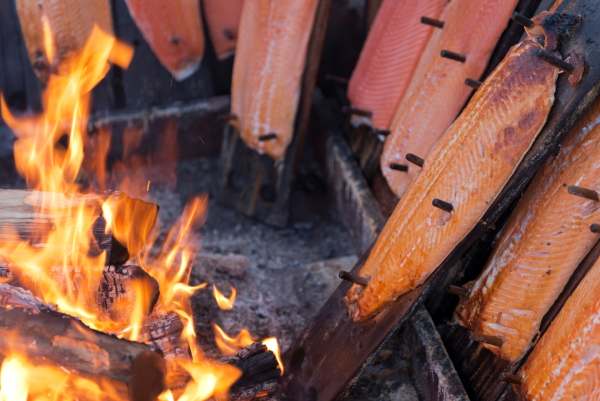
Over the course of the tour we will have six local heritage celebration meals. The first will be our very first camp dinner, where we will celebrate the Salmon, a central part of the local Haida culture. We’ll cook it over the fire right by the Pacific Ocean.
The following five heritage dinners will be at restaurants that emphasize local ingredients and culinary traditions. So you can expect some Alberta beef in Calgary, Bison and Bannock in Winnipeg, French market cuisine in Montreal, a Lobster menu in Charlottetown and some amazing Cod in St. Johns. Don’t fret if you’re vegetarian, we’ll take care of you with amazing local options as well.
14. Canadian Experiences Included
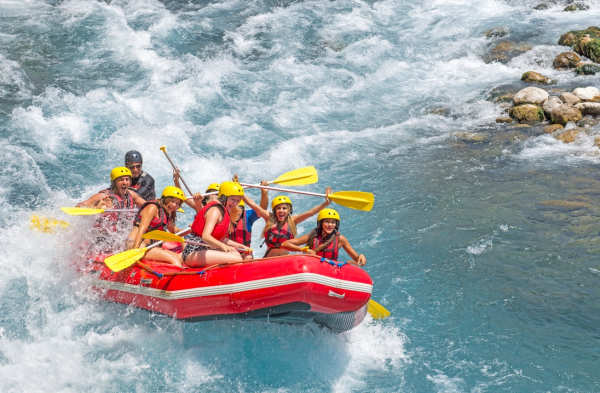
We know it can be hard to investigate all the places we will be traveling through before the tour starts, so since this is our home country we thought we would throw in a few don’t-miss highlights… on us.
- Haida Gwaii museum in Skidegate, where you can learn about the diverse and unique Haida culture.
- A white water rafting trip for everyone on the Athabasca River in Jasper.
- A visit to the Museum of Human Rights in Winnipeg.
- Craft Brewery tour at Steam Whistle Brewing – Toronto’s original craft brewery, located next door to the CN Tower, and the Rogers Centre.
- A trip to the Acadian Heritage Village in Caraquet to experience what life was like in traditional Acadian times.
- A walking tour of Charlottetown including the Confederation building – the birthplace of what we now call Canada.
15. It’s Organized by a Bunch of Canadians
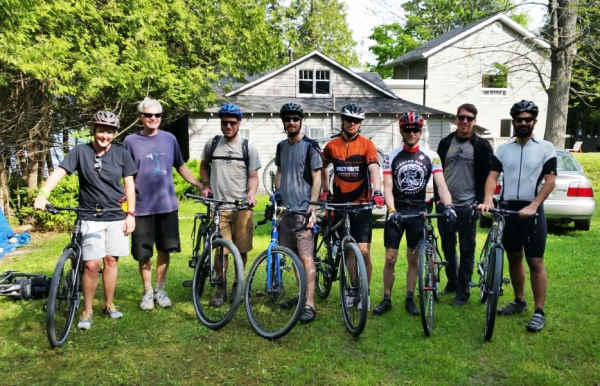
The majority of our team lives and works in Canada. We are excited to share all the unique characteristics of our own country for a change. Our series of trans-continental tours have taken us all over the world, but Canada remains our home. We bring together our experience that made us the leading long distance tour operator and selected the Best Adventure Travel Company by the Independent newspaper in 2015. Check out our Meet the Staff page here.
A full list of what’s included is found here.
Registration is now open for the 2017 Oh, Canada! cycling expedition. We hope you will join us next summer.
]]>
Check out the full details here.
After 15 years of taking cyclists to some of the most exotic places on earth, TDA Global Cycling would like to invite you to our home, Canada. Join us to discover a country like no other and celebrate this country’s 150th birthday by cycling over 8,800 km from the mystical First Nation’s archipelago of Haida Gwaii on Canada’s Pacific coast to friendly St John‘s, Newfoundland on the Atlantic Ocean. In fact, Lonely Planet has just announced that Canada is the #1 country to visit in 2017. Along the way experience and cycle almost 1,500 km of the Trans Canada Trail – the longest cycling trail in the world, a cycling/hiking/canoeing route that will be inaugurated as part of the country’s 150th year celebration. And 2017 is the 200th birthday of the bicycle. And, come to think of it, 2017 is also TDA Global Cycling’s 15th birthday. Those are some pretty great reasons to celebrate.
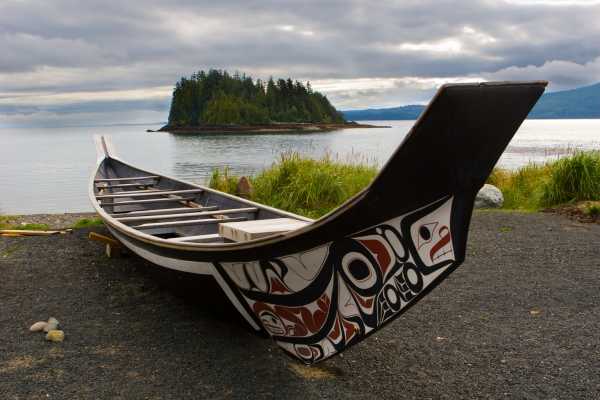
Come explore the history and culture of a country known around the world as peaceful, multicultural, forward-looking, vast, beautiful, self-deprecating and less we forget, polite & funny. Experience Canada’s unique social mosaic – Aboriginal, English, French and millions of immigrants from just about every country in the world. Did you know Montreal is the world’s second largest French-speaking city in the world after Paris? That Toronto is the second largest Tamil-speaking city in the world after Chennai? Or that fabulous Vancouver has been voted over and over again as one of the three most liveable cities in the world?
Check out the full details here.
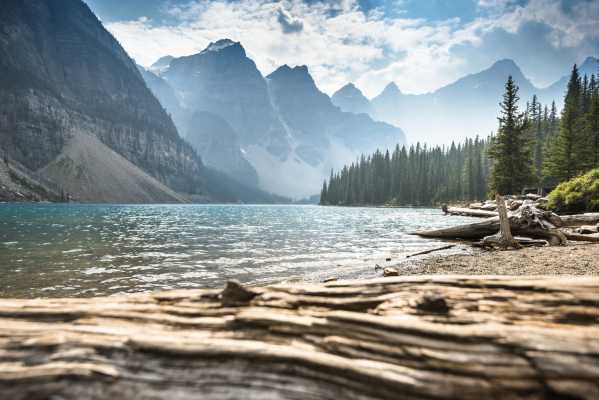
Riders will spend the traditional Canadian summer, those amazing months between the May 2-4 weekend (more on that later) and Labour Day, cycling across the world’s second largest country. Cyclists will pedal through the majestic Rocky Mountains, over the immense Great Plains, and along the rugged shores of Lake Superior. They will weave through Ontario & Quebec’s’s endless lakes and forests, spin along the mighty St Lawrence River, around Cape Breton’s incredible Cabot Trail and across the wilds of Newfoundland.

Along the way riders will fuel up on some distinctly Canadian treats like Nanaimo bars, Pemmican, Poutine, Sugar Pie, Timbits, Beaver Tails, Butter tarts, Figgy Duff, Bannock, Flapper pie & Prairie Oysters – all washed down with some Newfie Screech or a 2-4 of Molson Canadian. Not to mention catching glimpses of Canadian wildlife – grizzly bears, the statuesque northern moose, the dam-building beaver, Canada Geese – or hearing the song of the most iconic of Canadian birds, the call of the loon whose image has been immortalized on our one dollar coin.
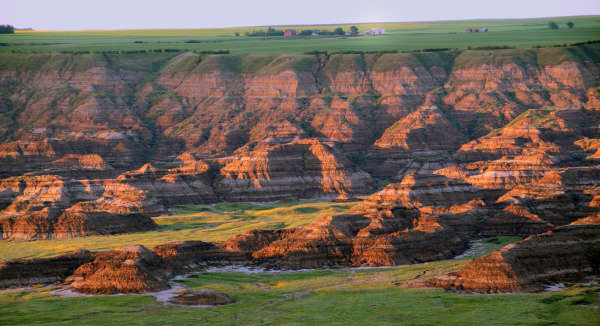
Sounds like a plan, eh?