Blog
 REGISTER NOW


The Desert Coast & Ancient Cities: The South American Epic Enters Northern Peru
Camille Kirby is the Content Creator on the 2026 South American Epic Cycling Expedition.
“Northern Peru is flat and full of trash.”
I had been warned not to get my hopes up. Those who had visited before described a place of unsavory smells, dusty winds, and endless flatness. After the lush Colombian hills and smiling Ecuadorian faces we had grown accustomed to, they said Peru would be a slap in the face. And so we began our entrance into Peru.
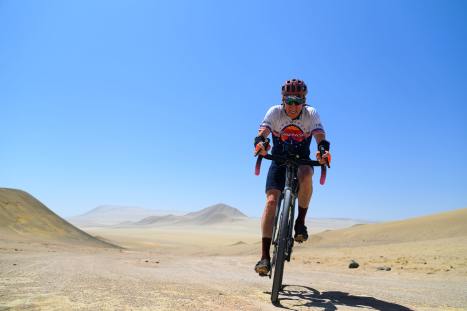
I found myself cycling into Chiclayo, our first rest-day city. Seeing dusty, trash-strewn roads from the window of a vehicle is one thing; being on a bicycle in the middle of it is entirely different. The warnings quickly reveal themselves to be true. A harsh headwind blowing in from the nearby Pacific carried dust across a resource-depleted landscape, while the flat terrain stretched endlessly toward the horizon. The sameness of the straight route makes the riding feel hypnotic. But somewhere between the dust and the wind, something began to get more interesting.
I spot a huge billboard for a local hospital above a collection of half-finished homes. It depicts a pre-Hispanic warrior receiving an X-ray. He wears golden armor and an ornate headpiece, but his image is sliced in half, revealing his skeleton underneath. It’s almost the perfect metaphor for the Peru we’re entering: the past exposed by the present.
This dusty stretch of desert was once home to one of the largest civilizations in the Americas. Not the Incas—the civilization that so dominates our collective image of Peru—but the Moche and later the Chimu, cultures that flourished here for centuries before the Inca Empire emerged.
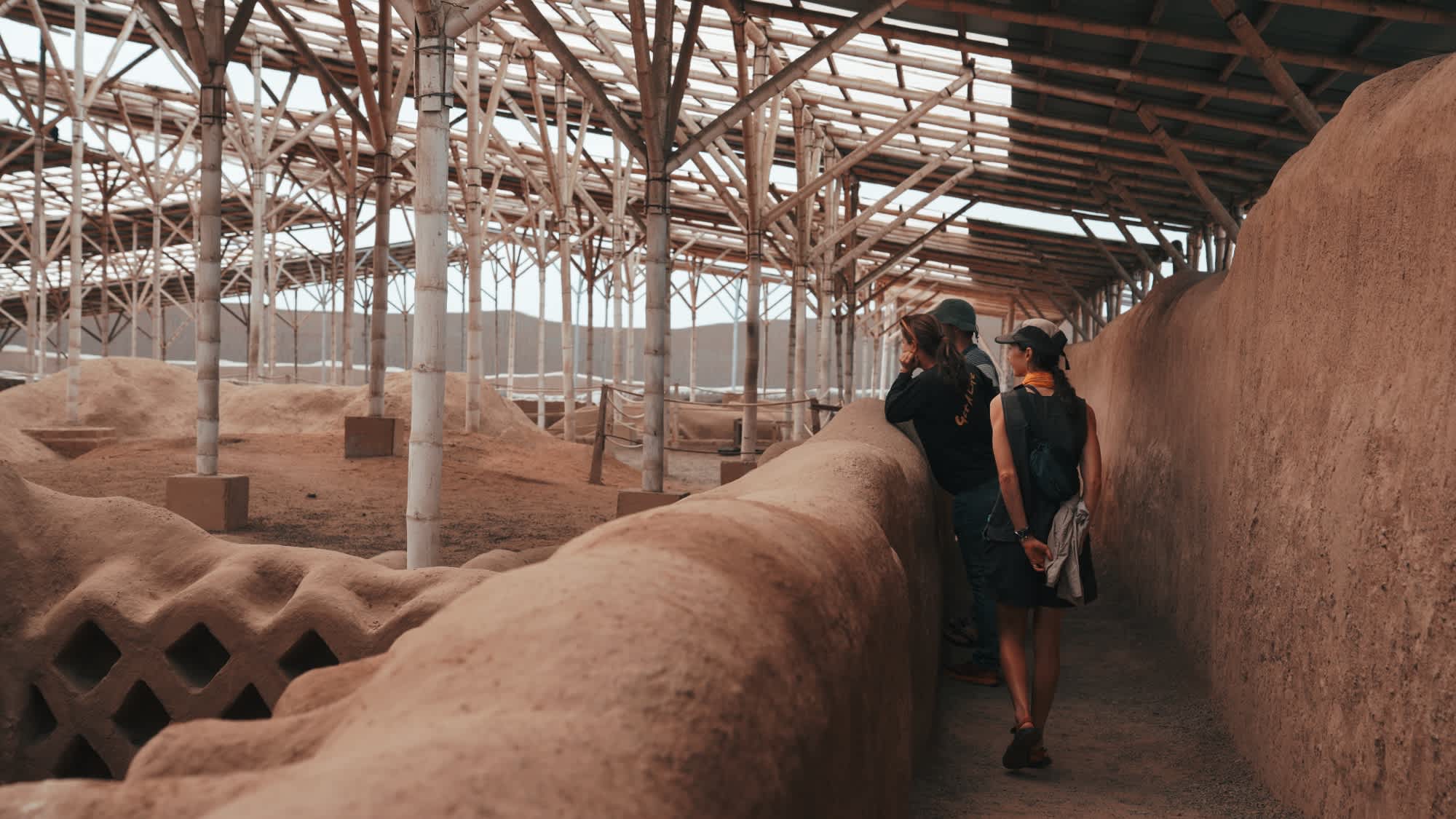
Maddison Holmes visits archeological site Chan Chan with Colleen Gordon and Yanez Novoa outside of Trujillo, Peru.
When you think of Peru, your mind tends to carve out the silhouette of Machu Picchu. You picture green mountainsides dotted with white llamas, the Amazon basin, or perhaps the chaotic sprawl of Lima. The Peru that is often forgotten is the coastal one. More than 3,000 kilometers of arid desert stretch along the Pacific, and beneath the dusty cities and surf towns lies an enormous trail of pre-Hispanic history, much of it hidden in plain sight.
Then comes Chan Chan. Just north of Trujillo sits the largest city ever built entirely from adobe. It was once the capital of the Chimu, which were at their height between roughly 1000 and 1470. At our rider meeting in Pacasmayo, the night before riding into Trujillo, I tell the riders about the ancient city and how it was once surrounded by fresh, flowing water. Their eyes widen. That can’t possibly be true.
Hundreds of years ago, runoff from the Andes flowed into the Moche River Valley, creating a network of rivers that carried water from the mountains to the Pacific. The Chimu harnessed those waterways with sophisticated irrigation systems, transforming this seemingly inhospitable desert into a thriving civilization. Lucho, our local support in Peru and the man behind the Casa de Ciclistas in Trujillo, tells me that the Incas eventually recognized the importance of these rivers to their enemies and began diverting water away from the coast. Cut off from their freshwater sources, the Chimu were driven inland. Eventually, they were defeated or absorbed by the expanding Inca Empire. Their language disappeared. Their cities were looted by the Spanish. What remains are ruins, and we’re riding right through them.
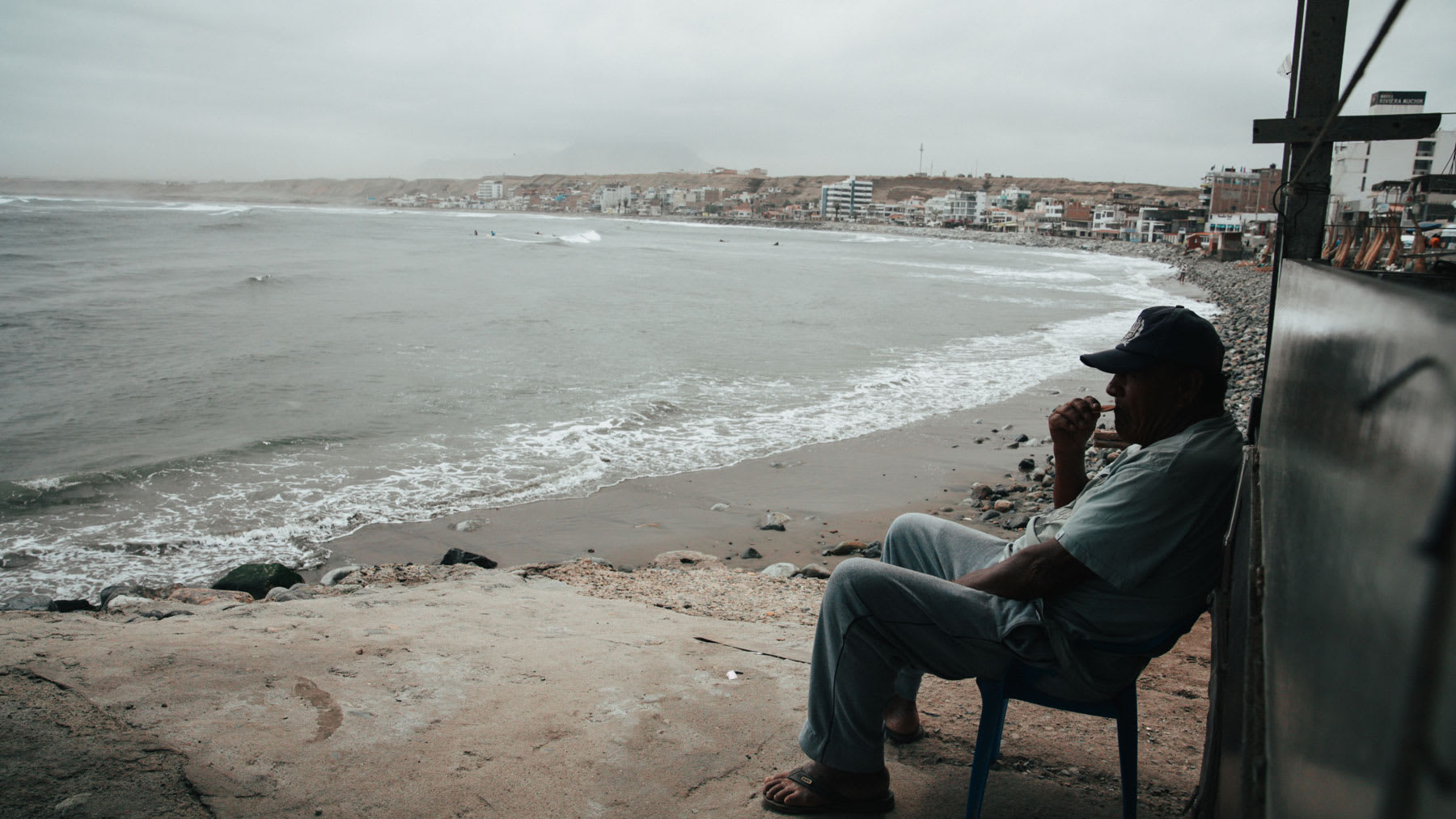
A Peruvian local watches the waves roll by in Huanchaco, Peru.
On the surface, we’re pedaling across the flats of an arid desert. Beneath our wheels, however, is archaeological site after archaeological site—some carefully preserved, others neglected and slowly disappearing into the landscape. We are cycling on history, through history, becoming part of a geography continuously reshaped by water, wind, people, and time. As you ride into Trujillo, taking a pothole-ridden road where sections of pavement have already been reclaimed by the sea, you can see how this landscape might succumb to the same forces that have slowly eaten away at Chan Chan’s adobe palaces. This is the heart of coastal Peru.
Most people arrive in search of the Peru they already know: the Andes, the Amazon, the mountains, the dramatic vistas. The coast offers none of that. It offers dirt and grime, history and heart. It wasn’t until this section of the journey—without the picture-perfect scenery—that I began to feel like an explorer. When traversing the length of South America you’re going to get the inspiring volcanoes of Ecuador, but you’re also going to get the flat desert passes of Peru. It means Cotopaxi as well as the Pacific, lush valleys and forgotten archaeological sites, battered roads and cities that don’t look anything like the Peru we imagined.
The beauty of a journey like this isn’t just found in the places that take your breath away. Sometimes it’s found in the places you were told not to get excited about. Northern Peru is flat, dusty and messy. But beneath our tyres are the ruins of one of the greatest civilizations in the world. How lucky are we to trace its rise and fall with two wheels?
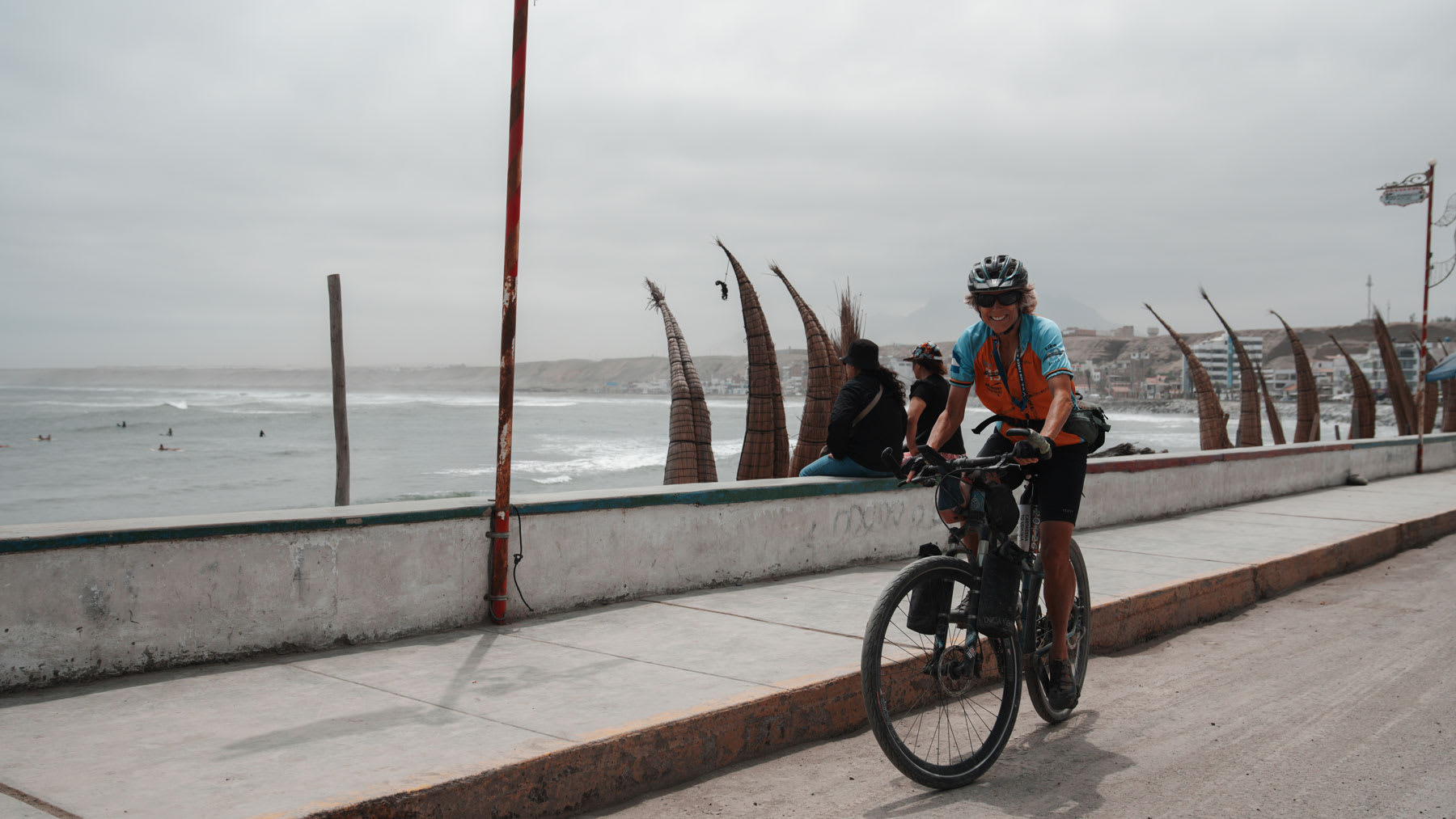
Anne Brooks rides into Huanchaco, Peru on a cloudy afternoon.
RELATED
TOUR
South American Epic
This challenging expedition offers you the best opportunity to explore the vastness and diversity of South America by bike. In keeping with the TDA...

Leave a Comment for "The Desert Coast & Ancient Cities: The South American Epic Enters Northern Peru"