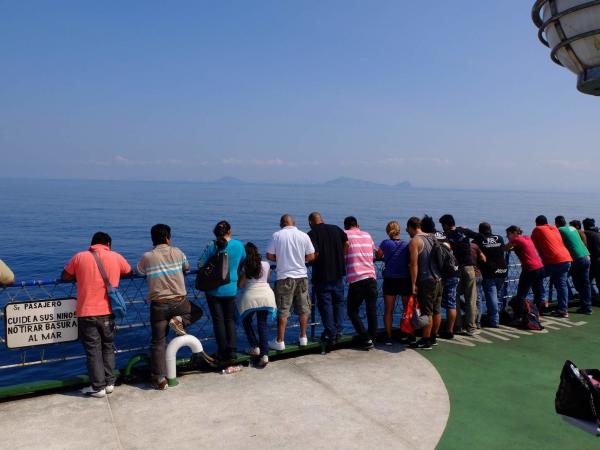
The North American Epic cycling expedition, at 14,540 km, is the longest organized bicycle tour on the planet, starting in Tuktoyaktuk on the Arctic Ocean and finishing in Panama City. Four days before the riders finished their epic ride, one of the participants stood in front of the group of fellow cyclists and asked: “How far is far?”
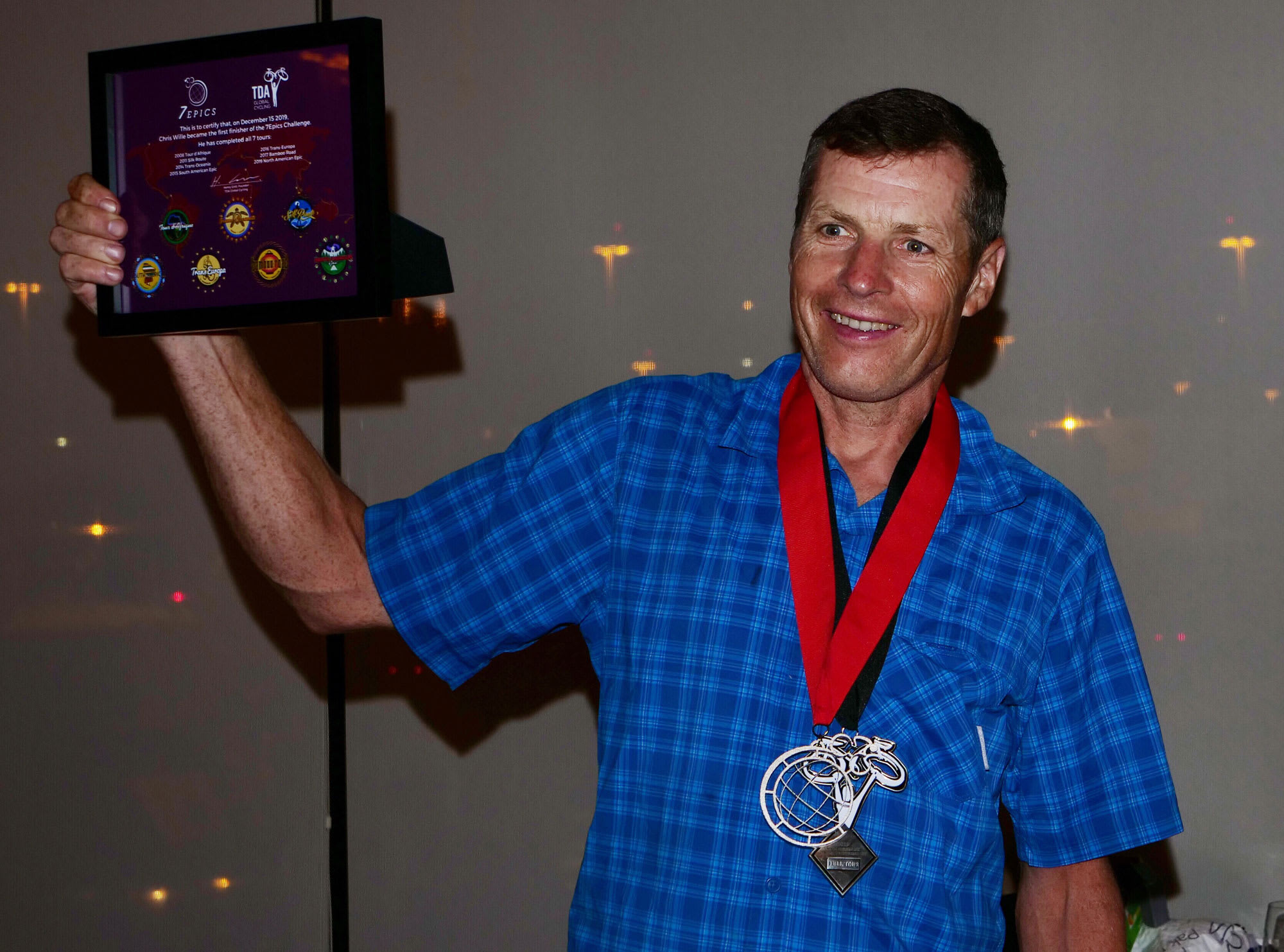
Chris Wille – First rider to complete the 7Epics
It was part of a friendly talk that described how he had arrived at this stage. How he never planned it. How in four days he would complete the 7Epics – seven transcontinental cycling tours covering six continents.
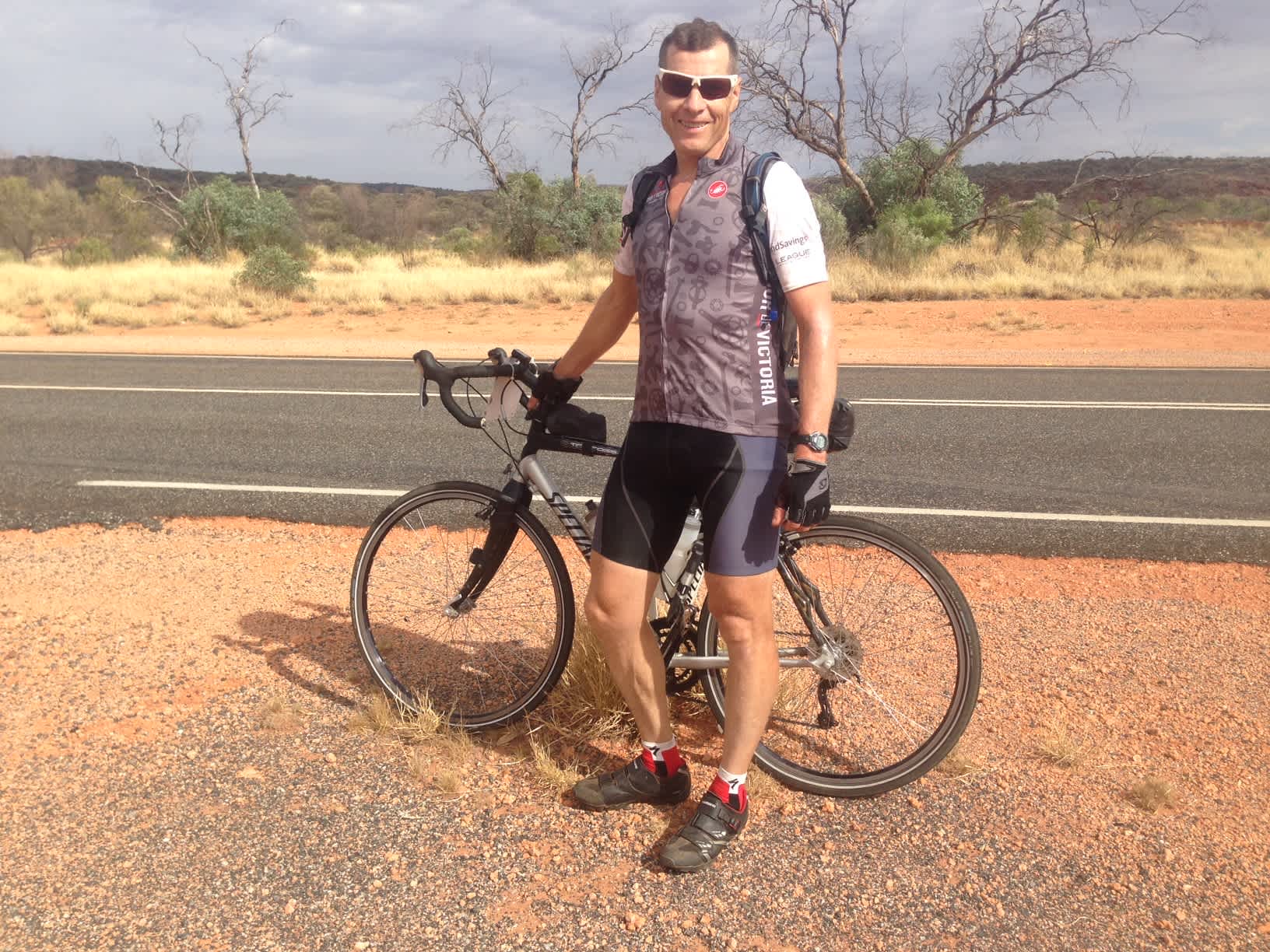
2014 Trans-Oceania (Medan to Sydney)
Several years ago, as TDA Global Cycling was expanding its stable of long distance tours across the planet, I asked myself a question – “Mountain climbers ultimate challenge was climbing the 7 summits, marathon runners like to brag about running on 7 continents, but what about cyclists?” Why not set up a concept that would capture the imagination of the ultimate cyclists? And so was born the concept of the 7Epics – 7 long cycling tours that would cross 6 continents.
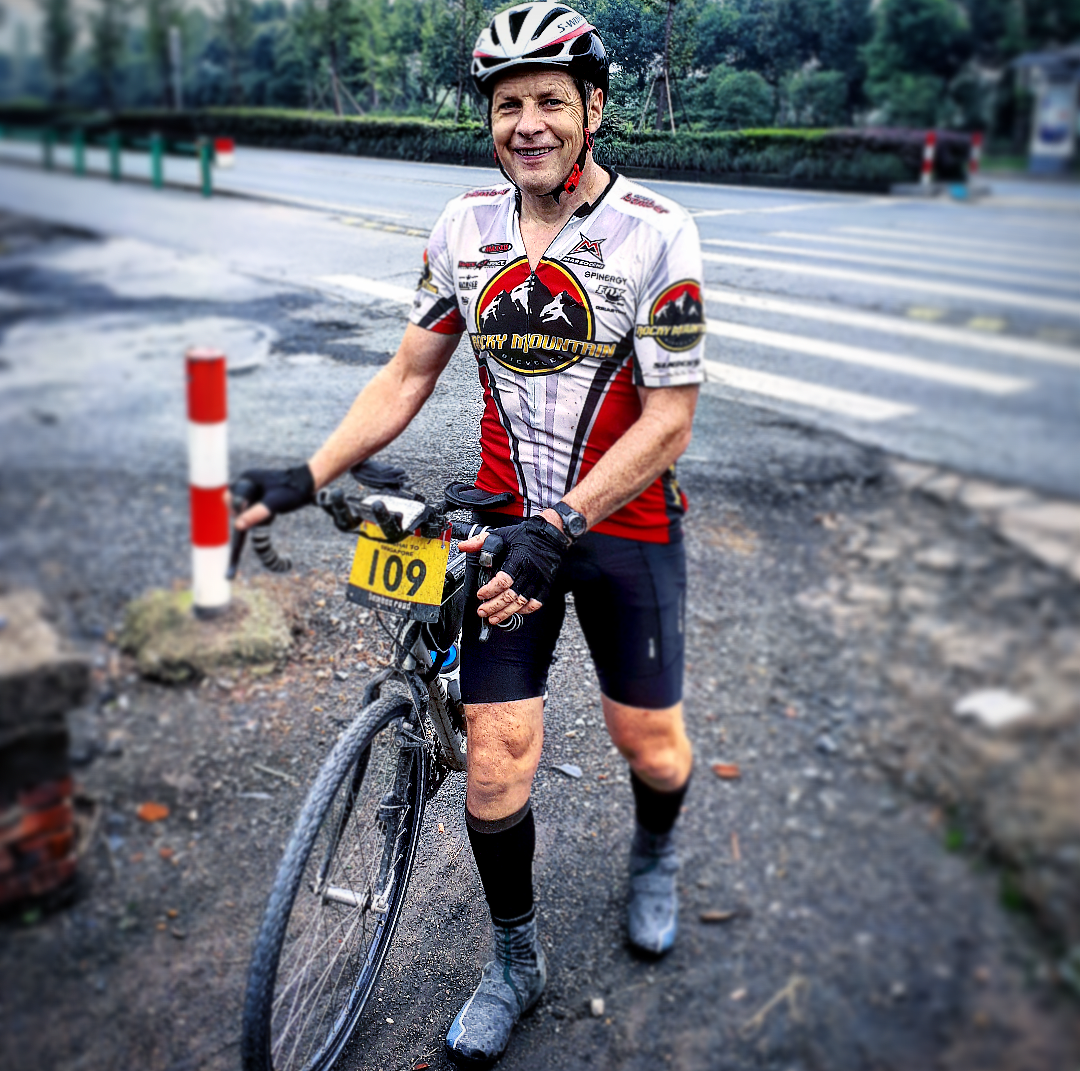
2017 Bamboo Road (Shanghai – Singapore)
At that time, our company was already offering tours across Africa, Asia, South America and Europe so it was just a question of adding a couple of more trips before issuing the challenge.
>>Related Post: Rider Profile – Chris Wille
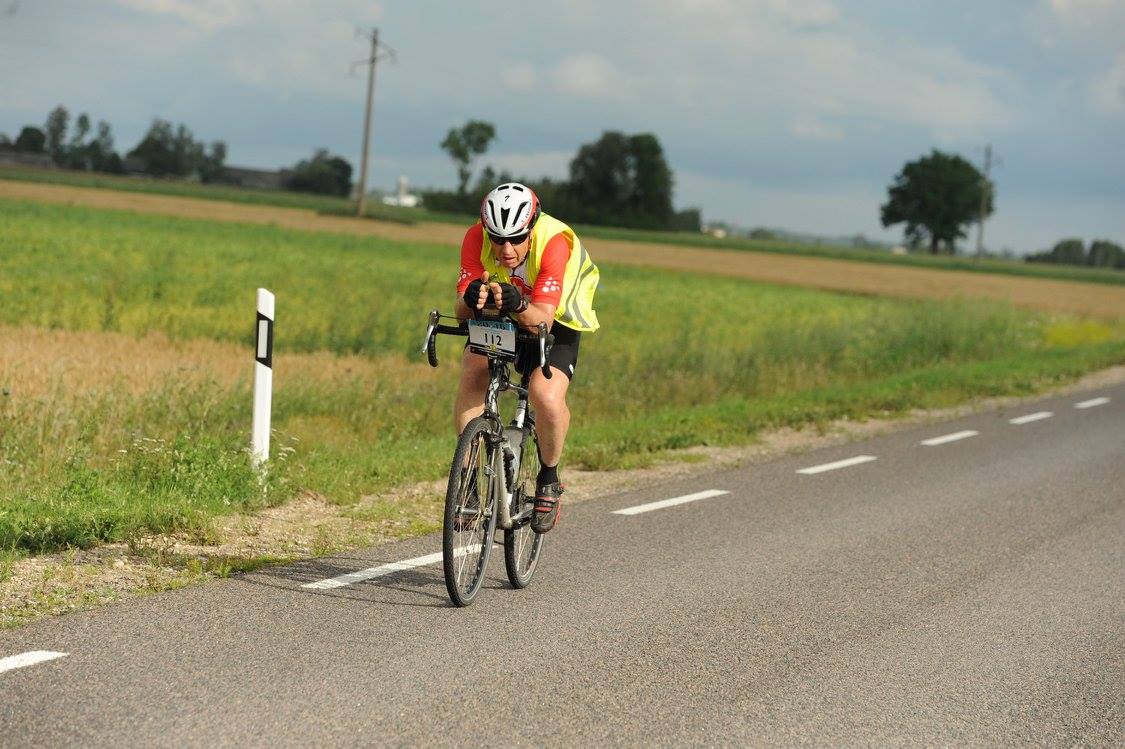
2016 Trans-Europa (St Petersburg – Lisbon)
“When I was a child,” says the man in front of the attentive cyclists, “far was that hill in the distance. Eventually when I climbed that hill, it was not far at all”. As the years went by, the man continued, “far changed with each new experience; climbing hills and mountains on Vancouver Island, running marathons, than see if I could do a triathlon.”
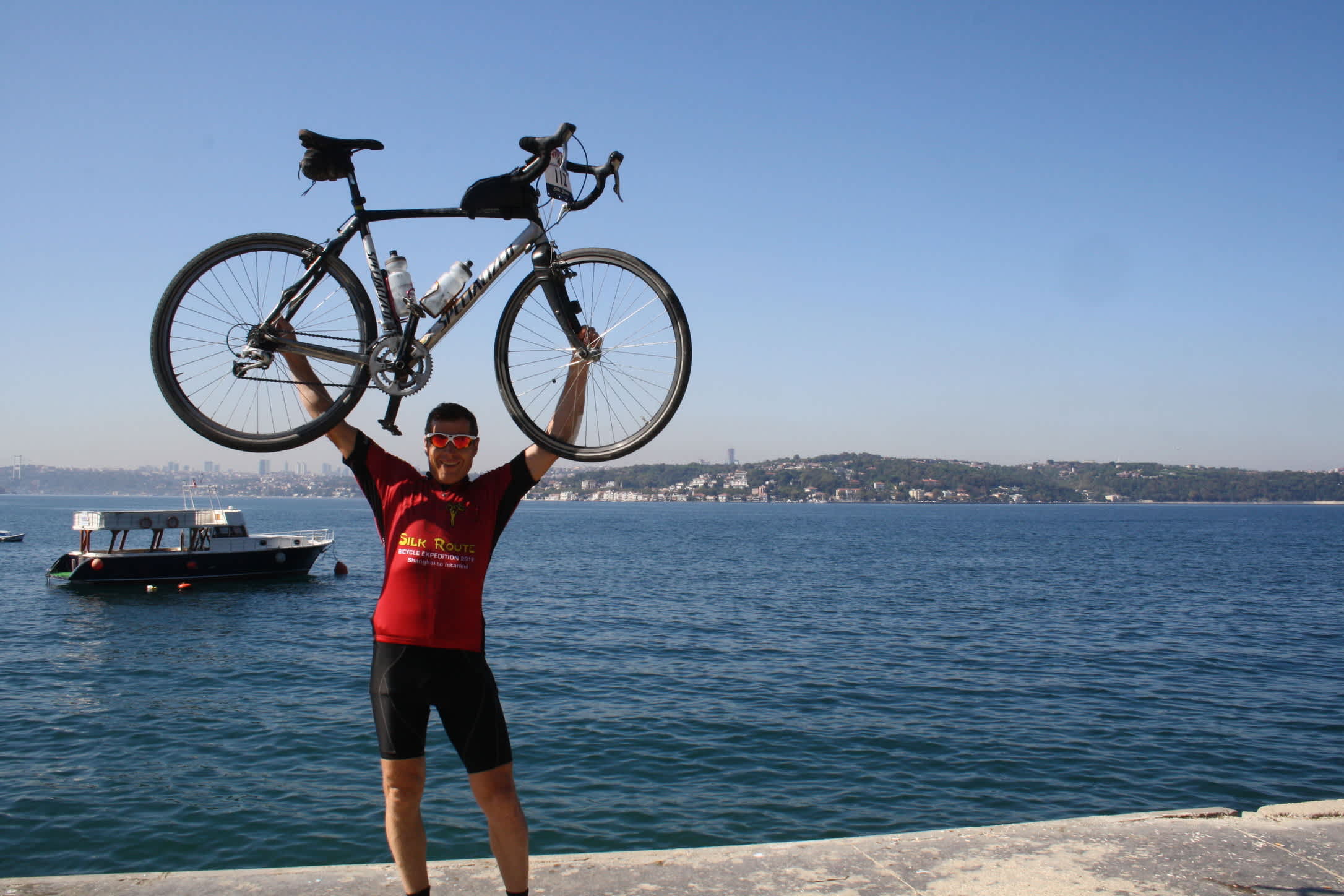
2012 Silk Route (Shanghai – Istanbul)
The fellow speaking is Chris Wille and he is from Victoria, Canada. For 30 years he and his wife ran a very stressful business while encountering a variety of difficult personal and life challenges.
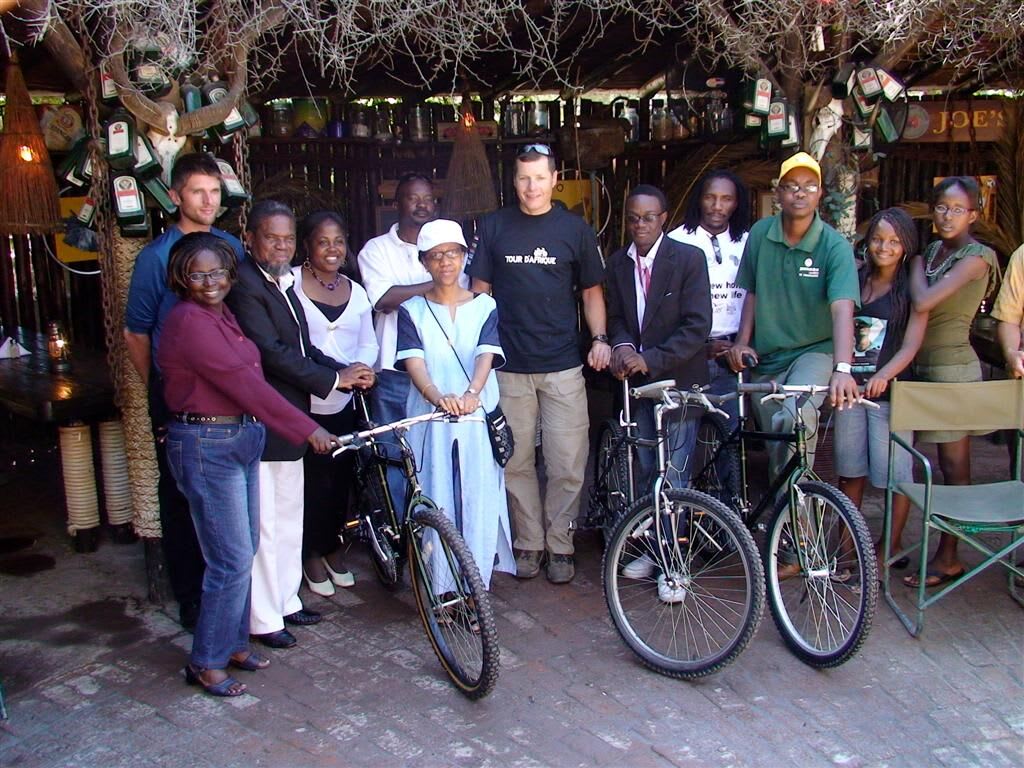
2008 Tour d’Afrique (Cairo – Cape Town)
In 2007 Chris decided that it was time again to see what is ‘far’ and signed up for the 2008 Tour d’Afrique. The event was a personal challenge but it also turned out to be a great way of learning about places of which, before the tour, he knew very little.
The experience also kick-started Chris’ interest in donating old bikes and he and his wife set up a Victoria chapter of Bikes for Humanity which has now donated several containers of bikes for Africa.

Bikes4Humanity, Victoria
When our company created the 7Epics, Chris was one of the people whose imagination was sparked, even though it may have seemed ‘far’. Chris, however, already knew from his own life experiences that ‘far’ is just a term, a word that depends on how you use it. He decided, knowing that life throws all kinds of challenges at you, it seemed a good idea to see how far he could go.
Related Post: TDA Super Alumni Profile – Chris Wille
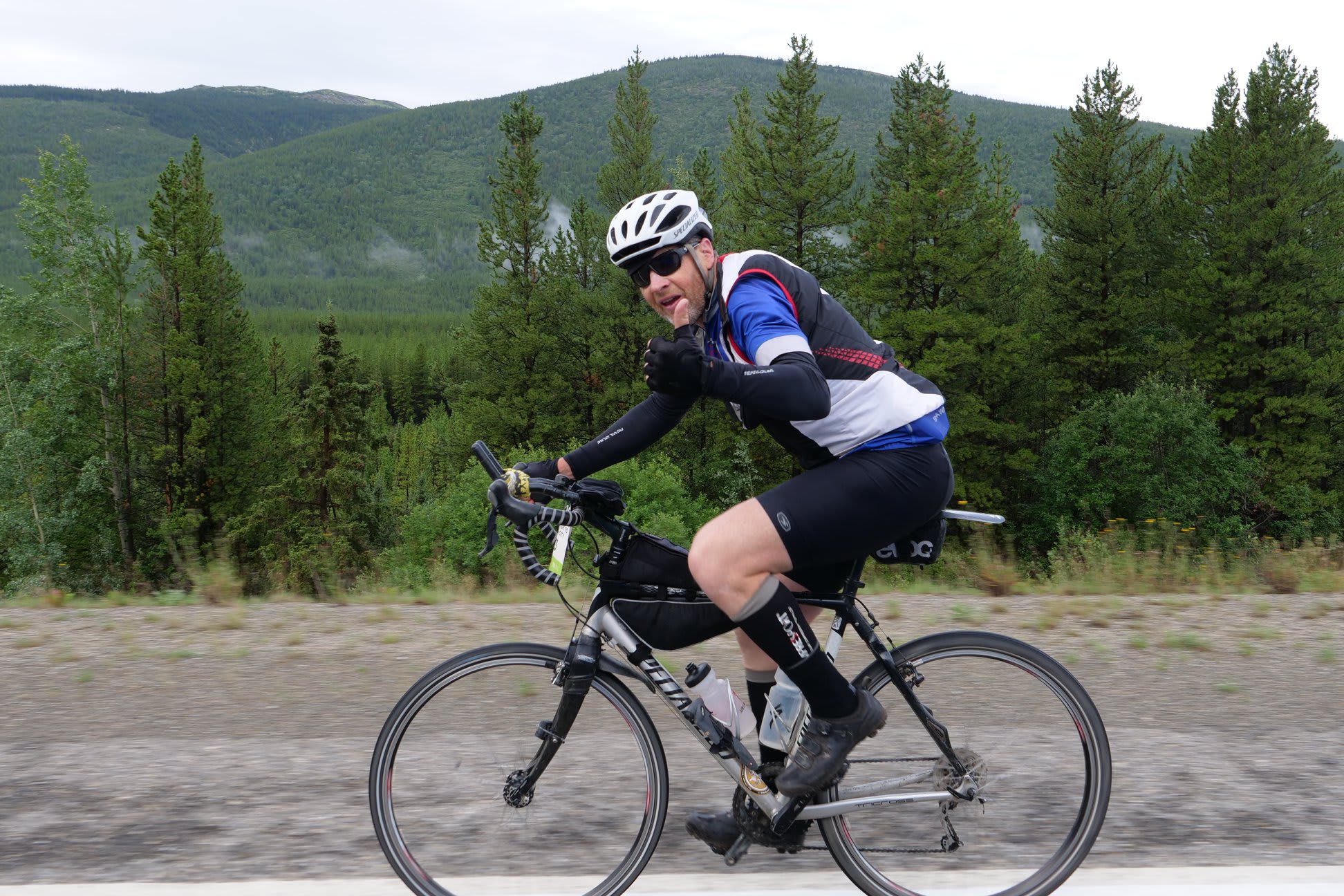
2019 North American Epic (Tuktoyaktuk – Panama City)
“And now I stand in front of you having cycled the 76,000 km total distance of the 7 Epics or almost twice the circumference of the planet at the equator.”
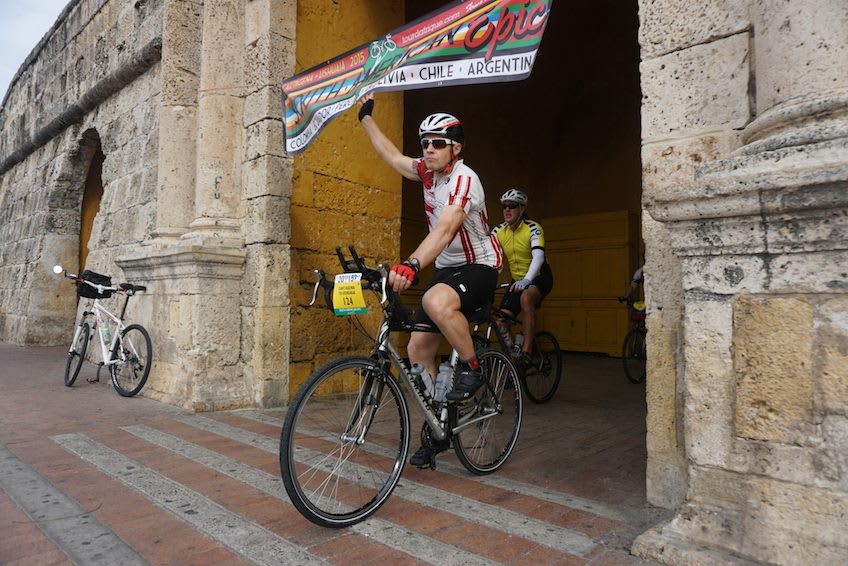
2015 South American Epic (Cartagena – Ushuaia)
How far is far? Well, according to Chris, it all depends on you: How far do you really want to go?
]]>Today, Thursday January 17th, at dawn, 33 cyclists will gather at the foot of the Pyramids in Giza and start their long journey south to Cape Town in distant South Africa. They will join a list of over 500 other cyclists from around the world who, over the past 16 years, have chosen to take on the mental and physical challenge of the Tour d’Afrique.
For many of the participants, however, their Tour d’Afrique adventure started long before today’s exciting (and chilly!) gathering under the Sphinx’s enigmatic gaze.
It’s been a dream 10 years in the making for Jérôme. For Karl, this tour was on his list ever since his solo attempt to cross Africa in 1990. For others it was simply a childhood fantasy – to cross Africa from top to bottom.
Early December was the start for some of our field staff. That was when they began to drive our support vehicles north from Cape Town through Africa (a big thanks for Stephanie, Tallis and Elisha!). Weeks later they arrived in time to help the rest of the staff make the final preparations and meet the cyclists.
For others, the start might have been when their visas were approved…
View this post on Instagram
…or perhaps it was when they were finally leaving…and packing their lives into a couple bags and a box and jetting off to Africa.
View this post on Instagram
New Orleans > New York > Cairo > lots and lots of long bike rides > Capetown
Possibly the start was really once they had landed in Cairo and faced the first of many unforeseen challenges…
…or when they stepped out into Cairo’s chaotic street life and started to realize just exactly what they had signed up for.
Follow along through Instagram using #tourdafrique or your favourite social media site. Watch our blog in the coming weeks and be sure to follow some of the rider’s personal blogs.
]]>News reports have come out with the terrible news that four independent cyclists were killed when struck by a car yesterday in Tajikistan.
We want to assure the families of our cyclists and anyone following our Silk Route cycling event that this incident was not related to our tour and all of our group are safe.
Our thoughts are with the victim’s families, and their cycling companions.
]]>I recently came across an article in the UK based newspaper, The Times, “Goodbye Hygge. Hello Sisu: the new Scandi trends” that caught my attention. A couple of years ago I wrote a blog called Understanding 7 Epics. In it I highlighted ‘Hygge‘ as one of the seven foreign concepts that reveal the reasons for, and benefits of, leaving home and embarking on a cycling expedition for one, two or even four or five months.
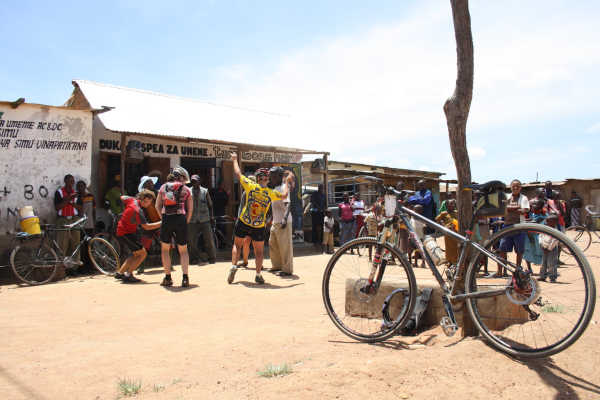
7Epics Requires Some Sisu
However the word Sisu was not one of the seven concepts I explored. Visiting Wikipedia, I quickly found out that Sisu is a Finnish word which loosely means “stoic determination, grit, bravery, resilience and hardiness“. Reading this I immediately thought; is there a better word to describe the people who have signed up for the 7 Epics?
After all if you have decided to undertake a cycling adventure that will take you to six continents, through 60 odd countries and cover 72,000 km, you certainly will need determination, grit and resilience. Wikipedia goes on to explain that “Sisu is about taking action against the odds and displaying courage and resoluteness in the face of adversity.”
>>Find Out More About The 7Epics
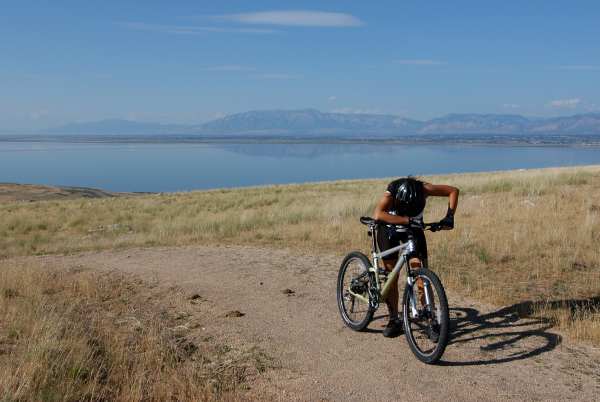
Not Just Grit, But Guts
Another literal translation of Sisu, and perhaps the one that is most important when it comes to making a decision to participate in the 7 Epics is ‘having guts’. There is no doubt that it takes guts to decide that, yes, I will do this amazing thing. I will visit six continents and countries of different sizes, cultures and religions. I will spend the time with the people I meet. I will visit their places of worship and their iconic sites. I will share a coffee or a drink with them. I will not be intimidated and influenced by what others say, be it the media, my friends and neighbours or the fear-mongering politicians. I will go, see and experience for myself what the world is all about.
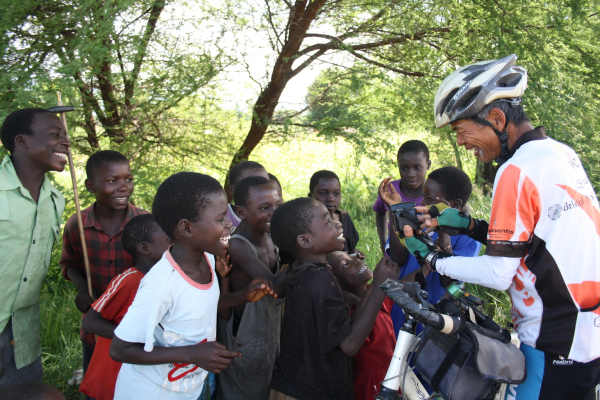
Yes, 7 Epics is a most difficult physical undertaking. However, in a world that is turning away from encouraging rapprochement between people, cultures and countries, 7 Epics is first and foremost a way for people to get to know each other. I only wish that people would realize this and have more Sisu.
]]>Bike touring in Europe – What a way to explore a country or cross a continent!
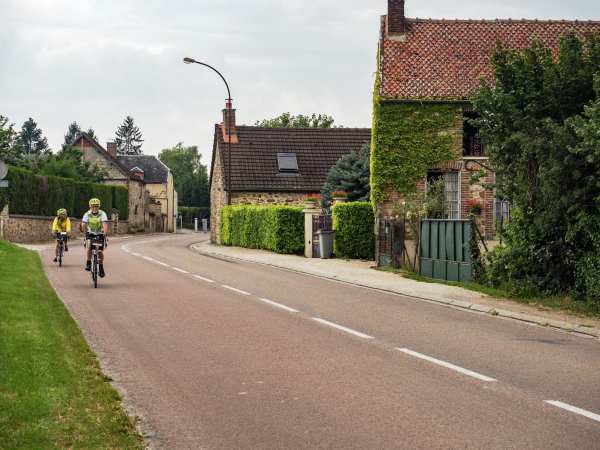
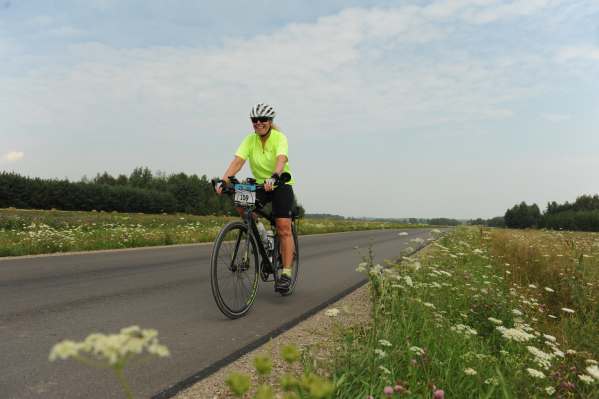
In 2018 we have two long distance routes that offer many options in the 20 countries they cross. Cycle with us for a week in Italy or Spain, or traverse the whole continent on Europe’s longest bike tour – the Trans-Europa – which covers an astounding 13 countries, and 6,000 km.
>>See the dates and details for the 2018 Trans-Europa
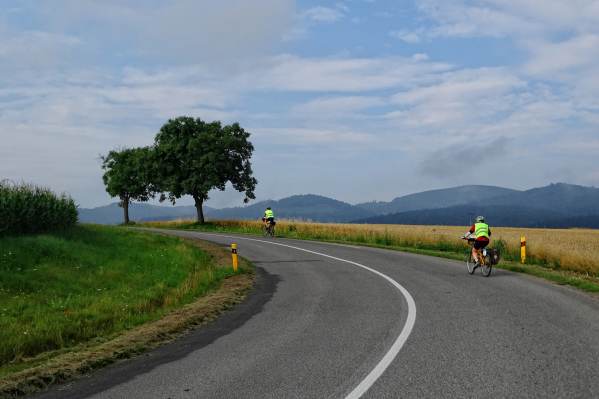
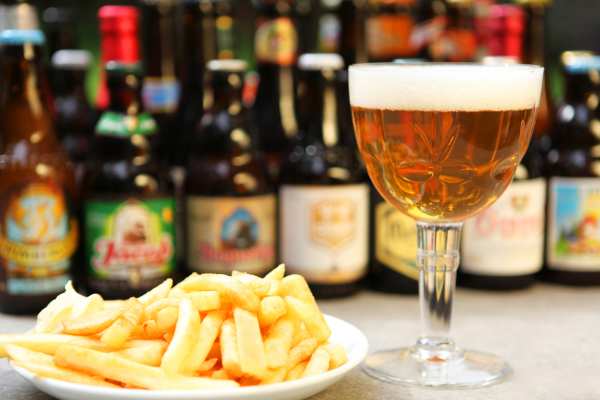
We are also offering Europe’s newest and most anticipated long distance cycling tour – the Pub Ride. It was so popular that we had to announce a second set of dates.
Conde Naste Traveler says “if copious amounts of beer, idyllic countryside, quaint villages, and some of Europe’s most happening cities sounds like a good way to spend next summer, we’d recommend signing up quick.” We couldn’t agree more!
>>See the dates and details for the Pub Ride 2
What Riders are Saying about our European Cycling Tours
“A fantastic experience crossing a continent via a route less traveled with a bunch of like minded people.” – Peter, New Zealand
“The tour was way beyond expectations and the staff were incredible. Amazing ride. The terrain changes are incredible as you cross the different countries. Stop along the way and don’t miss the cultural experiences on offer.” – Denise, Australia
>>See who is already signed up for the Trans-Europa
credit: Shaun Busuttil
“Fabulous, as ever – awesome company, magnificent cycling and delicious food from Vilma! What more can you ask for!” – Liz, UK
“I need to mention somewhere how great the tour staff were. Warm, professional, competent and genuinely nice people.” – Eric, USA
>>See who is already signed up for the Pub Ride 2
As you might know, we have a club on Strava open to anyone interested in global cycling routes. On any given day you can see leaderboards full of big rides happening on various continents around the world. Here are 6 segments that have been hotly contested by our cyclists on our tours. This is just a small sampling, as we have over 100,000 km of cycling routes in more than 80 countries around the globe.
>>Take a look at our Strava Club (open to all)
Transfăgărășan Highway on the Orient Express
This stunning switchback climb looks daunting from the bottom but is engineered to be a gentle grade most of the way up. And you are rewarded with spectacular views from the top so cyclists from our tours can be forgiven if their times don’t rank near the top 10 of a route popular with most cyclists in the region.
Along the Konkan Coast on the Hippie Trail
Some assume that because this section of our Hippie Trail tour is along the coast that it will be flat – far from it. This Strava segment is a good example of the many short steep climbs along the beautiful coast alongside the Arabian Sea as the road dives down towards the water and then turn up again into the hills above.
The Gorge on the Tour d’Afrique
This is a legendary climb on a legendary tour. So prominent are these 18 km that the entire 15 day section is named after it. And note that Mark Beaumont also ranks in the top 5 – not even the man who just cycled the world in 80 days could match some of our riders!
Akbaital Pass on the Silk Route
This grueling 6.6 km segment tops out at 4,661m elevation. It’s deep in the heart of the Pamir Mountains on the way to the outpost of Murghab on the Pamir Highway section of our cycling tour. This route has been traversed by group and solo cyclists alike for many years, but the altitude, remoteness, and lack of supplies means it requires a lot of planning in advance.
Crown Range Summit at the end of Trans-Oceania
There is no easy finish on the way into Queenstown – the final stop on the Trans-Oceania. The last day includes one final climb up to the Crown Range Summit before they get to relax after their mammoth 4 month cycle journey across Australia and New Zealand. Luckily, the riders are rewarded with an exciting 11km switchback descent. Our cyclists are among over 1600 that have attempted this popular segment.
Andes Ascent on the Way to Cuzco on the South American Epic
Between Nazca to Cuzco the cyclists climb alot! They ride high up into the Andes and don’t come down again for quite some time. This segment is one of many tough climbs, and with each pedal stroke high the altitude affects everyone more, the temperatures begin to drop and road conditions deteriorate – pure pleasure, right?
>>Join TDA Global Cycling’s Strava Club (open to all)
What Did we Miss?
Members of our Strava Club as well as many of our former riders have completed segments all over the globe, so we would love to hear what those favourites are, and which ones deserve to be added to this list above. These don’t have to be on the route of our tours – any route anywhere in the world that you love.
Leave us a comment below and tell us your favourite segment…
]]>
Salar de Uyuni – the Salt Flats of Bolivia. At 10,582 square kilometres, it is the largest Salt Flat in the world. This is quite likely one of the toughest sections on what is the world’s longest supported cycling tour – our one and only South American Epic. From the Bolivian city of La Paz you will cycle across the Altiplano, which despite being challenging (high winds and intense UV sun during the day combined with frigid cold nights), is also surprisingly beautiful. Long, straight roads are flanked by mountains, making for some incredible sunsets and gorgeous bush camps. Then we enter the Salt Flats.
RELATED
TOUR
South American Epic
This challenging expedition offers you the best opportunity to explore the vastness and diversity of South America by bike. In keeping with the TDA...
Here’s how it was described by our communications director last year:
“Vast and snow-white, it explodes into a wide open sea of salt for as far as the eye can see, making for a surreal surface to ride a bike on. Aymara legend has it that Tunupa Volcano married nearby Kusku, who eventually ran away with Kusina. Grieving Tunupa started to cry while breast-feeding her son, her tears mixing with the milk and spilling out onto the dried up lake to form the salt flat.” Read more here.
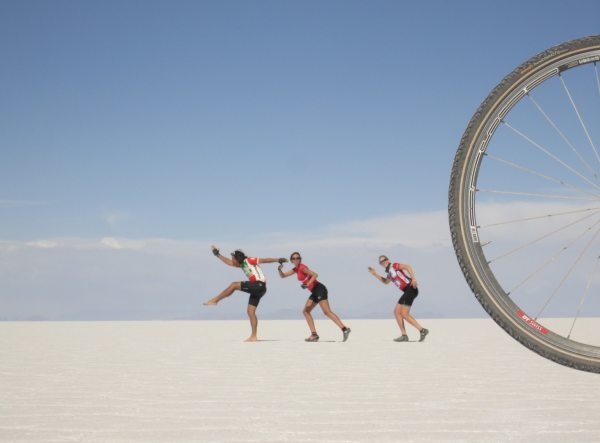
A rest day in Uyuni will allow the cyclists to explore the Salar or, if they wish, the ‘Great Train Graveyard.’ Then it’s time to leave the Salt Flats and head for Argentina. But that only happens after two of the most challenging stages on the tour – challenging climbs, wind, cold nights and misty mornings and rough and deteriorating roads. As a reward for pushing through the last few days, the riders will drop down from the harsh Bolivian plateau and enjoy more moderate temperatures and delicious Argentinian wine and cuisine.
Here is a daily description that includes distances, climbing and descending totals.
Cycling the Salt Flats: Day by Day
October 4 – La Paz to Patacamaya
104 km
⬆️ 1350 m, ⬇️️️ 1210 m
We make our first pedal strokes leaving the hostel in La Paz. Our adventure starts with a ride out of La Paz in the early morning to beat the traffic. Your first challenge will be the first 13 km out of the city which is all uphill.
October 5 – Patacamaya to Oruro
115 km
⬆️ 700 m, ⬇️ 790 m
This pleasant, scenic ride amongst rolling green hills dotted with several villages will make you feel like the adventure has really begun as you cycle further and further away from civilization. Basic camping tonight with temperatures dropping significantly as the sun goes down.
October 6, Day 4 – Oruro to Challapata
132 km
⬆️ 530 m, ⬇️ 530 m
Limited climbing today after starting from the busy town of Oruro and then camping near the Challapata railway station.
October 7, Day 5 – Challapata to Meteor Crater
106 km
⬆️ 980 m, ⬇️ 980 m
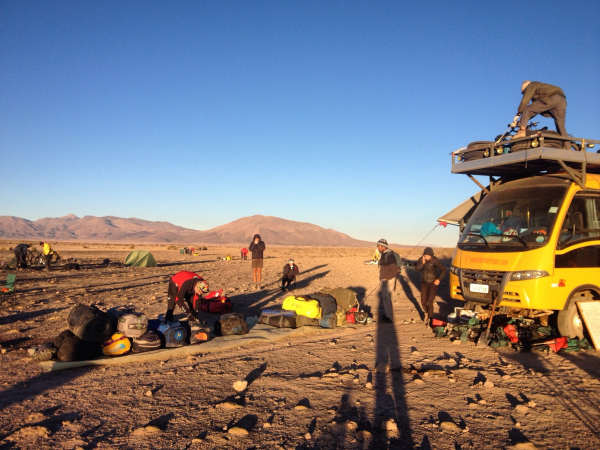
There’s a good chance as you are cycling today you will spot Andean flamingoes, llamas and other wildlife. The stage is mostly paved, except the final 15 km as we approach the salt flats. You will not see pavement again for quite awhile. The campsite is next to a meteor crater.
October 8, Day 6 – Meteor Crater to Conqueza
77 km
⬆️ 590 m, ⬇️ 650 m
A nice change of scenery today as we enter the salt flats, with great views of Tupuna Volcano all day long.
October 9, Day 7 – Conqueza to Uyuni
135 km
⬆️ 675 m, ⬇️ 660 m
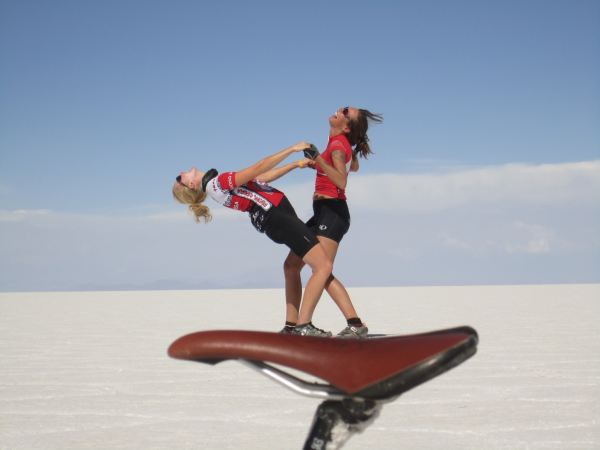
Deep in the salt flats, the navigation becomes challenging with your depth perception playing tricks on you. Stick to the tracks left by vehicles and heed the advice of your tour leader. Tonight we stay in a cozy hotel in the town of Uyuni.
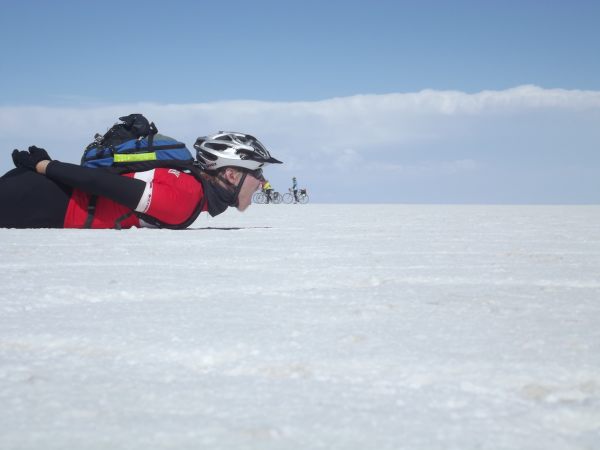
October 10, Day 8 – Rest Day Uyuni
We have a non-cycling day in Uyuni. This is your last night in a hotel bed for a few nights so enjoy it. Take time to explore The Great Train Graveyard. Atlas Obscura describes the scene – ‘On the outskirts of a desert trading village high on the Andean plain, steel giants have been destroyed by salt winds’.
October 11, Day 9 – Uyuni to Atocha
101 km
⬆️ 560 m, ⬇️ 490 m
Things start to get increasingly challenging for the second half of this adventure. Expect strong head winds, icy early morning temperatures, and deteriorating road conditions. It would be fair to describe the conditions as harsh for today and tomorrow. Camping tonight at a local school.
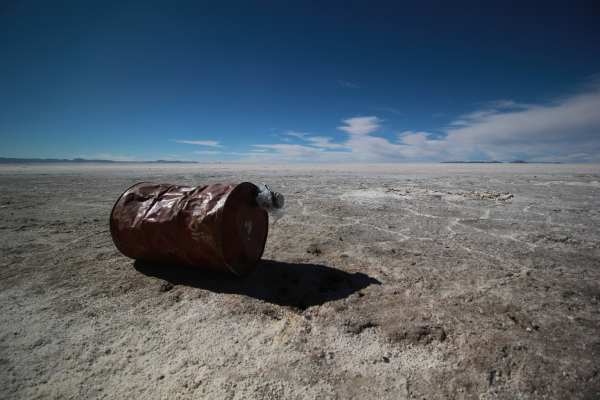
October 12, Day 10 – Atocha to Salo
81 km
⬆️ 1960 m, ⬇️ 2490 m
This will prove to be one of the toughest stages on the adventure. Over 81 km you will climb almost 2000 m on challenging, unpaved dirt roads. These are the stages you will remember. This is where the adventure gets real. Great views of Cerro Choroluque Volcano today.
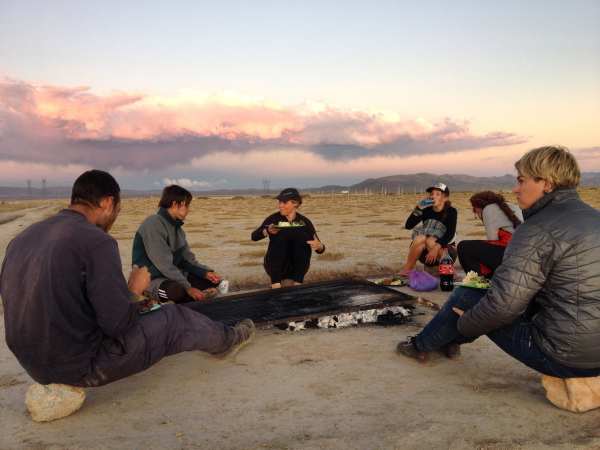
October 13, Day 11 – Salo to La Quiaca
118 km
⬆️ 1560 m, ⬇️ 1315 m
This will be another challenging stage, with a lot of climbing. We cross into Argentina today and get to treat ourselves to a shower and a room at a small hotel. It’s clean and has wifi and a bar – everything a cyclist dreams of after a gruelling couple days in the SaltFlats.
October 14, Day 12 – La Quiaca to Humahuaca
154 km
⬆️ 950 m, ⬇️ 1300 m
We really start to feel things changing….
“Cold Bolivian Andes melted into meandering rivers, twisting through red rocky corridors. The geography of Argentina was equally rivaled by its culture and cuisine. The distinct European influence of Argentina was pleasantly obvious as soon as we passed through the small frontier town of Chocaya.” Read more.
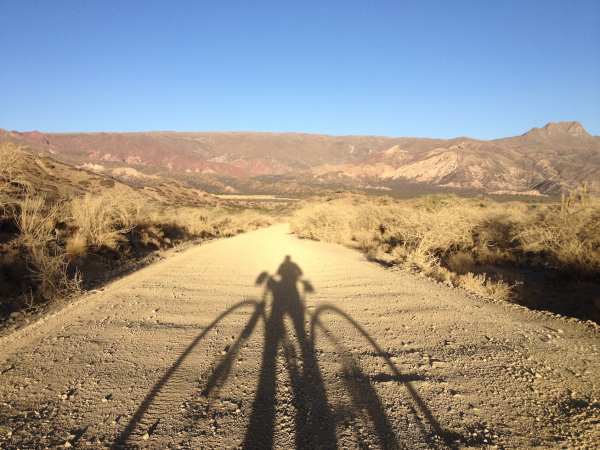
October 15, Day 13 – Humahuaca to Yala
114 km
⬆️ 500 m, ⬇️ 1990 m
Argentina is world renowned for its wine and, because of the prevalence of European ancestry in the region, good cheese, fresh baked bread, olives and espresso are all readily available. For a group of riders who spent the last several days in the harsh climate on the Altiplano, these small luxuries go a long way.
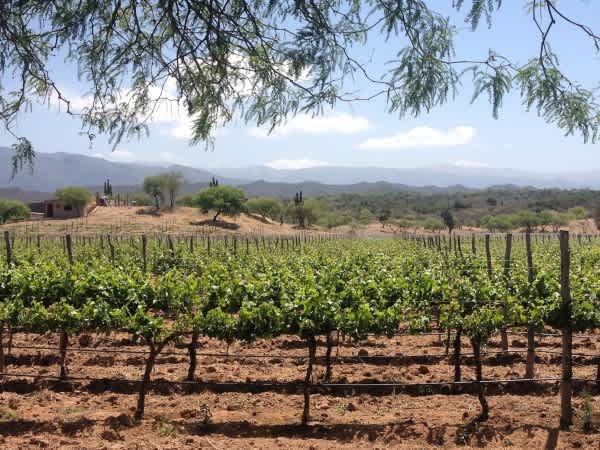
October 16, Day 14 – Yala to Salta
114 km
⬆️ 1315 m, ⬇️ 1590 m
As we make our way from the border to the city of Salta, the small, sinuous highways are lined with vineyards, stretching for kilometres to the foothills to the Andes Mountains. On arrival to Salta we can rest and refresh ourselves for two nights in a hotel.
Cycling the Salt Flats is certainly one of the most unique, challenging and rewarding sections of the South American Epic. We hope you can join us and experience all it has to offer from the seat of your bicycle.
]]>
Last Friday in our monthly newsletter we announced the release of the second in our series Cycling the Silk Route – a 9-part YouTube series. During each of the coming months, we will be releasing one episode each month. The best way to make sure you don’t miss it is to sign up to our monthly newsletter where the official release happens.
>>Sign up for our monthly newsletter
Part 2: Ulan Bator to Gorno Altaysk
On the section known as the Mongol Empire, riders soon leave any trace of urban life behind as they pedal west into the Mongol steppe and eventually into the more mountainous Russian Altai Republic and its capital Gorno-Altaysk. This is the Mongolia many people imagine; vast rolling steppes, coated in green, dotted with traditional yurts surrounded by nomadic livestock and back-dropped by snow-capped mountains. The cycling will be tough but immensely rewarding. Nights will be spent tenting under the immense open skies and days churning through the gorgeous countryside.
]]>>>More about Cycling the Salt Flats on the 2017 South American Epic
The Bolivian Salt Flats are one of the iconic cycling environs that many cycle travelers have on their bucket list. Where else in the world can you cycle with your eyes closes kilometer after kilometer and not fear running into anything. Where else can your depth perception play such wild tricks on you?
We collected a few of our best (strangest?) photos from the Salt Flats and mixed in some words from other cycle travelers who have crossed this salty land. Enjoy…
What cycle travelers say about the Salt Flats
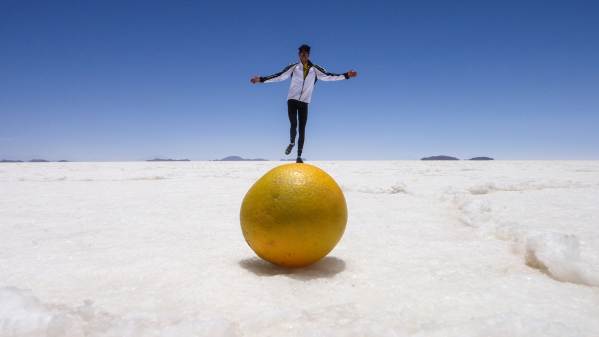
From Antonio Cala of the The Adventure Junkies blog…
“once you hit the salt flats everything seems worth it. You instantly forget those hours pushing your bike and start enjoying this very unique experience… There’s hardly any references on the horizon and being surrounded by salt in every direction for kilometers is quite impressive.
There are some paths made by the jeeps you can take, but you also have the freedom to cycle in any direction. You could even cycle with your eyes closed for hours without crashing into anything! After cycling dirt roads, dodging rocks and sand patches to get here, the salar’s hard, flat surface is a dream.”
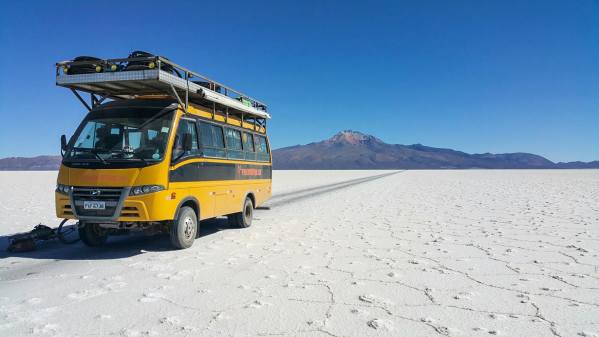
From Cass Gilbert on Bikepacking.com…
“For as almost as long as I can recall, traversing Bolivia’s salt flats had been a bike touring dream, sparked by images I once saw of a tribe of bearded, rag tag bike travellers pedalling across its open, featureless breadth. Two decades later, when I embarked on a mission to cycle across the length of the Americas, experiencing the Salar was the motivating factor that kept me going.”
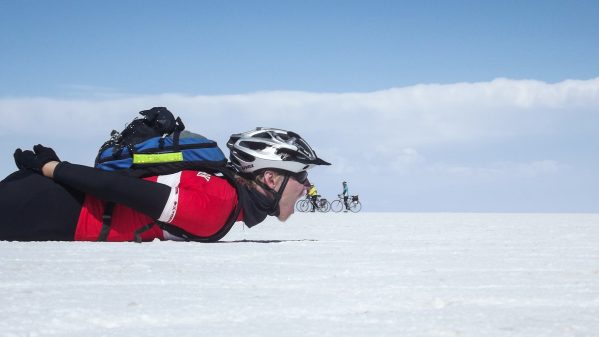
From Tore Groenne on the Adventure Cycling Association‘s blog…
“The wind was frigid. Soon the salt turned golden in the setting sun and fluffy, violet clouds drifted on the sky above Vólcan Tunupa.Out here are some of the largest day-to-night temperature fluctuations anywhere on the planet. While days can be scorching hot with temperatures of 90 degrees Fahrenheit and no refuge from a burning sun, the nights can be as cold as negative 40 with the wind chill.”
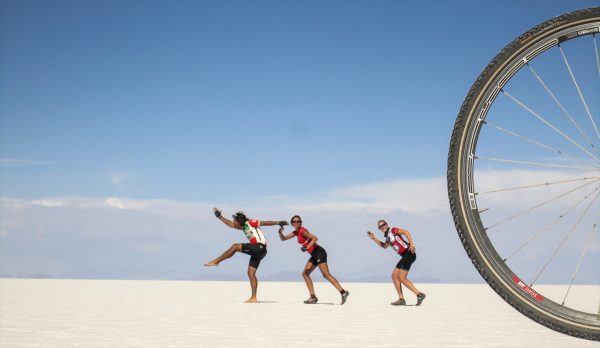
From The Wandering Nomads blog…
“Camping was by far the best part about the Salar. It was such a unique and isolated place to camp, where it’s just you, your tent, and a whole lot of stars! And salt. Of course, we can’t forget the salt.”
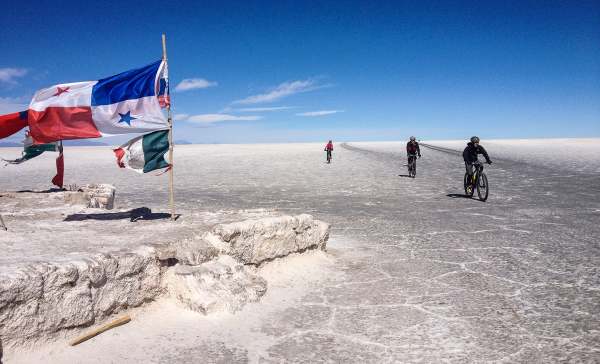
From The Long Haul Trekkers blog…
“the vastness of the Salar de Uyuni is unreal. Unless mountains rise above the horizon, perfectly-shaped hexagons span as far as the eye can see…Traversing the Salar de Uyuni on two wheels, the cyclist can ride with her eyes closed without fear of bumping into anything or going off course. With hardly a soul in sight, we could pedal anywhere we pleased. Our wheels crunched over the terrifically flat path for hours, the only barrier being the wind.”
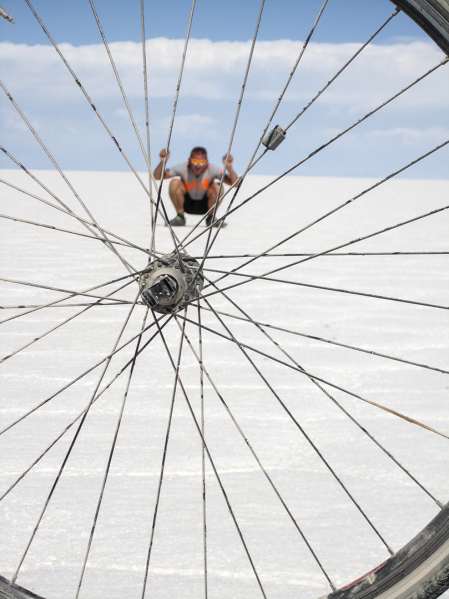
From our South American Epic blog…
“To make things even more bizarre, a flock of Andean flamingos landed just beyond the group’s tents to feed on the unique algae formation. Yeah, as in pink exotic flamingos.”
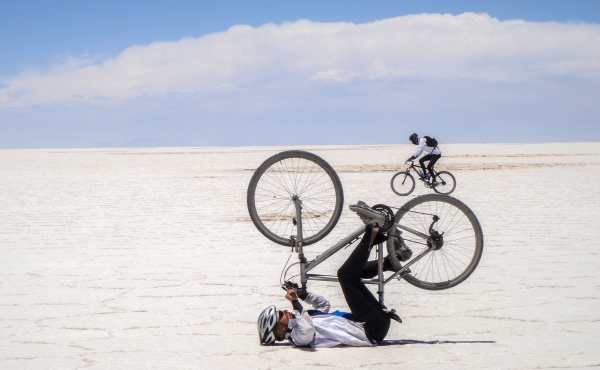
>>More about Cycling the Salt Flats on the 2017 South American Epic
]]>Feature photo credit: Antonio Olinto Ferreira
Over the past 10-20 years, as cycle touring’s popularity has taken off, so too have the numbers of long distance adventurers who have set their sights on South America. With most countries on this vast continent having transitioned from military dictatorships to democracy and freedom, South America offers a refuge from the insecurity or overcrowding that characterize much of the world today.
>>Learn more about our supported cycling tour across South America
Stretching from top to tip, the Andes Mountains form the continents backbone and provide the backdrop for the routes taken by most trans-continental travellers on two wheels. En route along the roughly 13500 km from Colombia to Tierra del Fuego, or just a portion of this most ambitious of itineraries, one will inevitably encounter some mind-blowing climbs and descents. Here are 8 of the most epic:
1. Bolivian Death Road
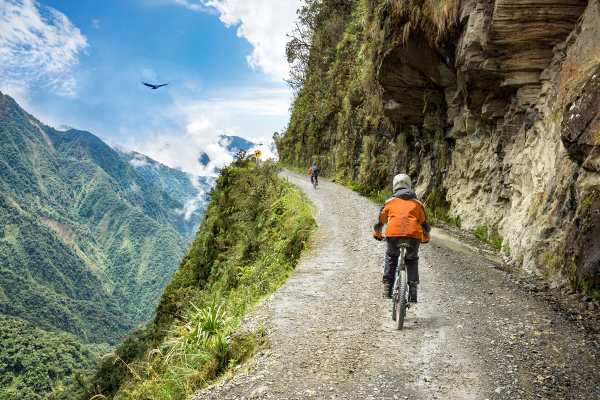
Legendary as the world’s most dangerous road until a paved alternative was completed in 2006, “El Camino de la Muerte” attracts thousands of thrill seeking mountain bikers annually. Starting outside the Bolivian capital of La Paz at La Cumbre Pass and a lofty 4650 meters (15250 feet) elevation, this now widened and relatively safer mostly dirt road drops almost 3500 meters (11500 feet), from the Andes to the Yungas rainforest far below, in 63 hair raising kilometers. In the past, countless lives were lost every year when vehicles (particularly busses) went careening over the edges of the 3,000-foot cliffs that line the road. Sadly some 25 cyclists have met the same fate. For the fainter of heart and saner of mind, Gravity Bolivia offers professionally guided daily descents, and advises that the road is best not tackled during the mid-December to early March rainy season when downpours, fog, washouts and other pitfalls are encountered.
2. Alto de Letras, Colombia
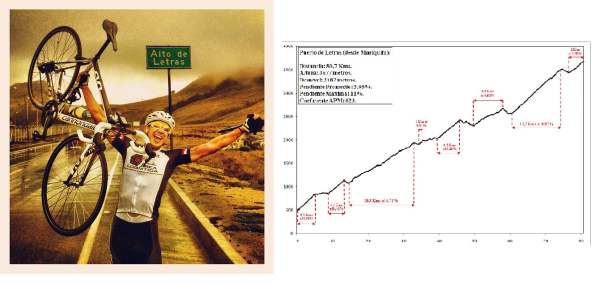
photo of celebrating cyclists by Alejandro Jimenez / Instagram @goandride
Ever wonder how Colombian riders like Nairo Quintana have joined the ranks of the world’s elite cyclists? All you need do is stare at a topographic map of their backyard. Alto de Letras is renowned for being the hardest cycling climb in Colombia – it’s included in the Vuelta a Colombia and is one of the longest paved ascents in the world. Starting in the small town of Mariquita it rises almost 3200 meters (10500 feet) over 80 km to the Páramo de Letras pass. Don’t be fooled by the average gradient of 4%, much of the ascent is 6-9%, with stretches of 10%+, but there is a short downhill every few kms when you can catch your breath and wonder what the hell am I doing …
3. Departing Nazca Bound for Cusco, Peru
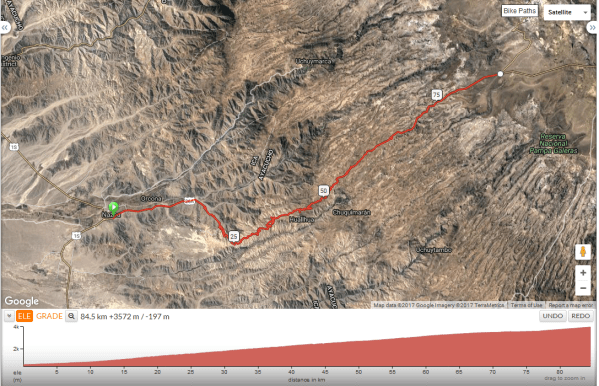
Two of Peru’s greatest attractions are the Nazca Lines, and the city of Cusco, former capital of the Inca Empire and the gateway to Machu Picchu. Both are must do’s on any trans South America cyclist’s bucket list. If you’re peddling out of the town of Nazca, the Andes loom ahead, and over the next 85-90 kms you face a daunting climb from the lowlands to the rarified air of 4000 meters above sea level. Those who have been along the Peruvian coast, or in the Nazca valleys for a while, must take this stretch slowly and carefully to ensure acclimatization and avoid altitude sickness. Of course, if you’re spinning in the opposite direction, it’s a seemingly endless downhill …
4. Trampoline of Death, Colombia
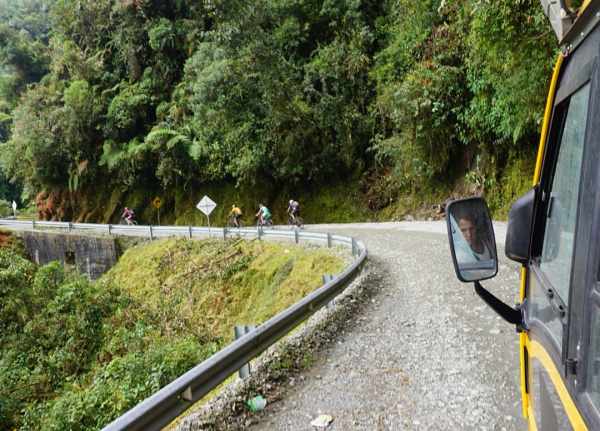
This ominous moniker has been given to the gravel road that connects the departments of Putumayo and Narino. On a brighter note intrepid cyclists also consider it to be one of Colombia’s most beautiful routes. Predictably the journey is both dangerous and breathtaking, due to the steep climbs and frequent landslides, as the road winds rapidly upwards through jungle to cloud forest, past mist-shrouded waterfalls, and ultimately onto the páramo.
>>Related: Cycling the Trampoline of Death
5. Aconcagua, Argentina/Chile
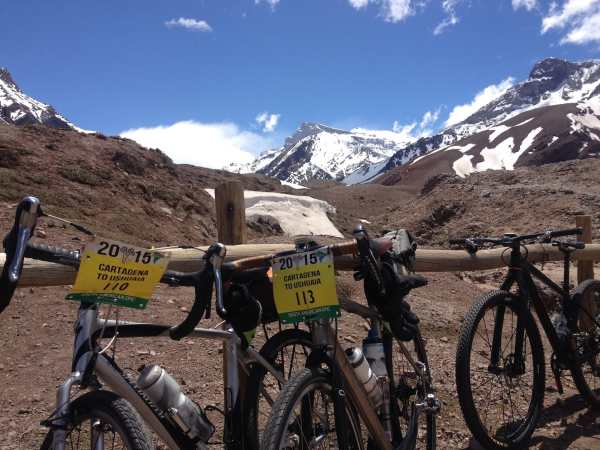
The largest border crossing between Argentina and Chile is located a mere 20 km from the summit of Aconcagua, the tallest peak in the Andes range at 6960 meters (22830 feet). Starting on the Argentinian side in the village of Uspallata you’ll gradually ascend 1200 meters on tarmac to the frontier at Las Cuevas, where most cycle tourists spend the night, before cruising down the Chilean side on a spectacular 2350 meter descent with 29 switchbacks into the town of Los Andes. Try to pick a day when clear skies are forecast so you can catch a glimpse of almighty Aconcagua at km 72. The drawbacks are this is a busy highway with several tunnels and unpredictable winds and weather, so warm reflective clothing and lights are a must, plus you’ll have to catch a ride through the Tunnel Cristo Redentor at the border which cyclists are not permitted to use.
6. Volcano Alley, Ecuador
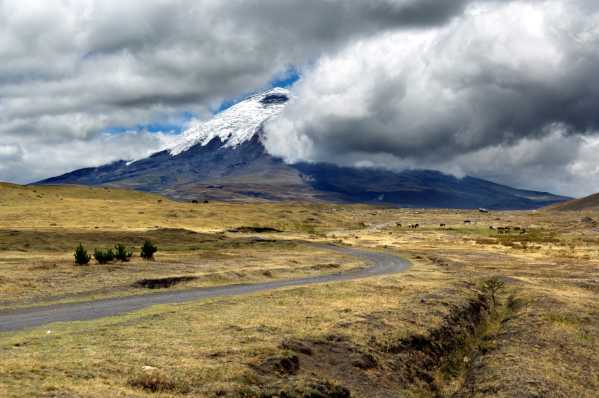
Volcano Alley refers to a 300 km/180 mile stretch of the Ecuadorian Andes near the capital city of Quito that includes all of the country’s highest mountains. Riding the 90 kms southbound from Quito to Latacunga will take you past Cotopaxi, the most infamous in this chain of active and foreboding volcanoes. While this portion only involves 1750 meters of climbing and descent, you’ll be challenged by the altitude of 2500-3500 meters and wowed by the vistas, presuming Illapa, the Inca god of weather, is with you.
7. Abra el Acay, Argentina
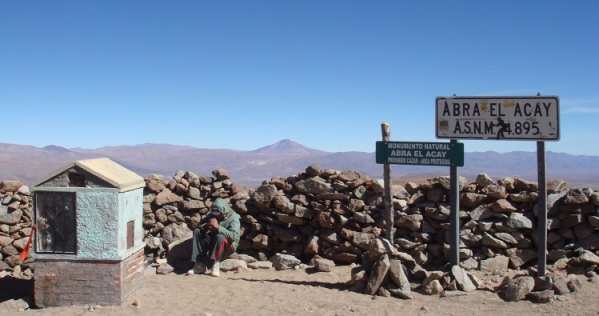
photo credit: DiverDave Wikimedia Commons (cc by-sa 3.0)
In 2000-01 Brasilian Antonio Olinto Ferreira undertook a 3000 km 2 month trek, the 7 Passos Andinos, tackling some of the gnarliest and remote mountain passes in and between northern Chile and Argentina. These included the Abra el Acay, in La Poma department, Salta Province, which, at 4895 meters, is the highest pass on Argentina’s fabled Ruta 40, and the highest navigable by vehicle pass in South America. You can watch his spirit-filled documentary capturing the mind boggling scenery he traversed, the cultures he encountered, and the hardships he overcame, here.
8. Reserva Nacional Cerro Castillo, Chile
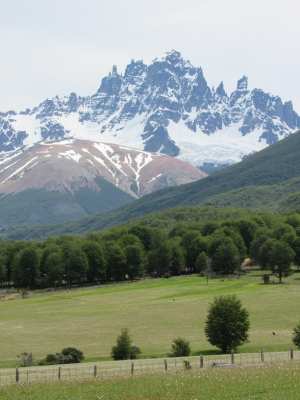 Not all cycle tourists relish massive climbs or riding at high altitude. With them in mind we include the southbound descent into or northbound climb out of the hamlet of Villa Cerro Castillo. Located 100 km south of the small city of Coyhaique and close to the midway point of the iconic Carretera Austral, you’ll be awed by the views of castle shaped Cerro Castillo mountain, as you zoom down or grind up 440 meters of elevation change over a 6 km stretch.
>>Related: Cycling Patagonia: Everything You Need to Know
Further Resources and Citations
http://www.olinto.com.br/
http://www.dangerousroads.org/bolivia/44-death-road-bolivia.html
http://theclimbingcyclist.com/
http://seecolombia.travel/
Brian Hoeniger works for TDA Global Cycling. You will find some of these climbs and descents on our South American Epic, the only organized cycling expedition to traverse the continent from top to bottom.
]]>To travel the Silk Road has been an arduous journey since its earliest beginnings. In distant times a few of the biggest obstacles were…
- Banditry
- The possibility of warring groups
- The lack of any roads or paths
- The scarcity of food and water
- Crossing inhospitable terrain such as the high mountains and long desert stretches
While travelers on the ancient Silk Road did have to negotiate their way into each new foreign land at times, or gain permissions from local rulers, they were spared one modern day challenge. Applying for multiple country visas before their departure and on route.
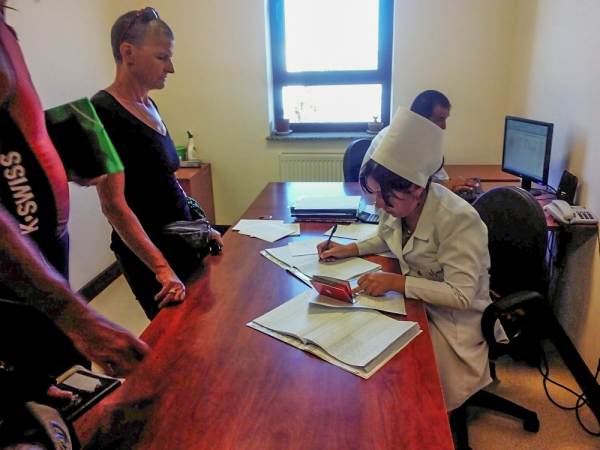
I’ve been fortunate to have crossed from Turkey to China overland on a couple of occasions and in my job at TDA Global Cycling I have been organizing bicycle tours across the Silk Road for the last 10 years (you can see the details of our Silk Route Cycling Expedition here). In that time I’ve learned quite a bit about the visa process for all the countries involved, as well as a few basic guidelines.
General Guidelines for Applying for Visas
- Plan well in advance, and read the details
- Give embassies only the information they want to hear, even if it does not exactly match your planned itinerary
- Be prepared to occasionally pay for expensive ‘LOIs’ (or ‘letters of invitation’)
- Be prepared for visa regulations to change without notice
- Always apply for a tourist visa
- You can use a visa service such as visahq.com, but it is cheaper if you apply directly to the embassy
There are many different routes that encompass the ancient Silk Roads to choose from; as well you can choose the direction that you will travel in.
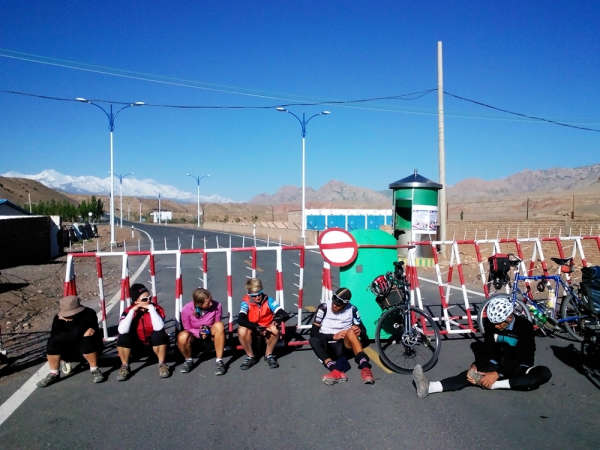
Obligatory Disclaimer: Visa requirements are constantly changing! The information I’m going to give is suited to a “westerner” cycling or otherwise traveling from China to Turkey over a period of approximately 4 months. This generally includes citizens of USA, Canada, EU countries, Switzerland, Australia, New Zealand and I have tried to note in the case where any of these nationalities are excluded or have different restrictions on their visa application. But please make sure to double check my advice with the embassies in your home country.
I’ll break down the information into three main categories: countries that do not require visas, countries that require visas before your departure, and countries where visas can be obtained on route.
Silk Road Countries that Do Not Require Visas (with some exceptions)
Travel to Kazakhstan
Good news – Kazakhstan recently opened its borders for visitors of 45 countries with a new 30 day visa-free regime. These countries include all EU countries, Australia, New Zealand, Switzerland, Canada, USA, among others.
“The Foreign Ministry said that starting January 1, [2017] citizens of EU and OECD countries, as well as Malaysia, Monaco, the United Arab Emirates, and Singapore could travel to Kazakhstan for up to 30 days without a visa.” from a recent report by AFP
For other countries if you are staying 15 days or less in the country, you can now receive your visa on arrival at the land border or airport.
For those staying more than 15 days, and not in one of the visa-free countries, you’ll need a visa in advance. Luckily it has become a simpler process in recent times and no letter of invitation is required for most westerners.
You’ll need to provide at least one hotel booking. This can be booked and then cancelled if you do not have set accommodation plans while you are there. You’ll also need to supply your own letter describing your travel plans, that you’ll be crossing overland and where you are entering and exiting the country.
Visas granted are typically single entry and valid for 30 days once you enter the country.
Travel to Kyrgyzstan
Most westerners no longer require a visa for travel to Kyrgyzstan. Citizens of most EU countries, Switzerland, Australia, Canada, United States, New Zealand can travel visa free for 60 days in Kyrgyzstan.
Visas Required Before Departure to these Silk Road Countries
Typically acquiring as many visas as possible before departure on a big Silk Road adventure trip is best, as it takes the worry out of having to deal with them on route. However, getting them in advance is not necessarily the easiest or cheapest method depending on the country. For some countries, it is a requirement to get the visas in advance as they will not grant them at the airports or land borders.
These can be the most time consuming and frustrating visas to obtain, and signing on with companies like ours, who arrange tours along the Silk Road, help alleviate some of the headaches and often make obtaining these visas a little easier. But if you are determined to go it alone, take a deep breath, and read on…
Tourist Visa for China
This visa is pretty straightforward if you don’t mind twisting reality a bit. The typical visa granted is a single entry valid for 30 days after the date of entry. If you are cycling a more northern route through Mongolia and Kazakhstan, this is more than enough. If you’re cycling across China directly to Kyrgyzstan, you’ll need a visa valid for 60 – 90 days.
Explaining to the relevant Chinese embassy or consulate your itinerary and that you’ll be traveling overland into Mongolia or Kyrgyzstan by bicycle sometimes works, however more often than not it causes more difficulties, especially if you will be traveling through western China. They are also very wary of travellers who have no pre-booked flights and accommodations so you might have to get creative with that.
The actual visa does not show anything about your planned itinerary on it, so there is no need to worry about following a different itinerary than the one you applied with. The reality is that embassy staff aren’t overly interested in your itinerary, so it is best to give them the information they need and not elaborate at all.
Tourist Visa for Russia
This is a visa that has become increasingly time consuming and expensive for most westerners over the last few years.
You will require a letter of invitation or tourist voucher, from a travel agency in Russia, if you google “Russia tourist voucher” you will find many agencies that can provide this for a fee. This voucher will have your itinerary on it and show the hotels where you plan to stay. If you haven’t planned any specific hotels you’ll stay at, or if you plan to camp, then you’ll need to describe this to the agency.
Typically you do not need to provide an airline ticket if you write a letter describing that you are traveling overland and explain where you will exit Russia.
Usually the visa issued is valid for the exact dates that you are supposed to be in the country.
Tourist Visa for Tajikistan
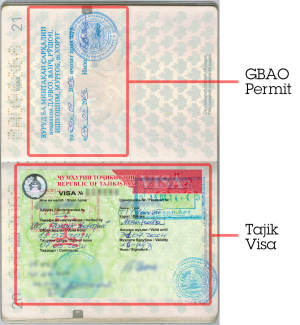 This visa has become simpler the last few years, and most westerners do not require a letter of invitation. You will need to provide an itinerary and a hotel booking, as well as your own letter describing your travels and where you will be entering and exiting the country.
The majority of embassies will allow you to apply for this visa more than 3 months in advance, which allows you to apply for this before you leave home. The visa itself will be valid for the exact dates of the itinerary which you supplied in your application, to a maximum of 30 days for single entry.
If you are traveling along the Pamir Highway, you will also need to request the GBAO permit when you apply for your visa. Be sure to check on the application form or respective embassy website how much extra payment to include for this permit. And pay close attention when you get your passport back in the mail from the embassy. They have been known to forget the GBAO stamp. Here is what you should get:
Tourist to Uzbekistan
There were recent hopes of Uzbekistan moving to a visa-free scheme, similar to the ones introduced in Kyrgzstan and Kazakhstan, but the plan is on hold and is now expected to come into effect in 2021!
So in the meantime most westerners will need a visa in advance and will also require a letter of invitation to get the visa. This has to come from a tourist agency in Uzbekistan. Similar to other invitation letters this will outline at least one accommodation you will stay at while in the country and provide the exact dates of your entry and exit to the country. You can find an agency to assist by googling “Uzbekistan Letter of Invitation” or by contacting a tour operator based in Uzbekistan.
If you are not booking any accommodation in advance, the agency can either list a hotel that you tell them you “plan” to stay at, or you can book something online. You will not have to provide a flight booking if you are explaining that you will be traveling overland.
This visa is also valid for the exact dates of your itinerary and typically can be applied for more than 3 months in advance, allowing you to apply for it before your departure.
Visas You Can Get on Route on the Silk Road
Tourist Visa for Mongolia
If you are heading on the northern route through Mongolia, Russia and Kazakhstan then you will enter Mongolia overland. Luckily for most westerners this is a very easy country in terms of visas, as in some cases you do not require any visa at all, while some nationalities require one at the border. Typically you are allowed 30 – 90 days in the country. Canadians, Germans can stay visa-free up to 30 days, and Americans up to 90 days. Whereas citizens of the UK, Australia, New Zealand, Switzerland among others do require a visa in advance.
Tourist Visa for Turkmenistan
For the independent traveler, this is a very tricky visa to attain. While tourism is promoted, it is only group tourism that is encouraged, and only if accompanied by an official Turkmeni guide.
Many solo travelers have been able to get a transit visa from embassies on route, this allows 5 days inside of Turkmenistan. The best place to attempt getting this would be in Dushanbe, Tajikistan or Tashkent, Uzbekistan. However, there are no guarantees and what these embassies will ask for in terms of information as it changes often.
If you are looking for a more concrete visa plan, then the best method, and easiest (though expensive) is to contact a travel company in Turkmenistan at least a month in advance and they can arrange a pre-approved visa that you’ll be able to pick up at the border on arrival. There is a catch though, you’ll need to have a concrete travel plan and have a guide with you.
Alternatively, you could join a group tour like our Silk Route Cycling Expedition where we assist you in arranging a tourist visa as part of our group.
Tourist Visa for Iran
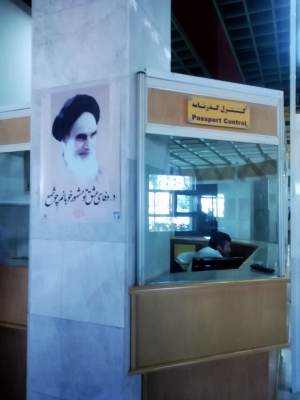 It is only possible to apply for an Iranian visa 3 months or less before your arrival. This is the reason why, if you are traveling slowly overland across the Silk Road, you will need to apply for this visa from the road.
Luckily attaining the visa on route is not too difficult, though there is always potential for surprises.
You’ll need to contact an Iranian travel company at least 6 weeks before you plan to pick up the visa at an Iranian embassy, and have them make the pre-approval application to the Ministry of Foreign Affairs in Tehran. Once this process is complete, you’ll receive an approval number that will be sent to you as well as the Iranian embassy that you’d be picking up your visa from. The fee for this service is separate from the actual visa fee that you’ll pay at the embassy.
Embassies on route that work well are in Dushanbe, Tashkent or Ashgabat. Don’t be afraid to use some elbow grease to help get your self in the door. Feel free to ask for the “big boss”, as it is not common for a westerner to be getting their visa there and the front of house staff can sometimes just start saying ‘no’ out of fear of doing something wrong.
Once you have the visa it should be valid for 30 days, which will be plenty of time to get across. If you have the luck of being American, you may be required to travel with an official guide the entire time you’re in the country.
Tourist Visa for Turkey
We saved the best for last. This is a simple “e-visa” that can be applied online for 3 months in advance. You do not have to send your passport away, you’ll just need to pay online and print off the approval page, which includes a bar code. This will grant you up to 6 months in Turkey as well as being multiple entry.
Some Additional Resources and Links
Caravanistan – Complete Guide to Silk Road Visas
Tom’s Bike Trip – Central Asian Visas for Cycle Tourists
TravellingTwo’s Visas While Bike Touring
VisaHQ has a good quick way for people to check what they need
I hope this helps give you a head start on your Silk Road visa research. Visa rules are constantly in flux, so check everything and check often in the weeks before you apply.
]]>
Last Friday in our monthly newsletter we announced the release of the first in our series Cycling the Silk Route – a 9-part YouTube series. During each of the next 8 months, we will be releasing one episode. The best way to make sure you don’t miss it is to sign up to our monthly newsletter where the official release happens each month.
>>Sign up for our monthly newsletter
Part 1: Beijing to Ulan Bator
The first episode covers the Great Wall section of this 4 1/2 month and 12,280 km long trans-Asia cycling expedition. The video follows the 2016 tour riders and their adventures as they embark on their journey at iconic lakeside Summer Palace in Beijing and approach the Great Wall itself – a series of fortifications along China’s northern frontier that was begun in the 7th century BC to protect against raids and invasions. Then it’s across the windblown Gobi Desert – home to Bactrian camels – and on to the Mongolia’s capital Ulan Bator, meaning “Red Hero” which today serves as the cultural, industrial and financial heart of this ancient and imposing land.
Enjoy…
]]>Due to an unstable security situation in Ethiopia the last months, and with a state of emergency still in place, we realized we needed to make plans for a new adventure in Africa.
We can now confirm that we will not cycle thru Ethiopia. The participants will instead make their way to Nairobi from Khartoum where the tour will re-commence on an exciting new route that includes two new countries we have never offered before. (You can see the breakdown of the new sections at the end of this post and full details are found here.)
Our 15th anniversary Tour d’Afrique was already destined to be a special year. We wanted to share the top 5 reasons why the new route should prove to be a worthy alternative to Ethiopia.
1. The Lakes in Kenya, West of Nairobi
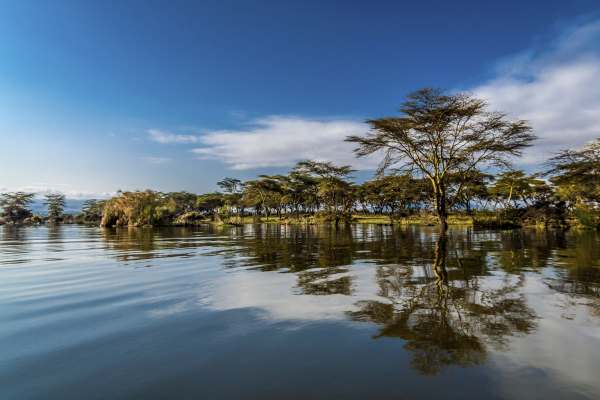
Heading west, we will pass by Lake Naivasha (pictured above) and Lake Nakuru. Lake Naivasha is home to over 400 species of birds and a large hippo population. If that doesn’t satisfy your wildlife impulses than stop at Lake Nakuru near the next days lunch stop and view the thousands of flamingos that line the shores. From there, we cycle to Kisumu near the border with Uganda and get our first views of Lake Victoria – Africa’s largest lake.
2, Uganda, the Jewel of Africa
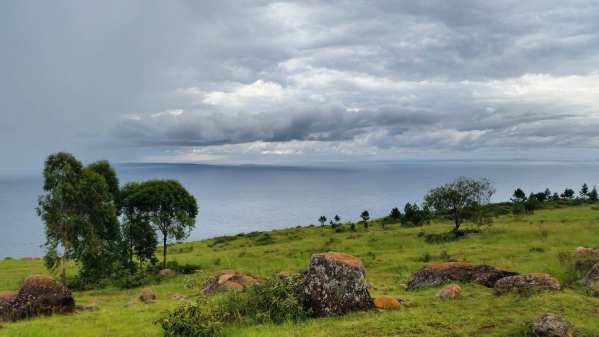
Uganda, once called the Jewel of Africa by Winston Churchill and the Pearl of Africa by others, is gorgeous and green, hilly and hot. Our route will follow near or along the shores of Lake Victoria and reach Jinja – known as the source of the While Nile. From there we head towards Kampala – known for its traffic. To solve this we decided to access the city by boat. After cycling the friendly villages on the shores of Lake Victoria, we will board a local fisherman’s boat and be transported into Uganda’s bustling capital and largest city.
3. Rwanda and the Mountain Gorillas
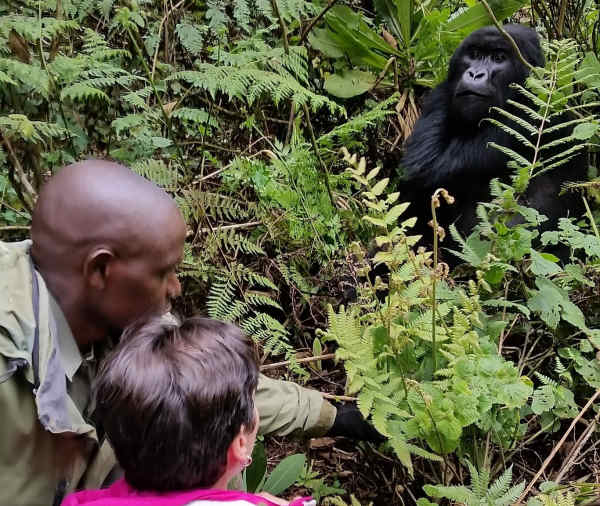
This tiny country has gone through an enormous regeneration in the last two decades. Known as the “Land of a Thousand Hills” the excellent asphalt road network make the challenge of the constant hills more manageable. It’s capital, Kigali, is modern and booming.
With two rest days in Kigali, you will have time to visit the famed mountain gorillas. Kigali is where you can pick up your gorilla trekking permit (if you pre-arranged this) and head up to Musanze by bus (buses in Rwanda leave on time and drive the speed limit – quite a treat!).
From Musanze you trek into the foothills of the stunning Volcanoes National Park, walking on thick layers of jungle undergrowth – sometimes a meter thick – you will soon come upon a family of gorillas. They spend most of their days lounging, play-fighting, and eating thistles, stinging nettle, and other tasty vegetarian specialties.
Your trackers will give you strict instructions to not approach the gorillas within 7 meters, but the gorillas will go where they please, walking past you on their way to another plant to chew on they barely acknowledge your presence – its an incredible opportunity to observe these serene and docile creatures up close.
4. Lake Victoria and East African Safari
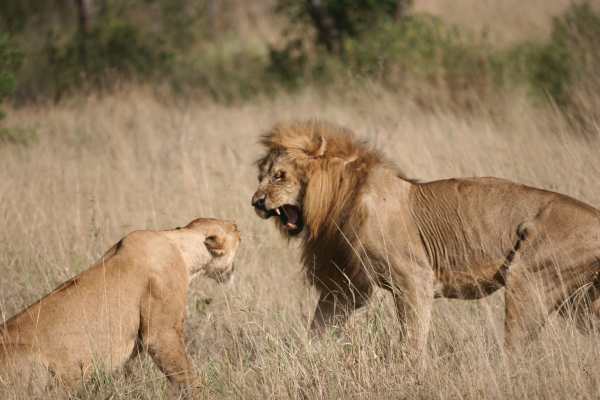
After leaving Rwanda, we cycle through lightly travelled areas of northwest Tanzania between protected areas of various game reserves. We reach Mwanza, Tanzania’s second largest city set on Lake Victoria’s shore, surrounded by hills strewn with enormous boulders. The next day we cycle to Speke Bay named after the explorer who searched for the source of the Nile River.
Included in the price for the new Safari Time section is a 3 day safari into the Serengetti and Ngorongoro Crater – two world class parks to observe ‘the Big 5’ in some of the most beautiful and diverse wildlife habitats.
5. Witnessing the Best of TDA’s Adventurous Spirit
When we put our heads together and come up with new routes and new plans, we are at our best. TDA is made up of a team of adventurous and well travelled people who love a new challenge and an opportunity to bring our cyclists to new and exciting destinations for cycle touring.
Our cyclists come to us because they trust our instincts, and know that when we try a new route we don’t do it without alot of research, and consultation to ensure it is equally enjoyable and safe for everyone.
Here are the New Sections
Desert Sands
Starts: Khartoum Feb. 4
Finishes: Nairobi Feb. 16
Jewel of Africa
Starts: Feb. 18 in Nairobi
Finishes: Mar. 3 in Kigali, Rwanda via Uganda
Safari Time
Starts: Kigali March 6
Finishes: Arusha March 14
Masai Steppe
Starts: Arusha March 16
Finishes: Lilongwe, Malawi March 31
Mystical Patagonia has stirred the imaginations of travellers for centuries. Its sparsely populated, wild, and beautiful lands extend down the triangle at the southern end of South America from approximately latitude 40°S to Tierra del Fuego, encompassing the Aísen, Magallanes, and part of Los Lagos regions in Chile, together with the Argentinian provinces south of the Rio Negro.
>>Check out our supported cycling tour of Patagonia
The narrow Chilean side and the cross-border frontier areas are dominated by formations carved by the last ice age, including jagged Andean peaks, U-shaped valleys, glacial lakes, ice fields, and crystal clear rivers. In stark contrast the rest of Patagonian Argentina is a vast wind swept emptiness of semi arid scrub plateau.
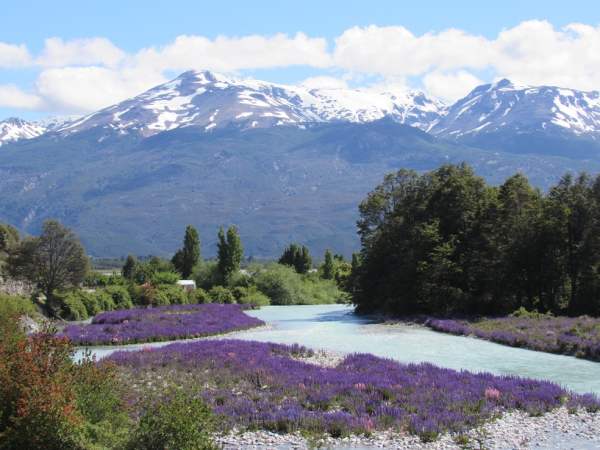
Turquoise River and Purple Lupines
In recent years, Patagonia has become a mecca for long distance cycle tourists. Typically they follow 2 renowned and incredibly scenic routes, Chile’s Carretera Austral and Argentina’s Ruta 40. Unless you are a glutton for brutal winds, the best itinerary may be a combination of both, crossing over the Andes between Esquel, Argentina and the white water rafting haven of Futaleufu, Chile, or further south after you tire of being buffeted by the punishing westerlies.
Carretera Austral
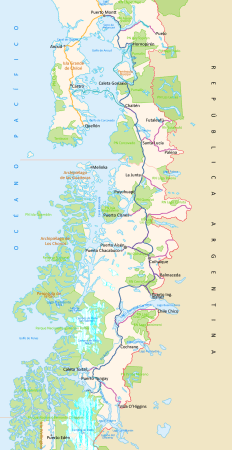 Many choose to ride the entire 1247 km length of the rugged Carretera Austral, starting in the port city of Puerto Montt, where one can indulge in seafood and pisco sours, and stock up on spare parts and outdoor adventure clothing before hitting the road. The legendary Carretera is about 60% gravel with some rough, corrugated stretches, and 40% paved, with more pavement slowly being added every year. En route you will take 5 ferries and spin through temperate rain forest and national reserves, across icy cold rivers and mountain passes, and past isolated farms, smoking volcanoes and snowy peaks. While there are a few long climbs and descents between watersheds, the physical challenges are not extreme and a small price to pay for pedalling past one magnificent and isolated scene after another.
After restoring your energy and replenishing supplies at the midway point in the small city of Coyhaique, the road traverses la Reserva Nacional Cerro Castillo before hugging the shoreline of Lago General Carrera and the banks of swirling Rio Baker. The settlement of Cochrane provides the last well equipped general store before the gravel stretch to the tiny frontier and glacial lakeside town of Villa O’Higgins where the Carretera officially ends.
credit: Carretera Austral map by B1mbo under CC-BY-SA-2.5
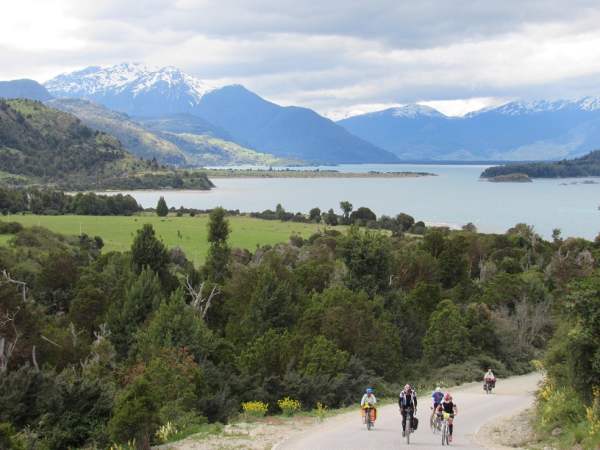
Lago General Carrera
The Gauntlet: Villa O’Higgins to El Chaltén Border Crossing
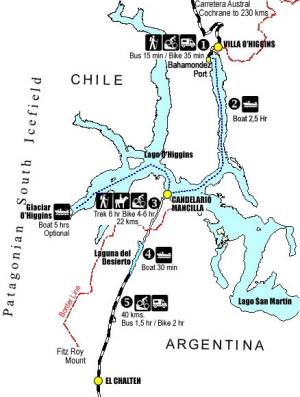 From there the cross border trek through no man’s land – involving two ferries, a 22 km slog thru muddy woods, and a final 37 km of off-road to the Argentinian backpacker haven of El Chaltén is one of the most fabled in the world of South American cycle touring. Technically it can be done in one long day, but the ferries are weather dependent so bring plenty of food, warm clothing and a tent, in case of a storm or nasty winds.
The alternative route from Chile to El Chaltén, for support vehicles and less intrepid cyclists, is to turn east just before Cochrane and climb up the stunning Valle de Chacabuco past flocks of guanaco to the Paso Roballos border post, joining up with Ruta 40 at the god forsaken outpost of Baja Caracoles. From there however it’s a 500 km battle against the winds to El Chaltén.
Cycling Argentina’s Ruta 40
 The alpine town of San Carlos de Bariloche, on the shores of immense Nahuel Huapi lake, is a base for trekking, kayaking and mountain biking, and a natural starting point for the ride south along Argentina’s Ruta Nacional 40, the long and largely paved highway that runs the length of the country. Bariloche also offers popular side trips including the renowned Seven Lakes route and the trans-Andes ferries and cycling ride into Chile.
South of Bariloche, iconic Ruta 40 skirts Lagos Gutierrez and Mascardi, and offers beautiful views of Cerro Catedral Sur. After passing the town of El Bolsón, cyclists can choose between two routes to Esquel, Most opt for the more scenic and secondary Ruta Provincial 71 via Cholila, meaning “beautiful valley” in Mapuche, where the bandits Butch Cassidy and the Sundance Kid built a ranch and hide out. In Esquel, you can trade your bike for a ride on the Old Patagonian Express, which still has weekly departures but only runs 20 km to Nahuel Pan.
The Notorious Patagonian Winds
Provided you opt to stay in Argentina rather than cross into Chile, south of Esquel the pampas begin and the infamous winds truly take hold, testing your will and skill. This is Patagonia’s most empty and desolate stretch where the distances between backwater town are longer, supplies and services are more expensive, and there is little to see along the roadside beyond merino sheep and the occasional guanaco. Just north of Perito Moreno, the junction with Ruta 43 offers one more chance to detour into Chile via Lago Buenos Aires before the desolate run to Baja Caracoles and beyond. For those continuing on Ruta 40 a major highlight is the UNESCO-listed Cueva de las Manos (Cave of Hands), reached by gravel side road, where archaeologists found 9,000-year-old stencilled handprints and galloping guanacos painted by ancient peoples.
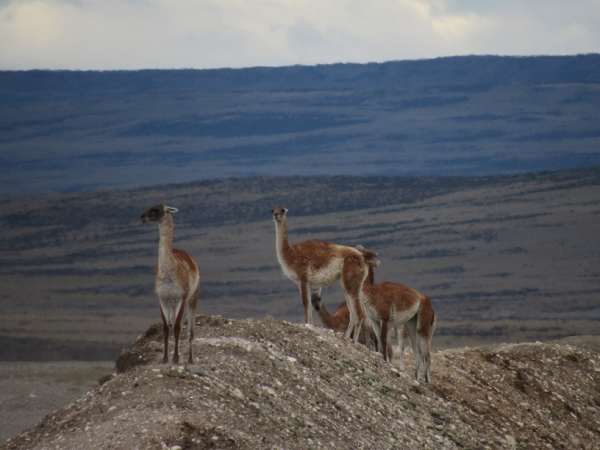
Guanacos alongside Ruta 40 in Santa Cruz province
All told it’s over 1,100 km from Esquel to El Chaltén along Ruta 40, including the final 80 km up the shores of Lago Viedma into what will likely be a brutal headwind. But if you are lucky skies will be clear and the views of Mount Fitz Roy, Cerro Torre and the Glaciar Viedma spectacular, and when you finally arrive in El Chaltén, you can indulge in life’s comforts, including its many bars and restaurants while revelling in the supernatural scenery.
Southern Patagonia
Los Glaciares national park extends across the huge Southern Patagonian ice field, from the towering Fitz Roy Massif to Lago Argentino, created by the Perito Moreno glacier. Leaving El Chaltén, its 80 km of brisk tailwinds followed by 120 km of head and crosswinds to El Calafate, the upmarket tourist center on the shores of the turquoise-coloured Lago.
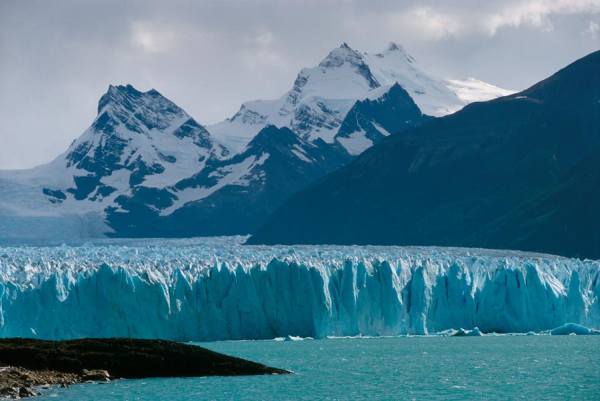
Perito Moreno glacier & Lago Argentino, photo credit: Ladislav Kamarád
From there another 2-3 days of wind blown peddling, some of it on dirt, will take you back into Chile at Cerro Castillo, bound for another of Patagonia’s star attractions, Torres del Paine. This world renowned park features trekking, horseback, and mountaineering circuits, great campsites, superlative hotels, and the chance to see guanaco and condor against jaw dropping landscapes.
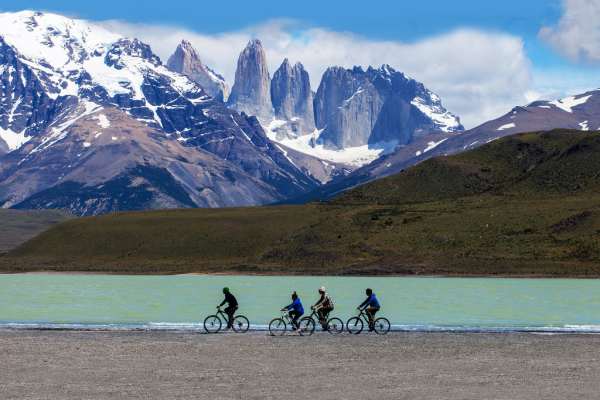
Cycling at Torres del Paine, photo credit: Timothy Dhalleine / Twitter @tdhalleine
The final stretch takes one first to Puerto Natales, a formerly modest fishing port on Seno Ùltima Esperanza that has become a tourist mecca as the gateway to Torres del Paine and the southern terminus of the ferry trip from Puerto Montt through the Chilean fjords. Artesanal beers, delicious restaurant fare, cozy lodgings, and kickback views along the waterfront are among its many attractions.
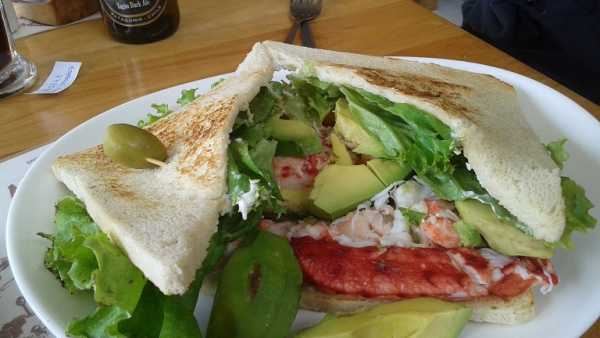
King crab and avocado sandwich for lunch in Puerto Natales
Then it’s on to Punta Arenas, an important port before the opening of the Panama Canal, as reflected in its stately mansions and location astride the Magellan Strait. Today it’s a seafood paradise and the gateway for Antarctica expeditions. For some, Punta Arenas will mark the end of their Patagonian adventure, but for others the huge Island of Tierra del Fuego, beckoning across the strait, is the ultimate goal. The ferry crossing to Porvenir takes 3-4 hours followed by a final 475 km ride across this windswept archipelago to Ushuaia, the world’s southernmost city, perched on the tip of South America, overlooking the Beagle channel.
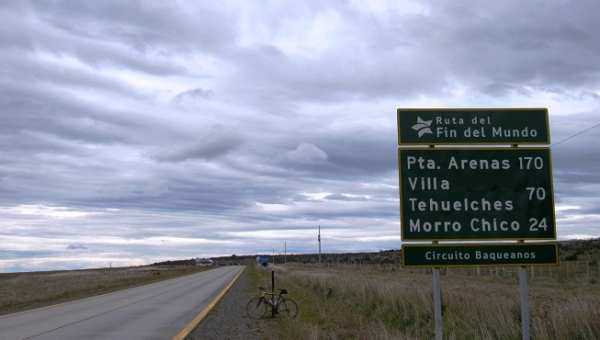
Getting to Patagonia
Getting to Patagonia is straightforward. After flying into Santiago, Chile, or Buenos Aires, Argentina, domestic jets will take you to Puerto Montt, Coyhaique, Bariloche, or El Calafate and homeward bound from Punta Arenas or Ushuaia. Most nationalities do not require a visa to enter Chile. Citizens of some western countries require an easily obtained Argentinian reciprocity visa in advance while others, including Americans, do not.
When to Go
The best months to go are from November to March, when the daytime temperature reaches the low twenties in northern Patagonia and the low-mid teens at Ushuaia and Punta Arenas. Expect all conditions – warm, cold, sun, wind, perfect days, and storms. And that’s in the southern summer. Any other time of year would be a bold undertaking, with short days and cold, blustery weather. Note that South Americans holiday in January and February, so November, December and March are ideal.
Where to Stay
Patagonia is wild camping nirvana, unbelievable scenery and isolation at its best. Rarely will you need to camp more than one night in a row as the small towns typically have a handful of cheap, friendly family run hosterias which also offer meals. For those not on a budget, the riverside fly fishing lodges, estancias (ranches), and upmarket accommodations in the tourist centers offer luxury and the opportunity to sample fine wines and dine on local specialities, including Patagonian lamb, Argentinian beef and the ubiquitous seafood.
Type of Bike and Gear to Bring
Hard tail mountain bikes and cyclocross bikes are best suited for a trans-Patagonia cycling expedition. Buy the best rear (and front) racks you can find as they will take a pounding on some of the rougher stretches which can include a fair amount of corrugation. Carry all the essential spare parts you need for your bike, as well as a water filter for when you are in the wilderness and there is no fast flowing mountain stream or river nearby. The better your equipment – including gortex rain gear, warm layers, an all season tent, and extra tent pegs to combat the wind – the less likely you will encounter a setback and the more enjoyable your trip of a lifetime will be.
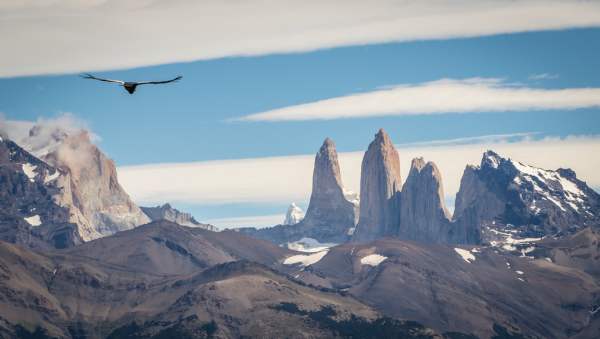
Torres del Paine & Condor, photo credit: Timothy Dhalleine / Twitter @tdhalleine
Further Reading
There is a great deal of useful information online for this region. Here are several of my sources and other sites and blogs I came across while putting this piece together.
11 Best Bike Touring Destinations in the World – Cycling About
Patagonia Region, Argentina – Encyclopedia Britanica
Sublime Carretera Austral – Cycling with Serendipity
10 Questions: Cycling Patagonia – TravellingTwo
Carretera Austral and Patagonia – CrazyGuyOnABike
Guide to Patagonia – Guardian Travel
Patagonia Trip of a Lifetime – Telegraph Travel
Patagonia – Lonely Planet
A Single Track Mind – TDA Global Cycling blog
And if you are looking for a supported cycling tour thru Patagonia consider joining us on the South American Epic as it passes thru Patagonia.
Closing Thoughts
Do it now! Patagonia is changing, the Carretera Austral is being paved, the gauntlet between Villa O’Higgins and El Chaltén may soon be replaced by a road and bridges, so … if you want to experience this magnificent region at its wildest you are starting to run out of time.
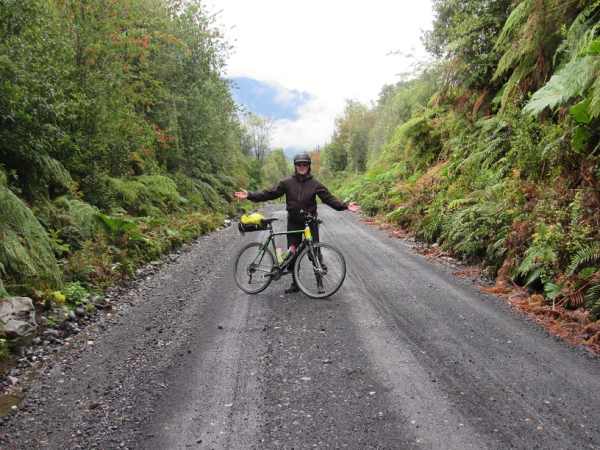
That’s me loving Parque Pumalin in Patagonia last year
Lastly. here is some advice from one of my fellow cyclists for those considering this cycling adventure…
“Be prepared to face some of the harshest conditions from weather to the route to the camping.Be prepared to cycle in some of the most scenic and desolate areas on earth. Be prepared for the awe. Expect the unexpected!” – Lorry Schmidt (Canada)
Brian Hoeniger works for TDA Global Cycling and cycled the Carretera Austral segment of the 2015 South American Epic. Registration is now open for the next edition starting in July 2017.
]]>This is the fifth post in our series profiling some of our Super Alumni, riders who have cycled many expeditions and kilometres with us over the past years. Check out the previous posts on Lloyd Strong, Svend Paulsen, Chris Wille & Brett Lanham.
Tell us a bit about your background, where you grew up and live, and what got you started into cycling.
Growing up in post-war Germany was very basic: you walked everywhere, i.e. 2km to the train station and back going to high school. What a luxury it was when my Dad bought me a bicycle and it took only 10 minutes instead of ½ an hour. Came to Canada in 1965 and got my driver’s licence 5 years later. Then life took its course.
What prompted you to decide to start doing long distance cycle touring? Were you apprehensive before you started?
In 1992, when my CRAZY girlfriend decided to bicycle ACROSS CANADA, I sent a postcard to her at every mail-stop to encourage her!!! She is solely responsible for getting me on the bike in 1999 by giving me her old bike. Test-riding it, I did not know how to stop as backwards pedalling did not work on this highly geared machine. So I learned something new. My first tours were short in distance and time, in Canada and USA with the Pedal Pals group.
Then in 2009 my friends discovered and booked Tour d’Afrique’s Orient Express. As the start in Paris was not possible for me, I opted to join the group in Vienna as I had seen enough of France and Germany in my youth.
Wow, I made it to Istanbul, Turkey!!! Was I apprehensive?? You bet! But the tour support was second to none! The detailed instructions to get from point A to B, the flagging of the route, the sweep who assists stranded cyclists, the lunch truck, the accommodation choices, were all well-organized. When riding uphill was too tough for me I chose to ride in the support vehicle. NO – I am not riding Every Fantastic Inch of the way – and that is OK. I do my best!!
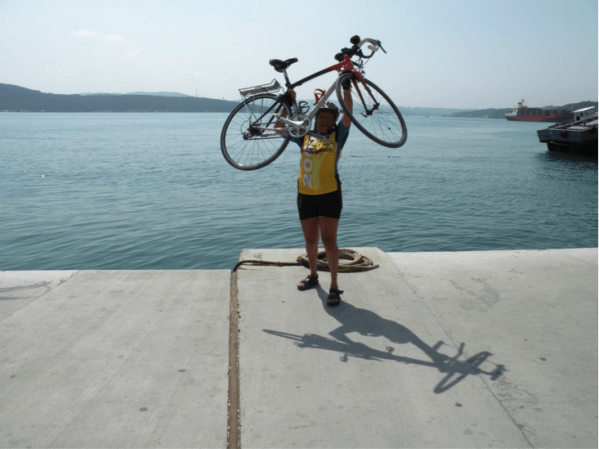
Celebrating at the Bosphorus near Istanbul
What places/moments have been the highlights of your cycle touring career? Beyond cycling, what other amazing travel adventures have you had?
Since my only “athletic strength” seems to be in my legs in 2010, after cycling around the Finger Lakes in New York state with my Pedal Pals, in September I visited Africa and trekked to the Gorillas in Uganda followed by the successful ascent of Kilimanjaro in Tanzania.
In 2011 I was ready for a repeat performance on bicycle as a few of my friends from the 2009 tour were cycling the North American Epic from San Francisco. I joined in Toronto and rode to the finish in St. John’s NL.
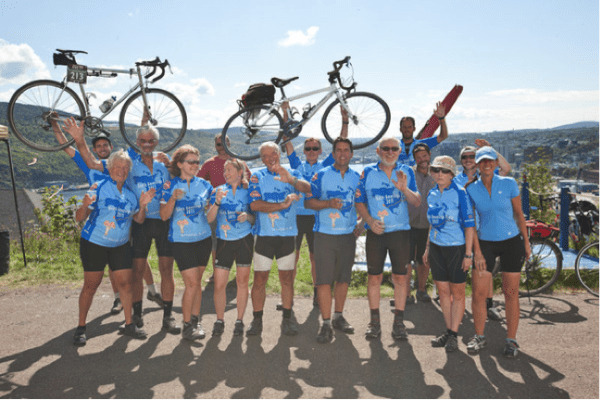
The 2011 NAE arrives in St John’s Newfoundland
Of course then plans were on the table for 2012 and 2 of my Pedal Pals joined me from St. Petersburg to Venice, the Amber Route, which is about half of the Trans Europa tour.
In 2013 I booked the Bamboo Rd, 8,000 km from Shanghai to Singapore. Through 6 south east Asian countries full of natural and ancient wonders like Ha Long Bay and Angor Wat and totally immersed in the local cultures – an unforgettable experience. My claim to fame on this tour was that I bicycled 100 miles (actually 171 km) in one day in Cambodia at the tender age of 72.
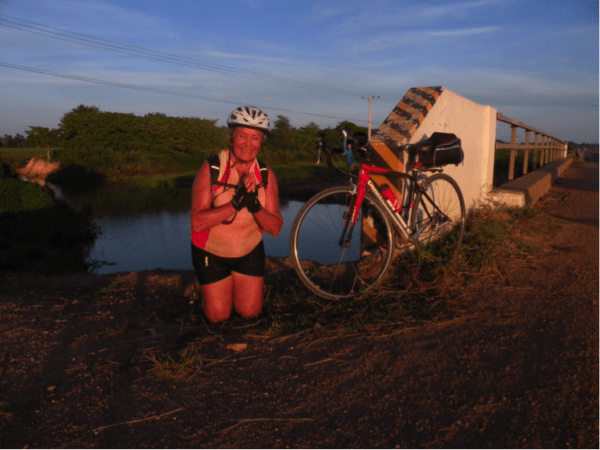
Century ride completed!
What life lessons has cycling taught you?
One of the joys of these tours for me is meeting people from all walks of life. For instance a couple on their honey moon, Danya and Jan. People of all nationalities from all continents, young and old, rich, and not so rich in worldly possessions. My thought is that, when your tires are on the road, from there you can only look up at and not down on anyone!!! The camaraderie is second to none and I feel lonely when I am home alone again. I am hooked on cycling and TDA. So once again this year I will join the Trans Oceania Tour in Auckland and cycle the North and South Islands of New Zealand.
How do I describe why I do this??? My dear mother used to say: If you think you can – you will!!
……………. And this expresses it best:
]]>
This is the fourth post in our series profiling some of our Super Alumni, riders who have cycled many expeditions and kilometres with us over the past years. Check out the previous posts on Svend Paulsen & Chris Wille & Brett Lanham.
Tell us a bit about your background, where you grew up and live, what your working career is/was, and what got you started into cycling.
I am retired from the General Motors Transmission Plant in my home town of Windsor Ontario. My career there was cut short by a severe motorcycle accident that resulted in breaking dang near every bone in my body. After 6 months in traction, rehab began and, eventually, it was suggested that cycling could be good for me. I bought a bicycle from a shop in the neighbourhood and began to ride around the block. Each time out I improved and increased my distance to visiting friends in the neighbourhood. With time I found myself going further and further. After a few years, a friend showed the travel section of the Detroit Free Press in which there was a story about the Palm Pedal across lower Michigan. It was a weeklong family oriented ride with low mileage that goes from Lake Michigan to Lake Erie. I was intrigued and signed on the following year. It was well organized and I had a lot of fun, so much so that I decided I could do this forever. I have never looked back. The Palm ride will be forever known as my “sweetheart cycling tour” because it was there I got bit bad by the touring bug. And that’s basically how I came into having such a burning desire to see the world via a bicycle.
Around the world completed.
What prompted you to decide to start doing long distance cycle touring? Were you apprehensive before you started ?
Now it needs to be said that I used to get grounded when I was a kid, and down in the basement was an old black and white TV with tin foil flags on the antenna that I could get to work. If the wind was in the right direction, I could pick up a channel with a travel show hosted by George Pierrot. He would go on about far flung places where he and his guests have been. So it’s kind of funny how things work out. A year later or so after the Palm and a few USA state tours, a good friend of mine, introduced me to Cycle Canada and I signed up for the Tour du Canada. The following year I met Kathleen Dempsey on Cycle America’s Coast to Coast tour. She told me about TDA and how she was planning to take on their signature ride, the Tour d’Afrique. Once again I was really intrigued; truth be told, it was one of those pivotal conversations that gave me a whole new curiosity. Up to this point in my life I really hadn’t been off our North American continent either. Admittedly, cycling in your native country is pretty easy to a point. Oh sure, the climbs and the weather can be rough at times, but we speak the language, and can find just about anything we want in North America. To me that kind of leads to a boring comfort. Don’t get me wrong, it takes a lot of effort and wherewithal to cycle anywhere and it’s still great to do these trips. However you really bump up the thrill level when you leave your comfort zone for a whole new experience. I was really apprehensive about going off continent the first time and I still get that way after all these years. There is a certain thrill you get when you experience a new culture, new foods, meet new people and of course the new scenery! Cycling has a way of putting you out there in such a way that you enjoy your “new playground.”
Hero’s Welcome at the Goha Hotel in Gondar, Ethiopia
What places/moments have been the highlights of your cycle touring career?
Without a doubt my favourite cycling tour is the Tour d’Afrique. Africa is a special continent with so many diverse countries and people that it truly was a pleasure to discover. Whenever I am asked about this tour all my answers evolve into more questions and amazing and long winded tales. In Africa I had unbelievable luck, both good and bad. I saw the Pyramids, swam in the Nile, and floated down the Zambezi. I saw more beautiful birds than I can count, and flowering trees that I’d never seen before. The local people are genuinely interested in you and where you lived.
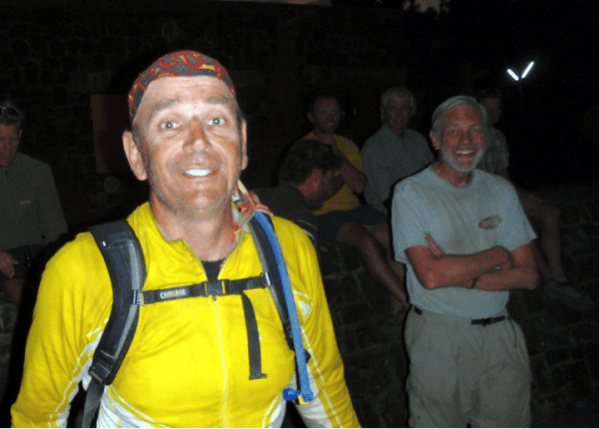
One of my fondest days on the TDA was the uphill stage into Gondar. I had been in the saddle almost 12 hours when I reached the top of the final climb and received a “hero’s welcome.” Miles had given me the coldest drink I ever had about 4 kms from the finish and I was cheered on by Brian as I ascended the last switch back. Fellow riders helped me set up tent and guided me to the showers.
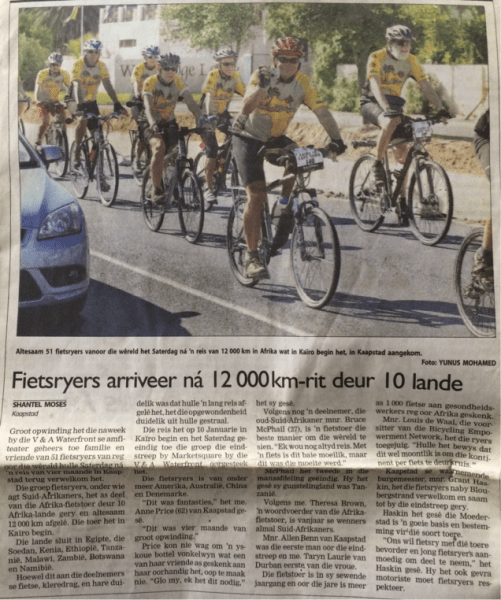
A few days later my frame cracked but I soldiered on to Addis where I purchased another bike from a departing sectional rider. For the last half of the tour I had worms crawling around in my back. It took four bicycles for me to get to the finish line in Cape Town and yet I still finished the tour as an official “EFI” rider! And I ended up on the front page of the Afrikaans “Die Burger” newspaper to boot! Mind you I also have the dubious honour of being the slowest cyclist ever to achieve EFI. What an honour… even the Paris-Brest-Paris cycling event has their “Lantern Rouge!” Memories of a lifetime !
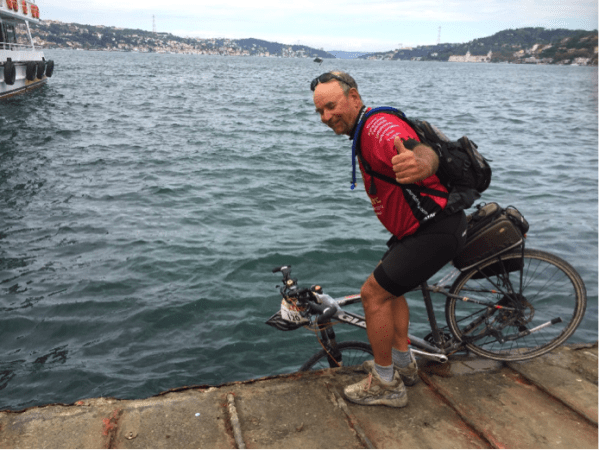
The single greatest moment of my cycling career was no doubt the day I completed my quest of riding around the world in a linear fashion. On the last day of Silk Route I dipped my tire in the Bosphorus Strait on the Asia side of Istanbul; almost right across from where I had celebrated in similar fashion on the European side at the end of the Orient Express. I have made a practice to dip my tire in a major body of water on all my epic adventures, even if it meant arriving early to make it happen and cycling my way back to a start line.
Do you have any pro tips for new cycle tourists?
Tips? Hah! I’ve got a lot of them…. Do your homework before you leave, make sure your gear is good. Things will break down and odds are you won’t find “Bob’s Bush Hut of Bicycle Parts” in the next town so be prepared. Riding around home is nothing compared to the roads and adventure you will be on, your bike will take a beating … and so will you! Depending on your skill level, you will, if you have an open mind and heart, experience more than you ever imagined. You will push yourself to higher limits, laugh more than ever have, and even shed a tear. Trust in yourself, you are stronger than you think and don’t be afraid to help a cyclist in trouble. Roll with the setbacks and go with the flow…. it’s an “adventure”. Enjoy your new friends, be there for them, and they will be there for you because we are all in it together. You may never ever see them again, but you will never forget them. And when it all starts to fall apart, a few words come to mind that a friend of mine, Rodney, told me to say out loud… “But I’m on holiday!!”
Planting the Seeds of Adventure
What life lessons has cycling given you?
Life lessons from cycling… most goals in life are achieved the same way as cycling the toughest climb or in the nastiest weather… one pedal stroke at a time with gentle pressure relentlessly applied!
Anything else you would like to add?
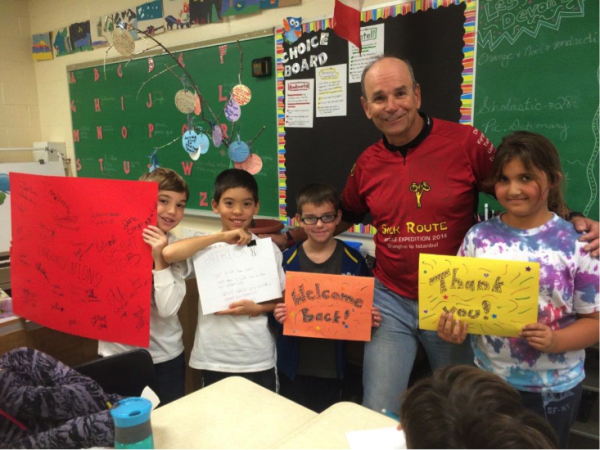
I didn’t realize that I was going to be so long winded, but that’s the way it goes, lol! Normally I keep my adventures to myself, however on occasion I have been talked into spinning tales of adventure to young girls and boys at a grade 4 class. Eyes get as big as saucers when I go on about animals I’ve seen and places I’ve been on a bicycle. I end up signing every scrap of paper with “don’t let your dream be a dream, make it happen.”
1st Place at the Harrow Fair
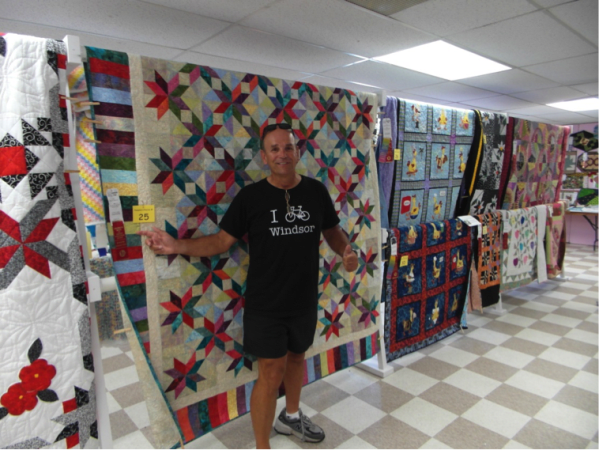
What else do I do when I’m not on a bicycle ? I am a quilter. I like to make quilts and enter them at the Harrow Fair. Now it costs $7.00 to enter and first place is worth $6.00! … BUT the competition is very stiff. While I will never get rich doing this, the memories of making and giving away these quilts are priceless … just like my adventures … and I will have lots to talk about when I ripen to 100 and become a centurion.
In the meantime I plan on crossing my 5th continent … TDA’s South American Epic in 2017, and if we should meet it is bound to be fun. While I do have a bad Coca Cola habit, cold or warmish it doesn’t matter, it’s a guarantee that I will hold up my end of the conversation! Hope to see you there!
]]>
This is the third post in our series profiling some of our Super Alumni, riders who have cycled many expeditions and kilometres with us over the past years. Check out the previous posts on Svend Paulsen & Brett Lanham.
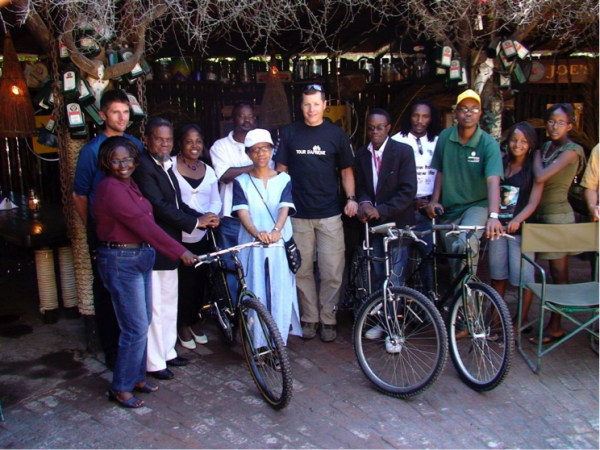
Chris is one of our most dedicated customers and strongest cyclists, having ridden EFI (every fucking inch) of the Tour d’Afrique, Orient Express, Silk Route, Trans-Oceania and the South American Epic. He also gives back to cycling and Africa in a big way, as the co-Director of Bicycles for Humanity chapter in Victoria, British Columbia, which to date has sent more than 3500 donated bikes to Namibia, Uganda and Malawi. Chris was also previously featured in one of our blog posts.
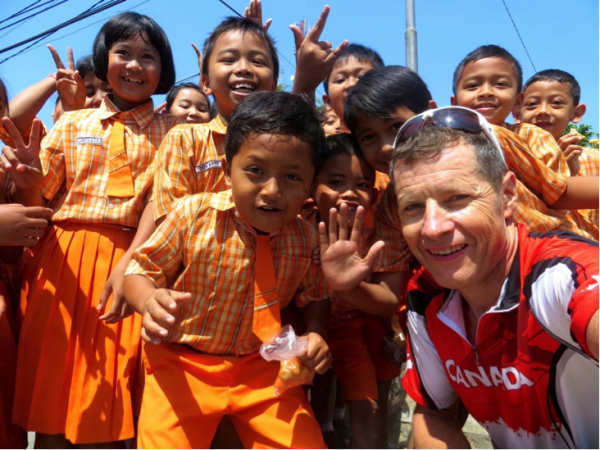
Tell us a bit about your background, where you grew up and live, what your working career is/was, and what got you started into cycling.
I’m a native of Victoria, BC, Canada. I had a busy, challenging 30 year career running a successful Automotive Repair shop in Victoria. Working 6 days a week, dealing with the public was high stress- Cycling & Triathlons became my release, like therapy. The longer the better. Triathlons went from Sprint distance to Olympic to 1/2 Iron to full Ironman. Cycling progressed from short local rides to multiday rides/tours, loved it, progressed from there. My late Father had a hunger and passion for travel that I seem to have inherited.
Tell us about your favourite cycling tour bike.
After cycling the Tour d’Afrique in 2008 & seeing first hand how well the Specialized Tri Cross bikes held up under the roughest of conditions, I bought one. Still riding it 7 years, 5 continents and 40,500 kilometres later. Very durable and comfortable. Not the fanciest of bikes, but very robust. It gets much love and a full overhaul between trips.
What prompted you to decide to start doing long distance cycle touring? Were you apprehensive before you started?
While working back in the early 2000’s I googled “Long distance cycle tours”, and discovered the TDA. At first I thought the participants were nuts – who rides 12,000 kms in 4 months across Africa? In time I realized that it was “ordinary people doing extraordinary things.” So I signed up for the 2008 TDA Africa ride when I was totally burned out from work and needed a change. Cycling across Africa was truly magical, and I became hooked on the Eat-Sleep-Ride nomadic lifestyle. There is no finer way to see and experience a continent and its cultures, its peoples, than from the best seat in the house, that of a simple bicycle. Yes I was nervous/apprehensive, but the TDA and its amazing staff make cycling easy – no logistics to worry about. Not to mention the camaraderie and fun sharing the journey with fellow riders from all over the globe. The sudden tragic passing away of several close family and friends also made it clear that life is short – there are no guarantees – so get out there and experience it while you can!
What places/moments have been the highlights of your cycle touring career?
There are so many I could write a book on the incredible experiences I’ve had. Cycling through the ancient history of Egypt, the Sahara desert, the wildlife of Tanzania, climbing Kilimanjaro, the marathon ride across China on the Silk Route … Riding the Pamir Highway and across Iran, magical Indonesia, spinning across the Red centre of Australia. The magnificent climbs and thrilling descents in Colombia, the Amazon river basin in Ecuador, the Salar del Uyuni (world’s largest salt flats, exploring ancient Inca sites in Peru, Machu Picchu, and the incredibly beautiful challenging roads of Patagonia in Argentina and Chile. Meeting the people and experiencing the food and cultures has been amazing- from homesteads in Yurts at 3500 meters in the Pamirs to being surrounded by curious onlookers at camps in Ethiopia, to sharing meals with Iranian families – I am so lucky! One meets the most interesting, amazing, inspiring like-minded people on these trips and I now have great friends literally all over the world.
How many kms (more or less) have you cycled with TDA?
5 Tours, 4 Epics, 52,914 kms + one cross Canada Tour with Cycle Canada = 60,414 kms and one lap around the world.
Beyond cycling, what other amazing travel adventures have you had?
When I turned 50 a few years ago I decided to have 2 quests. The first was to cycle around the world, one continent at a time, and the second was to run a marathon on each of the world’s 7 continents. Happy to say that upon rolling into Ushuaia at the end of the SA Epic, my round the world cycling quest was fulfilled. I’m so incredibly lucky to have cycled coast to coast, or North South across 6 of the world’s 7 continents. As for the marathons, have been super lucky to have run the incredible Kilimanjaro Marathon in Africa, an amazing marathon in Antarctica, the Great Wall marathon in China, and the Tuscany Eco-Marathon in Italy. Now I just have to run a marathon in South America and Oceania to complete that quest. I also dabble in mountaineering and have climbed many of the mountains on Vancouver Island and across the Pacific Northwest.
What life lessons has cycling given you?
There seems to be an inverse ratio of wealth to happiness – people we have come across on various continents that live very humble lives with next to nothing appear to be very happy. Wealthy people with the latest greatest everything much less so – more stressed, edgy, prone to road rage, etc. One needs only a bike, some food and a route to follow, preferably with orange flagging here and there, to be truly happy and content.
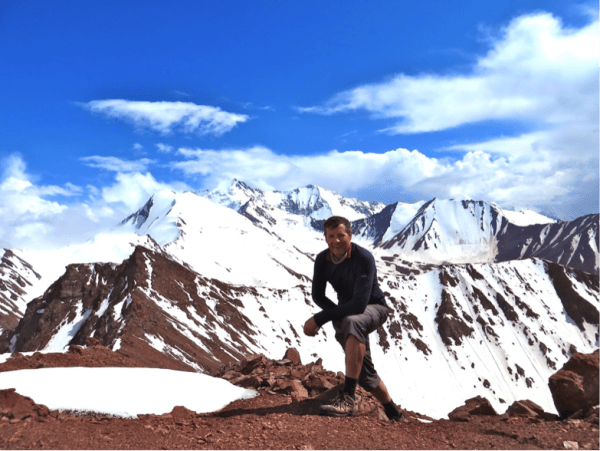
Do you have any pro tips for new cycle tourists?
The hardest part of a big cycling adventure is making the commitment and signing up. Be it a few weeks, a month or a whole tour, you really don’t start truly living until you are totally out of your comfort zone. It’s a big world out there so go exploring when you are in camp, there is so much more to see and experience after the days ride and it’s very enriching to immerse oneself in the local culture, wherever in the world they happen to be. Take it one day at a time, by the time a week goes by you won’t know what day of the week it is, and it won’t matter – a cycle tour has its own pleasant rhythm. Ordinary people doing extraordinary things!
]]>Three years ago I began to follow one hell of a fascinating adventure. No, this is not about unclimbed peaks to ascent, no amazing ‘firsts’, no ‘never before done’ by mankind. In fact, the adventure is something that was done a long, long time ago – at least in human evolutionary terms. An individual by the name of Paul Salopek, a Pulitzer prize winning journalist and a National Geographic Fellow, decided on a 21,000 mile (34,000 km) walking journey called Out of Eden which started in Ethiopia and will stretch out over several years all the way to South America.
Salopek’s journey in which I monitor on National Geographic dispatches is following the global trail of the first humans who migrated out of Africa during the Stone Age. The Pulitzer Centre web site describe his journey: “The goal of the world walk—and the Out of Eden project—is to slow readers down and allow them to reflect on current events as a form of pilgrimage. By using the history of our migration as a backdrop for international news, Salopek will examine the most important global stories of our day from ground level, at three miles an hour—walking into stories as diverse as human conflict and local innovations, mass migration and the Internet revolution, climate change and cultural survival.”

His dispatches make for fascinating reading, much more so for me and others who have participated in TDA Global Cycling Expeditions. This is because quite a bit of the terrain he covers is familiar territory. By looking at a map the viewer will quickly recognize the similarity of the route to the outline of 7 Epics that TDA runs. It is for that reason that reading his dispatches brings back memories of our own adventures and experiences, the sights and smell of the places and the people he encounters. His current report is from Kazakhstan a country which the Silk Route participants who started the tour just a few days ago – mind you in the opposite direction from Beijing – will be cycling through in 7 weeks or so.
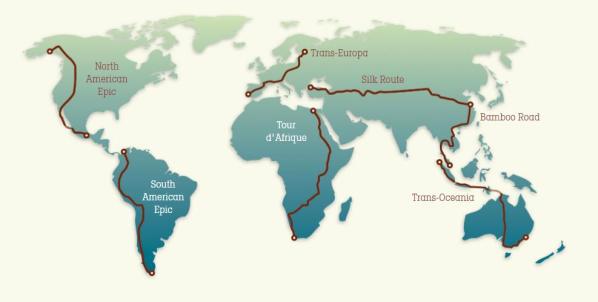
TDA Global Cycling’s 7 Epics
Salopek’s latest dispatch talks about the most precious life giving commodity water, which all of us cycling the desert parts of the world have pretty good appreciation of – see my own blog from cycling through the heart of Australia and one I wrote on World Water Day.
What makes his walk even more fascinating for me and what I have never realized when over the years we added one cycling epic after another is that our 7 Epics somehow follows the routes of humanity dispersal from Africa. And, of course, TDA Global Cycling started with the Tour d’Afrique tour, the place of humanity’s birth and its source of subsequent dispersal. It almost begs the question – do we all carry a genetic memory of human migration – a concept that has been studied by scientists in the last decade or so? My life partner often tells others when we are in a new place and lost that I have an internal GPS in my head but is there something more to this joke?
]]>Silk Route riders are soon to cross into Mongolia as they are midway through their first week of a 4.5 month long journey. They have been busy writing blogs and posting photos to social media. Here’s a brief selection to whet your appetite.
Remember to keep following their progress on Twitter, Facebook, and Instagram.
Preparations for #tdasilkroute are underway pic.twitter.com/omOCIvOqRw
— TDA Global Cycling (@tdacycling) April 13, 2016
https://twitter.com/Silk_Rider/status/727259887303012352
Off to cycle the Silk Route with TDA very soon. #TDASilkRoute
— Ruth Storm (@RuthStorm1) May 3, 2016
Check out the linup of riders for #tdasilkroute over on our facebook page https://t.co/gWZNZabwO8
— TDA Global Cycling (@tdacycling) May 18, 2016
Red Will #beijingtotehran #tdasilkroute #firstday #day1 #cycletouring #biketouring #bikelife #china @buffofficial #achildunheard #surly A photo posted by Beijing to Tehran (@biketripping) on
The Great Wall at JuYongGuan #history #beijingtotehran A photo posted by Beijing to Tehran (@biketripping) on
#TDASilkRoute So great to finally be out on the roads… pic.twitter.com/slGrM9syzW
— Aakesson (@Silk_Rider) May 15, 2016
The view from the saddle on #tdasilkroute Stage 1! #greatwallofchina A photo posted by TDA Global Cycling (@tdacycling) on
]]>New Silk Route blog post: I need to learn to nap https://t.co/WLoFuPPHDz #TDASilkRoute — Steve Winter (@steveWinterNZ) May 18, 2016
Click here to read our previous TDA Super Alumni profile of Brett Lanham, who has ridden over 50,000 km with us.
In the coming months we will be writing rider profiles of our most dedicated riders in a series called TDA Super Alumni. If you would like to join in the fun by telling your cycling and other life adventure tales to our website readers, just send a request by email to our office and we will send you the details.
We begin with Svend Paulsen, from Oshawa, Ontario, Canada, who recently turned 65 years young.
Tell us a bit about your background, where you grew up and live, what your working career is/was, and what got you started into cycling.
I have been retired from Teaching for over 8 years now. I taught in Quebec and then Ontario for 37 years, at all levels, focusing mainly on Physical Education but also some French. I became very involved in Athletics as a Coach and even moreso in officiating. As an Official I worked myself up to level 5 international in the Vertical Jumps and had to opportunity to work many World Championship events in Canada. Because I was so involved in coaching and officiating I did little traveling.
My first biking experience was in 1976 when my car was stolen from Lakehead University where I was studying. In order to get home from Thunder Bay I bought a bike and rode 1600 km to Montreal to watch the Olympics and an athlete I had been working with.
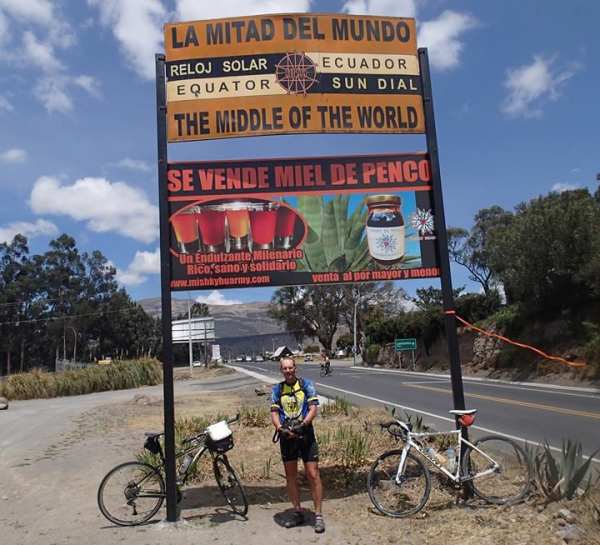
2015 at the Equator in Ecuador
What prompted you to decide to start doing long distance cycle touring?
My next big adventure was in 1981. Again I needed a break so I jumped on a bike and took off for 15 months solo, visiting west coast Canada & USA, New Zealand, Australia, and then back to Montreal.
Coaching, officiating and teaching occupied most of the 1990’s until I starting riding again in 2007. I was nearing retirement. I had a group of friends who always canoed, hiked and biked but I never went with them because I was too involved. I became involved.
One ride my buddy Frank Smith mentions a company called Tour d’Afrique . Along with another buddy, Hinchy (John Hinch), we decided to join. We were all retired. So in 2009 we did our first trip. It was great. We look back upon that trip and never forget the friends we made.
Since then we continue to bike together in and around Oshawa. We have done some small excursions together, namely our own Tour de Cottages in September.
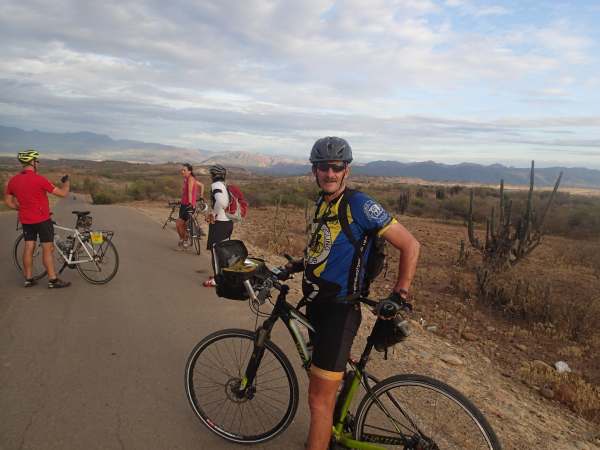
What places/moments have been the highlights of your cycle touring career?
There are too many to mention. In 2010 I did the abbreviated version of the Silk Route from Istanbul to Samarkand. I then flew to Saint Petersburg and cycled the Amber Route to Venice. From Venice I continued on my own, self-contained through Italy, Austria, Switzerland, Italy again, Greece and then back to Istanbul. In 2011 I joined TDA’s second South American trip from Buenos Aires to Lima. In 2013 I attempted the first Bamboo Road but unfortunately 4 days in I had an accident with a moped. I returned to Canada to have my left elbow replaced. 2015 saw me receive a new left hip and 6 months later cycle the South American Epic from Cartagena, Colombia to Ushuaia, Argentina.
The hardest was the last SA Epic mainly because the first two weeks were very tough when we were still getting our riding legs. All told with TDA I have biked around 42,000 km. My goal is to complete the 7 Epics.
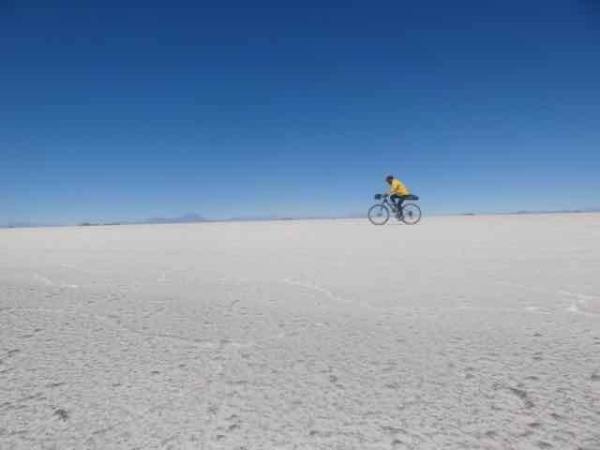
2015 Crossing the Salar in Bolivia
Beyond cycling, what other amazing travel adventures have you had?
I tried a few Triathlons in the mid 80’s. And a few months ago I went to Antarctica after finishing the South American Epic.
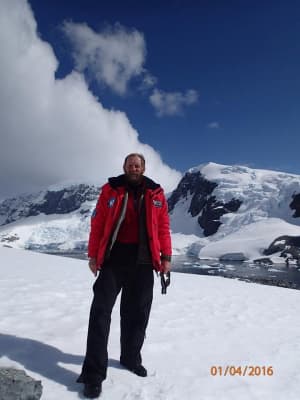
In Antarctica
Tell us about your favorite cycling tour bike.
I have always used a hard tail mountain bike. I love Schwalbe Marathon Plus tires.
What life lessons has cycling given you?
I do not want to bike by myself any more. I like the challenge of not knowing what to expect each day while having the support of all the new friends around me. The one thing that brings me back is the people of like mind that I now can call life long friends.
With TDA it is a very simple life. Get Up, Eat, Ride, Eat, Talk, Sleep.
But as I said, it’s the people that I meet that I remember the most.
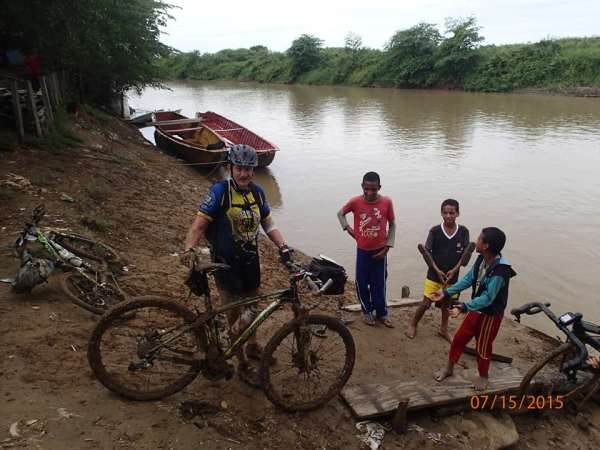
2015 Getting ready to take a rural ferry in Colombia
Communications director Britten took a well deserved break from the tour and traveled ahead into Patagonia and came back with this report. The South American Epic heads onto the Carretera Austral entering Patagonia this week.
It’s a place that stirs the imagination of travelers all over the world. Rugged, iconic mountain peaks. Crystal clear river water. It’s the bottom of the world — Mordor, where Frodo fatefully destroys the ring. And getting there by our own leg-powered bikes makes it feel even more like the epic finale Tolkien wrote about in Lord of the Rings.
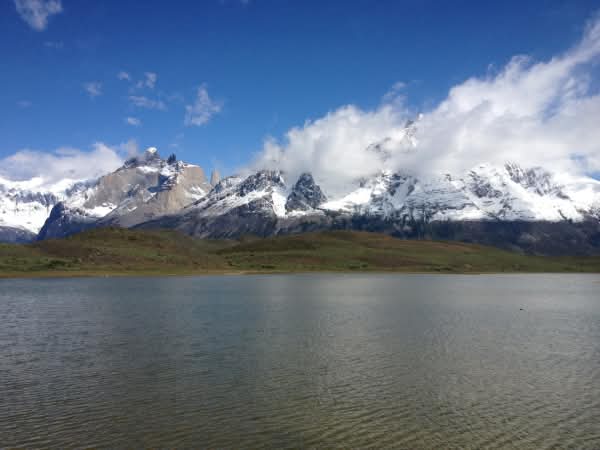
The final section from Puerto Montt to Ushuaia will take us through the famous Patagonia along the rough-and-tumble road known as the Carretera Austral, which is essentially a sinewy strip of gravel road that claws its way south. High wind and biting cold await us – this we know. But we also know that some of the most beautiful scenery of the entire trip remains to be seen. I happen to know this personally, as I just came back from a short vacation down to some of the places we’ll be passing through soon.
With 8 days to explore, I decided to skip ahead of the group and spend some extra time in a region I’ve wanted to visit desperately ever since a National Geographic program yanked my attention as an adventure-hungry 10-year-old boy.
I couldn’t believe how lucky I was to get near-perfect weather, especially since the Patagonia is infamous for its wild weather mood swings. It can go from sunny and calm to stormy and dangerously windy in a couple hours. My eyes were set on a couple places in particular: Torres del Paine, the Perito Moreno Glacier, and of course Mount Fitz Roy. The throngs of hikers didn’t take away from the awe these places produced. Framed in the clear blue sky, the mountains did not disappoint. The peaks stick straight up into the air, as if to angrily puncturing the sky. With such strong wind ripping through the cracks and crevices of the granite spires, the mountains erode in a unique, raw way. I’ve never seen anything like it.
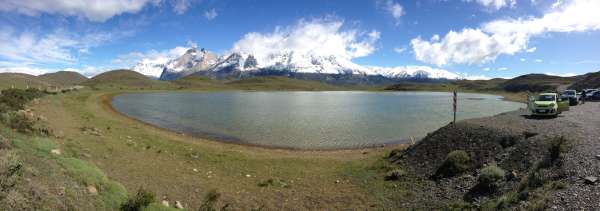
As I made my way through the area in a rental car, I enthusiastically cheered on the few intrepid cyclists I saw on the road with excessive honking and fist pumping outside the window. The solidarity I felt with them was equally as inspiring as it was heavy and ominous; I knew I’d be battling the wind on these same roads with the rest of the group very soon.
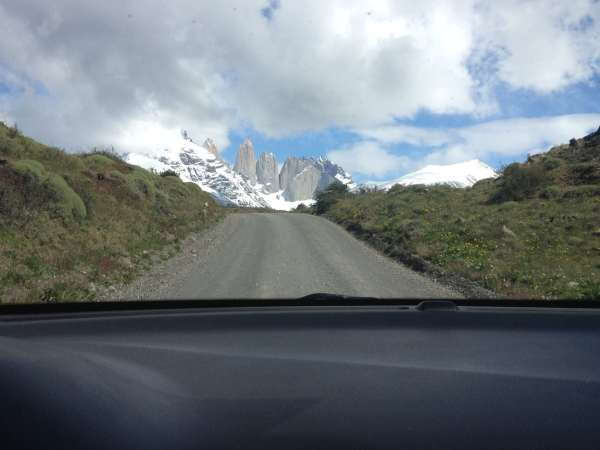
As hard as it is to believe, we’re on the final leg of this ridiculous adventure. One month left?! I won’t even pretend to be able to reflect just yet but I can say with certainty that we’ve got some hardy days on the horizon. But what’s a proper adventure without an ass-kicking, humbling, and empowering finish? Not the epic one we signed up for, that’s for sure.
]]>The cyclists on the South American Epic just completed the Lake District section on this epic tour. Here Will sums up Santiago – the city where this section started.
Before arriving in Santiago, I knew very little about the city. From friends and other travelers I had heard mostly bad reviews – “don’t bother, it’s not worth it” or “it’s just like any other city.” Regardless of the reviews, we did end up stopping along the way. Granted, Santiago does bear many resemblances to large North American cities, but there’s something to be said for one of Latin America’s most modern cities. While it may seem to some ‘just like any other city’ in North America, it is like no other city in South America.
In my experience, no other city that I have visited in Latin America has been so manicured, wealthy and well equipped with common-sense infrastructure. While this might not appeal to every intrepid traveler, for those of us on tour who’ve struggled through wind and rain, camping and cold showers for months on end, basic amenities can be a real treat. Apart from the simple joy of a hot shower and a café with WIFI, Santiago is a social and economic enigma on the continent, and for this reason alone I think it deserves some mention.
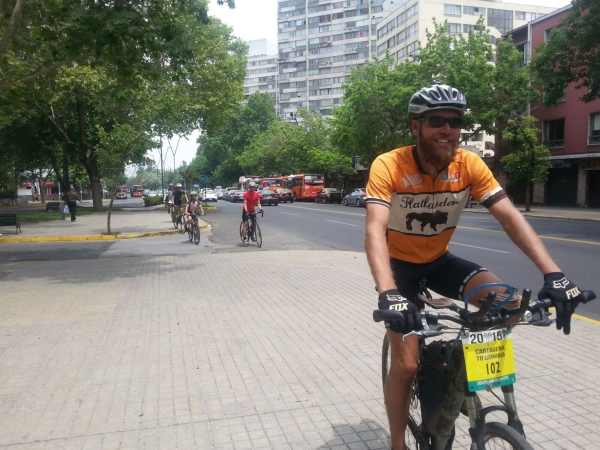
Jason is happy to arrive in Santiago
With over 7 million people, Santiago is a sprawling metropolis, situated in the middle of a nation rich in natural and agricultural resources. The city sits just above sea level, but still benefits from mountain views on clear days. The downtown core bubbles over with glitzy skyscrapers, from which neatly dressed Chilean business-people spill out onto polished side-walks. A sharply dressed business elite isn’t unique to other Latin America cities, but what is unique in this city, is just how far the wealth stretches outwards, both geographically and economically. In other Latin cities, step outside commercial core and things start to look pretty dilapidated pretty quick. However, in Santiago, you can drive for up to an hour from the centre, and still experience well-groomed streets, tidy shops and houses, and paved roads filled with rather well-behaved drivers. Santiago is a very wealthy city, and much of that wealth is in the hands of a healthy middle-class.
A thriving middle class is uncommon in South America. Most countries are polarized, having either super rich or super poor populations – with the latter visibly marginalized to slums. Don’t get me wrong, Chile does have poverty, and it does have inequality, but compared to other Latin countries I’ve been to it is definitely not as prevalent or acute. Why exactly Chile enjoys such a thriving middle class, when the rest of the continent struggles with abject inequality, is not entirely clear to me, nor is there enough room for me to explore it in an already lengthy blog post. The history of Spanish colonization, European migration and investment, rich agricultural land, sea access, and modern industrial sector fuel a robust Chilean economy. From an environmental perspective, their heavy reliance on export-oriented agriculture and mining might not be the most sustainable cornerstones, but they have created wealth that is fairly well-shared in the country.
Given that Santiagoians enjoy a bit more jingle in pockets and purses, it seems that they have a little more money to spend on leisure and recreation. This is made evident by the ubiquity of outdoor and sporting shops. Climbing and mountaineering are of course popular given that Chile also boasts some the most spectacular mountains in the hemisphere, but luckily for us, Chileans are bonkers for biking. Because of this, the city is littered with bike lanes (ciclo-vias) that transect the grid-pattern of the city with impressive reach – stretching well beyond major routes and well out of down town. On our way to the hotel we snaked beside an attractive bike path that wove through lush green spaces, transporting frustratingly active and attractive Chileans from place to place.
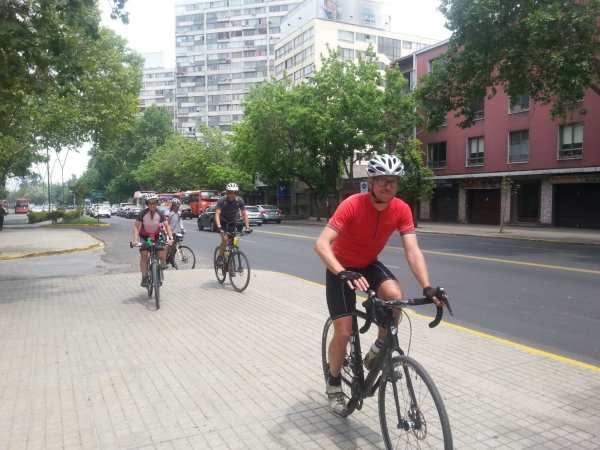
Riders reach hotel via the ciclovia
Though cars and motorbikes whip down the main boulevards and avenues, Santiago also has a very sophisticated public transit system – in particular their subway system. With five lines running across the city, it’s very easy to get from one end to the other. The platforms are shiny; the service is quick, and all for about $1.50 USD. Modern transportation services like this too are rare in Latin America. Most Latin-American cities’ transportation systems are chaotic, smoggy, vehicular orgies, which (despite their charm) seem to have very little planning involved in their arrangement. Despite the charm of this organized chaos, as Latin American cities continue to grow, Santiago perhaps offers a plausible transportation solution moving forward.
Pushes for progress and modernity always come with their costs to custom and culture, and Santiago of course is no exception. Big box stores abound, creating that all too familiar ‘landscape of nowhere’ which can be found pretty much anywhere. But charm and intrigue still live beneath the surface. A perfect example of where modern and traditional have come to a workable compromise is the central market. Situated in a massive old colonial building which stretches several blocks, this commercial centre has everything a shopper could find at a big box location, but all the charm of an old open air market. You can easily find your electronics and brand-name running shoes, but like the traditional markets we’ve passed through in Peru and Bolivia, the aisles spill over with neatly piled fruit and vegetables stalls, and a fresh seafood market showcases of the local favorites. Right beside the veg and seafood stalls, local hole in the wall restaurants prepare cheap, fresh meals, such as ceviche, seafood stew, fried whole fish, and dozens of other delights. I made a point to graze through sampling everything I could find and afford.
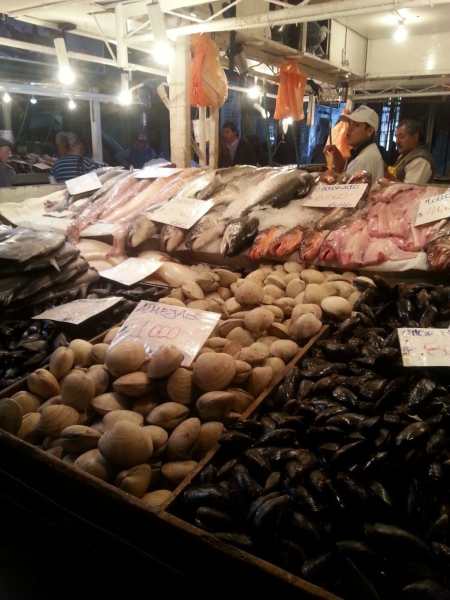
To wrap up, Santiago does bear a strong resemblance to many North American cities, but this modern city is quite unique in a South American context. The reasonable distribution of wealth in the country has ensured a strong middle class, an interest in active living, and excellent infrastructure to support cycling and public transit. Though compromises are made in modernizing, Santiago retains its Latin American charm. As a group of haggard cyclists traversing a continent together, Santiago was also a great place to stock up and recharge. Moving on from Santiago, the tour enters some of its most challenging and beautiful portions. Patagonia, here we come!
]]>Here is Conor’s latest update from Thailand on the 2015 Bamboo Road cycling expedition.
Although none of the Bamboo riders may have felt it at the time, looking back at our start in China the days actually seem cool now. As we have worked our way south through Vietnam, Lao, Cambodia and now Thailand the days have become hotter and more humid. Where up north riders often took their time during the ride, many have now adapted their strategy to push hard early in the morning in hopes of avoiding the worst of the days heat and sun. Arriving to town, many seek refuge in whatever air-conditioning they can find; whether it’s the hotel or just the closest Seven-Eleven. Bikes are often locked up on arrival and local transport is accomplished through the shade and breeze of the cheap and ever-present Tuk Tuk.
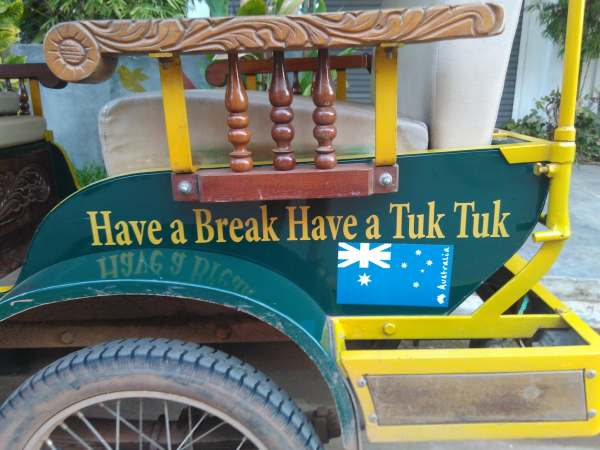
Tuk Tuk’s have become an everyday part of life on the Bamboo Road
Fortunately, as our route heads south we have now entered the Malay Peninsula where the coast is never far away. With our route hitting the coast several times in a day riders are able to feel a cool sea breeze or even stop for a quick swim mid-ride. Just when the heat seems unbearable, the beautiful open beaches of Thailand’s east coast appear and make the riding that much easier. Of course, where there are beautiful beaches you’ll find buses of tourists, however with over 3,000 km of coastline in Thailand there’s plenty to go around!
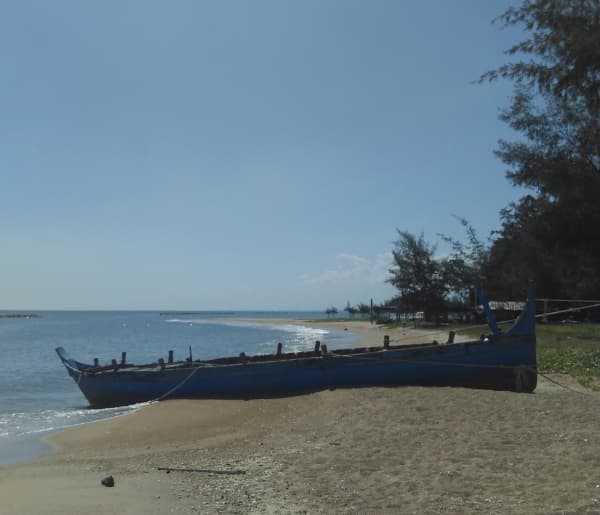
With views like these, the heat doesn’t seem so bad!
However, it’s not just the weather that has been heating up as we move south. As the local cuisine changes we have encountered spicier foods, from curries to stir-fry’s the level of spice has increased daily. The Bamboo riders have learned to order food carefully if they’re sensitive to spice or at least temper their eagerness to order the spiciest dishes unless they have the hardiest of taste buds. Even breakfast is not off limits to spice; at 6am you’re likely to find a small bowl of chili peppers ready to add to any dish. But just like the saving grace of beaches when the temps get hot, Thailand’s Singha beer is always a crowd favorite and life saver.
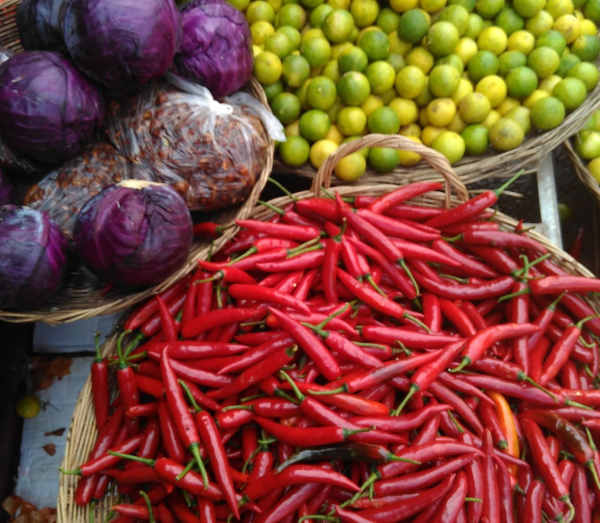
Thailand’s unofficial national ingredient: the chili pepper
]]>
Cycling in the Lake District on the South American Epic, Henry Gold gives us his first post.
It is never easy to describe the appeal of TDA tours. Take today, a ride from Chanco to San Nicholas, a 143km ride with an elevation gain of just over 2,000m, significant section of the road under construction, forcing the riders into a detour on dirt road and climbs of 15% gradient or more. This being southern Chile, there is always wind to contend with. Add to this, the original lodging in town did not work out and Cris – the intrepid leader – was in urgent search to find accommodation for a group of 47 people, with no hotels in town. So it would be a good assumption that tonight the riders will not be a happy bunch.
While Cris was looking for a place, a Brazilian woman living in San Nicholas recognized his vehicle licence plate (from Brazil), after which a long discussion ensued ending with an offer; “let me know if you need anything” – pointing her finger to her home with a full kitchen.
As Cris ran around looking for a place, a man who owned a tire shop offered his farm just outside of town: “I have a big field and you can camp there.” Cris and the owner went to take a quick look. A decision was made. The farm on a small hill facing some of the highest Andean peaks with the light reflecting from the snow in the distance would have to do. An impromptu outdoor shower was set up, the dinner truck arrived unloaded and started preparing dinner.
Once back in town the first racers arrived worn out and hungry. Being Sunday and fiesta time, everything was closed. So Cris headed to the Brazilian woman who immediately started cooking food. Soon enough the racers were not only fed but showered and enjoying the hospitality. It took them over three hours before they decided to make their way to the campsite.
In the meantime, other riders were arriving at the farm where Carlos and his son Carlos have returned from shopping and brought soft drinks and beers for the riders. One by one tired riders arrived and somehow the lack of facilities seemed not to matter. What mattered was the simple things: a wide field covered with flowers, a beautiful view of the Andes, the open-hearted welcome by the owner, and the camaraderie that comes along when a group experiences something unique.
After dinner of barbecue chicken, salads and rice, the riders were sitting on Carlos’ veranda, exchanging ideas, sipping drinks as the sunset hit the mountain peaks, and experiencing a general sense of a day well spent.
]]>You may recall that tour medic Irin’s post from Northern Argentina. Here is tour staff Will explaining some more of that dramatic time of the tour. The South American Epic is now in the Lake District of Chile south of Santiago. More reports from Chile to follow.
Our time in Northern Argentina was spent meandering by bike through lush vineyards by day, and by night enjoying wine and tasty snacks in pleasant spring-time temperatures (read more about wining and dining in my last blog post). For our first two weeks in Argentina the snow-capped Andes sat placidly on the horizon, but as we moved out of the Mendoza region and towards the border with Chile, those same mountain views became more and more dramatic.
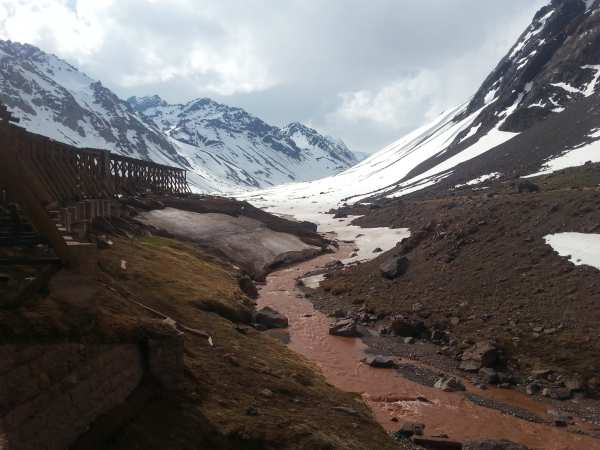
The weather also became more unpredictable as we started our ascent back into the mountains. Temperatures dropped and the threat of precipitation loomed. It loomed, and then it attacked. After dinner one night in a small campsite near Perdenal, a deluge of rain and hail pounded our campsite. Water ran though the campsite, like a river, as staff and riders alike raced to get their tents to higher ground. The next night, forecasts of an electrical storm forced us to pack up our tents and head into Ushpallata one day early (here is the report from that epic day).
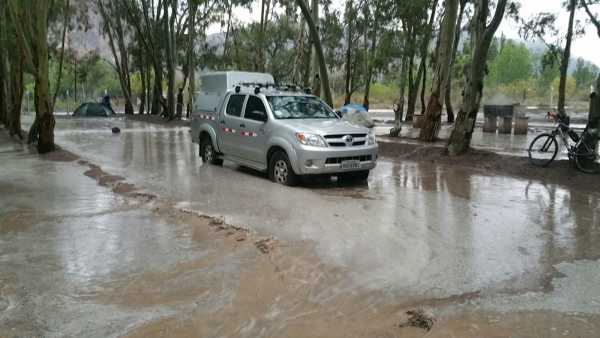
We arrived into Ushpallata under the cover of night, but when we woke up we discovered that we were completely surrounded by white capped mountains. From Ushpallata, we spent an incredible two days climbing up narrow mountain roads, zooming through covered tunnels, passing by ski-hills decorated with rustic ski-lodges, all the while taking in ever more stunning views. The second days’ climb to the summit had us riding in the shadow of South America’s highest mountain peak, Aconagua, which sits at an impressive 6962 metres.
At the approximate base of this massive rock sits the small ski town of Las Cuevas. This quaint little village is built right onto the edge of the slopes. Being springtime, the village was emptied out of tourists, and the SAE crew had the whole place to themselves. Riders filed in and made their way to their dorm rooms like school kids on a ski-vacation – and later made their way to the cozy wood-clad lodge for drinks and homemade empanadas. Dinner was being prepared by our host, Carlos and his wife, who owned the lodge. For most of the afternoon they were busy preparing our dinner, a lovely meal of homemade pasta and savoury tomato and beef sauce.
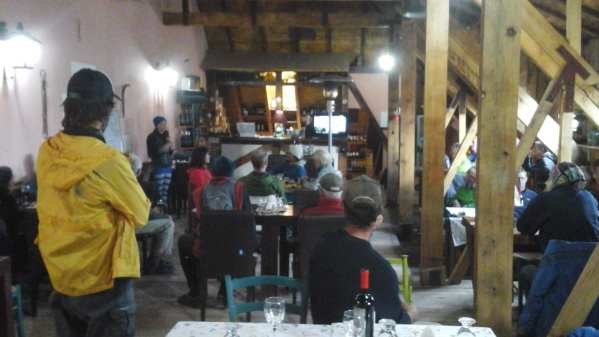
Because they were preparing dinner, the staff team had some free time to have some fun and explore the area. Antonio, our Brazilian bike mechanic, had his first encounter with snow, to which he was very pleased. Our medic Jodi, who is no stranger to snow-cap mountains, insisted that a sliding party was in order. It didn’t take much convincing the other staff. Without hesitation the extra tubes from the support vehicles were inflated, extra layers applied, and the TDA team was off to the slopes. It was the first time sledding for our Tour Director Sharita, but I can safely say it was all of our first time with high altitude tubing.
In my opinion, the best way to experience the beauty of the Andes is to hurl yourself down them in a giant, improvised, inflated, rubber donut. Our little foray in the mountains was just what we needed to recharge, and muster up the energy to make the border crossing into Chile the next day.
A few more shots from our tubing….
Last week we had a staff profile of Adrian on the South American Epic. Here is one from our tour underway in SE Asia – the Bamboo Road.
Hometown: Cape Town, South Africa
Age: 36
Previous Experience: 3 years as a bike mechanic in South Africa, 3 years working for Kona Bicycle Company’s UK distributor, Mechanic for Kona’s World Cup Team, SBCU Bike Fit course with Specialized in San Jose, CA
Education: Diploma in Mechanical Engineering in South Africa
Previous TDA Experience: Africa 2014, Silk Route 2014, Africa 2015
Current Role: Mechanic on the Bamboo Road
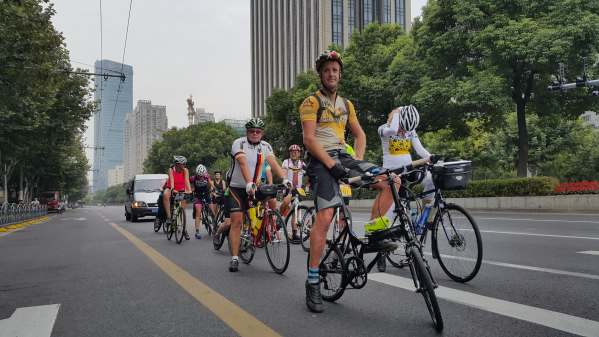
Why TDA?
Initially, I was interested in joining TDA as a means of seeing Africa. In South Africa we tend not to travel the continent and instead go overseas. My brother, Doug worked for TDA first while I held down a more “permanent” job, and then came back telling stories of his great experiences. It didn’t take much convincing to leave my previous job and we’ve both been at it ever since.
Why bike travel?
Because cycling is a fantastic sport! It’s the most rewarding sport I’ve been a part of; as far as experiences, seeing new landscapes, maintaining fitness and being healthy. It’s the perfect balance between working hard and experiencing the world. It’s not an easy sport, but it’s always worth it.
So what do you like about serving as mechanic on a TDA tour?
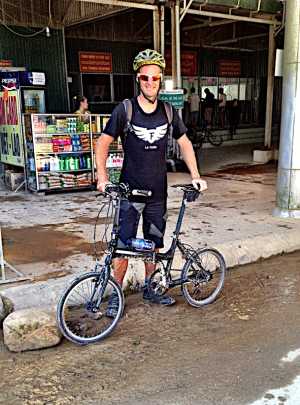 I would say solving problems with limited resources. Keeping bikes moving when we don’t often have the perfect replacement parts or even tools. It makes you work with what you’ve got and think a little more. Serving as a bike mechanic in a shop you have access to great tooling, clean working environment and availability of spares. On a tour? You have none of those. It’s a focus on keeping the critical running gear working on a bike.
I especially enjoy working on bike builds at the start of a tour. Since we spend so much time on our bikes, it makes an incredible difference on how a bike is set up. With countless hours in the saddle, the precise fit and placement of bike components makes a world of difference.
Describe your dream trip:
It would be a race, but self-navigated with camping, shit weather and extreme terrain. It would likely require a full suspension mountain bike because it should include at least 3000m climbing every day. Suitable locations? Iceland (for the weather), Patagonia (for the extreme terrain), or the Atlas Mountains (for great climbing).
]]>See the details of the 2016 Trans-Europa cycling tour here.
Creating bicycle tours in Europe is one of the best jobs in the world. There are so many highlights, so many great roads; often the toughest decision is figuring out what you have to miss, rather than what there is to see (read what some of the past cyclists had to say). So when we heard that Pope Francis was coming to Krakow at the same time as we were scheduled to arrive in the city, and that his followers had booked up every hotel room within 50 km, we were confident that another route – just as enticing – could be found.
From our Trans Europa staff, who conveniently live in Slovakia and Hungary, as well as from the founder of TDA, Henry Gold, whose roots are nestled in the foothills of the Carpathian Mountains of Slovakia, we devised a new adventure. From Warsaw we have the chance to follow nearby to the Wisla River as it meanders southward across the Polish countryside, visiting small villages and towns. As we arrive in Southeast Poland we leave the Wisla River behind to head towards Slovakia and the town of Košice. Before arriving in Košice though we will tackle the very Carpathian Mountains where Henry Gold grew up, perhaps we’ll even get to see some of his relatives along the way!
 CREDIT: Jozef Kotulič on Wikimedia Commons, CC BY 3.0
Košice is a city we’ve never visited on a TDA trip before. In eastern Slovakia it boasts a wealth of history, and was indeed named the European Capital of Culture in 2013. Our friends at Lonely Planet describe the city this way:
“Košice was always a medieval gem awaiting discovery. New enhancements build on an arts scene already home to the paintings of Andy Warhol and one of Europe’s loveliest theatres. Its vast oval-shaped námestie (central square) contains the largest collection of historical monuments in Slovakia, enlivened by a myriad buzzing cafes and restaurants. Out of town, nature encroaches spectacularly with the delights of Central Europe’s grandest cave network. It’s the base of choice, too, for forays deeper into the tradition-seeped east.”
Don’t just trust Lonely Planet though, the New York Times has a few things to say also. On top of that, Košice has now been named the European Capital of Sport for 2016!
From Košice we will head to the southern edge of Slovakia where we will enter Hungary, one of the greatest empires of not so distant times. Sticking to a northern route we will experience a part of the country rarely seen by tourists and a taste of the “real” Hungary, before our arrival in one of the most upbeat and bohemian cities of Europe, Budapest. With two rest days to enjoy the tastes, sites and sounds, and no doubt some great touristic suggestions from our tour leader Gergo, who lives in Budapest.
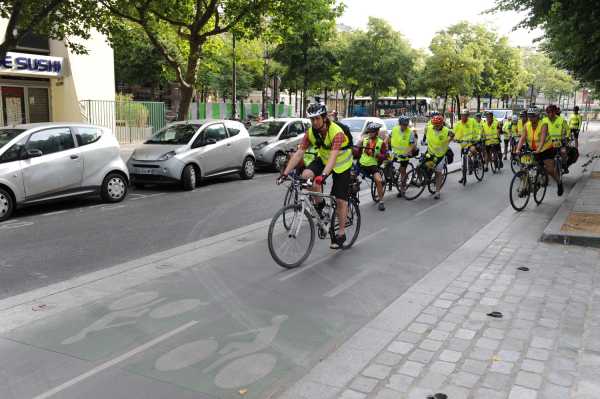
Gergo has been telling us for years of the wonders of cycling alongside Lake Balaton, where his family has been going on bike journeys together for three decades, and now it’s our chance to experience it with him. We’ll head out from Budapest and then ride along the lake’s northern shore, and most certainly enjoying a swim each day after our work in the saddle is complete. Soon after the country of Slovenia awaits where we’ll rejoin our previous Trans Europa route and continue on all the way to Lisbon.
Take a look here at the two sections that have been revised as a result of our dear friend the Pope:
The Amber Route from Vilnius to Budapest
The Alps and Adriatic from Budapest to Venice
Following up from our last Argentina reflection, here is another from Will from the South American Epic.
Bolivia was memorable for the dramatic mountain views surrounding La Paz, the wind-swept plains of the alti-plano and the mesmerizing allure of the salt flats. But for all its charm, Bolivia had its challenges too. Blistering winds and frigid night-time temperatures left riders and staff alike mildly stunned and dreaming of greener pastures on the other side of the border. As it turns out, our greener pastures took the form of acres and acres of vineyards.
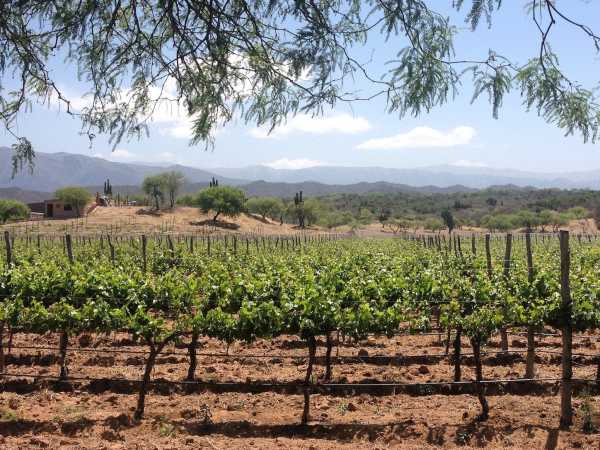
As we edged into Northern Argentina from Bolivia, we dropped in altitude and jumped in temperature. Cold Bolivian Andes melted into meandering rivers, twisting through red rocky corridors. The geography of Argentina was equally rivaled by its culture and cuisine. The distinct European influence of Argentina was pleasantly obvious as soon as we passed through the small frontier town of Chocaya. While Bolivia boasts unbelievable landscapes and a rich indigenous culture, it is not well known for its food or drink.
Argentina, on the other hand, is world renowned for its wine, and because of the prevalence of European ancestry in the region, good cheese, fresh baked bread, olives and espresso are all readily available. For a group of riders who spent the last month in bush camps, eating simple fair, these small luxuries go a long way. Argentina is most praised for its Malbec and Syrah grapes – and great vintages of both are ubiquitous across the region. Wine plays a major role in the Argentinian economy and is a major influence on its culture as well.
As we made our way from the border to the city of Salta, the small sinuous highways were lined with vineyards, stretching for kilometers to the foothills to the Andes Mountains that lay ahead. The province of Salta is lesser known on the international stage than their southern counterpart of Mendoza, so many of the wines on offer there are unavailable outside of Argentina. Many of the wine growers here produce on a small scale for bodegas that are sold and enjoyed locally. We eagerly did our part to enjoy them while passing through.
As we travelled out of Salta city and into smaller wine producing towns like Cafayate and later San Juan, the richness of the local wine culture became increasingly obvious. What I’ve failed to mention so far is that delicious small batch wines (that would cost a fortune back home) can be purchased for 2-3 dollars here in Argentina. If you really want to treat yourself, spend $5 at the corner store or gas station, grab a hunk of crusty bread and cheese and you’ve got your afternoon sorted. Given that the ‘siesta’ is strictly enforced, there’s literally no better way to spend an afternoon as most shops and restaurants shutter their doors until the evening when things liven up again. Argentina has a knack for injecting class into the most unlikely locales, and at a price that can’t be beat.
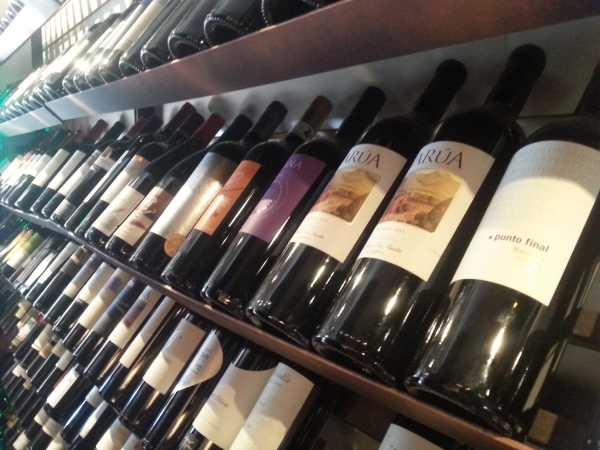
More than once I’ve enjoyed a great glass of wine, or an espresso at a gas station, while picking away at a plate of cured meats, olives and bread. Given the availability of delicious wines at great prices, the South American Epic has doubled as a wine sampling tour as we wind our way down from Northern Argentina to the border with Chile. It’s fair to say that panniers have hung a little heavier for these past few weeks, bottles clinking in chorus as riders arrive to camp. And compared to the cold wind swept camps of days gone by, sites in Argentina have been a little more festive, with the help of cheap, delicious, lesser-known wines, and more comfortable conditions to enjoy them in.
Of course the leisurely evenings sipping wine and enjoying the comfortable temperatures won’t last forever. Soon we will be climbing back into the Andes, and struggling through wind and rain in the Patagonia. But, having had the time to take a breath and enjoy the pleasures Argentina has to offer, will make us all the more ready for the challenges ahead. And if we’re lucky, we’ll still have a few of those bottles tucked away to celebrate a hard days ride.
]]>The riders and staff of the South American Epic are now on a day off in Santiago. Here is a look back on their time just recently finished traversing northern Argentina.
 After Bolivia entering Argentina was like entering the land of milk and honey. Plenty and a huge variety of food, wines, beers. And suddenly the landscape changed as well. Being back in a rocky area brought a lot of variety and entertainment to our rides. Between Salta and Cafayate the Garganta del Diablo (The Devil’s Throat) in the Quebrada de las Conchas – 75km long and in some parts very narrow part of the valley of the Rio Guachipas – gave us some good photo motifs for our scavenger hunt and was the start of many spectacular rock formations and mountains in Argentina. Coming down from the Andes in the beginning of Argentina brought the warm weather again. Soon swim suits and shorts were unpacked and every opportunity to jump in a river or natural pool was used.
 On our way towards Santiago de Chile we had to cross the Andes again. After San Juan the weather got colder and colder again. We came across our first snowflakes on the climb between Pedernal and Uspallata. The weather made it impossible to camp, not because of the cold or snow, but because our campsite was in the middle of an electrical storm. After our campsite had been flooded we decided to head into Uspallata a day early, which gave us plenty of time to explore this little town. Some of us went on a hike or bike ride to the Mountain of the Seven Colours – a beautiful mountain with all shades of green, pink, grey, red and yellow. Walking the 9km there and the consequential blisters were definitely worth it.
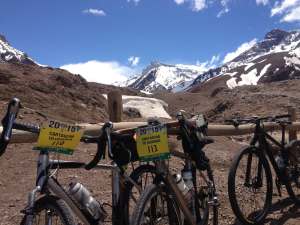 Exiting Uspallata it was only another 65km to the Chilean boarder. But those 65km were some of the most spectacular and entertaining kilometers of trip. Climbing out of Uspallata we passed famous Inca Bridge, an impressive and colourful natural arch over the Vacas River. Only 10km later we rode passed the entry of the Aconcagua Provincial Park. The lucky ones amongst us saw the tip of the Cerro Aconcagua – at 6960m it’s the highest mountain outside of Asia – before it disappeared in the clouds.
 Because of a snow storm only two days before, we passed the night in a hostel in Las Cuevas, our last night in northern Argentina. Being hosted by a very nice family who even prepared our meals gave us plenty of time to spend in the snow, exploring, sledding and having snowball fights. After another night of excellent wine and food in Argentina it was time to say goodbye – for now. The next day we passed the boarder into Chile. Bye bye Argentina – see you in a month.
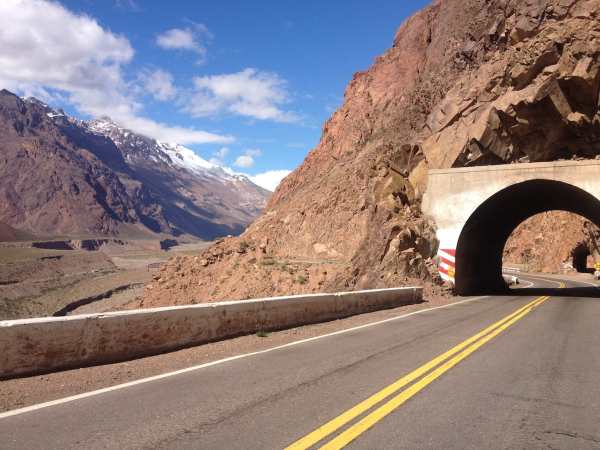
One of many tunnels on the road to the Chilean border
Dinner at the hostel lodge

Ancient Incan bridge
]]>
Jacob’s latest report from the North American Epic cycling tour:
Arriving in La Paz (Mexico, not Bolivia!) was an important moment on the North American Epic. Not only did it announce the end of the terrific Baja California section – one of the toughest but also most enjoyable couple of weeks so far, it also acted as a bookend to the riding we have done all the way from Anchorage. In La Paz we took an overnight ferry to the town of Mazatlan in ‘mainland’ Mexico, giving the tour a refreshing change of scenery, and some extra recuperation time. With this last geographical obstacle out of the way, the tour is now on the penultimate ‘Beaches & Beer’ section before our final approach to Mexico City begins.
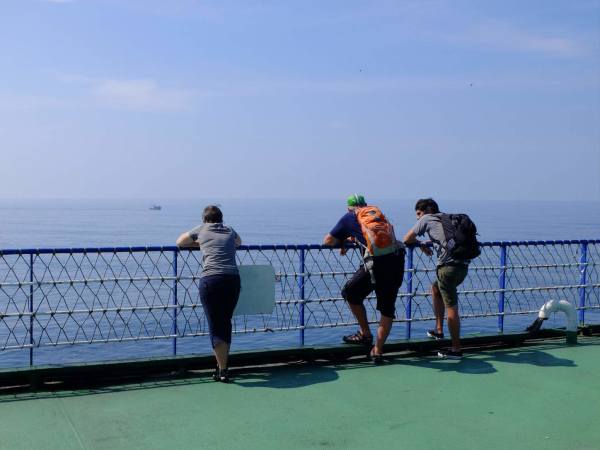
The whole ferry experience was much more routine than expected – but that is not necessarily a bad thing! After riding a testing 18 kilometres in the rain to the terminal, the riders boarded the passenger ferry with their bicycles without a hitch. On board, the European plug sockets as well as the British and Dutch signage, revealed the slightly ageing vessels origins. A small canteen area and film room provided refreshments and entertainment, whilst we all had nicely sized cabins to relax and sleep in overnight. The inclusive food consisted mainly of various shades of beige – beans and tortillas, and was almost identical for both the evening and morning meal. Up on the top deck, riders enjoyed both a great sunset and a stunning sunrise, with views of the calm and serene Pacific Ocean. Even though this ferry experience didn’t have the craziness of a crossing through Sudan, or elsewhere, there was certainly a sense of accomplishment and reflection before we resumed riding towards the finale of the tour.
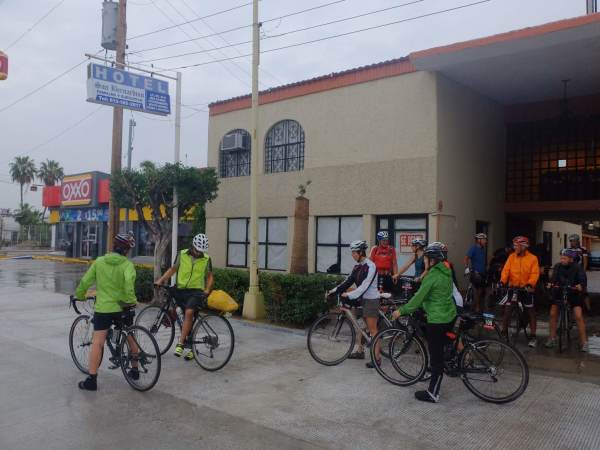
Our last few days riding in Baja provided an interesting twist to our prior experiences, with rain being a major feature towards the end. Despite one major downpour, the showers were light and actually a refreshing change to the searing heat we have experienced so much recently. We tackled a couple of (by Baja standards) challenging climbs with switchbacks and steep sections. Our first impressions of mainland Mexico are of the vibrant city of Mazatlan which has great beaches and plenty of places to grab some food. The most noticeable change is the humidity as opposed to the very dry heat of Baja. This will present a new challenge for the riders on the last few stages, as well as being in more highly populated areas than we are used to. After reaching the resort town of Puerto Vallarta we will begin heading inland from the sea on the aptly named ‘Conquistadores’ section, towards the highlands of central Mexico.