Blog
 REGISTER NOW


Oaxaca On Two Wheels: A Street-Art Ride Into Mexico’s Soul
Arjuna Boucher-Pertuisot is the Content Creator on the 2025 North American Cycling Expedition. A huge shout out to Coyote Aventuras & guide Diego Jacob Cano for their support and insight into this fascinating city.
My rest day in Oaxaca didn’t involve the normal rhythm of the tour, long climbs or rushing to a hotel. Instead, Michael arranged something that fit the city perfectly: a bike tour through Oaxaca’s most iconic street-art neighbourhoods with local artist and guide Diego Jacob Cano. It ended up being one of the most meaningful cultural moments I have experienced since arriving in Mexico.
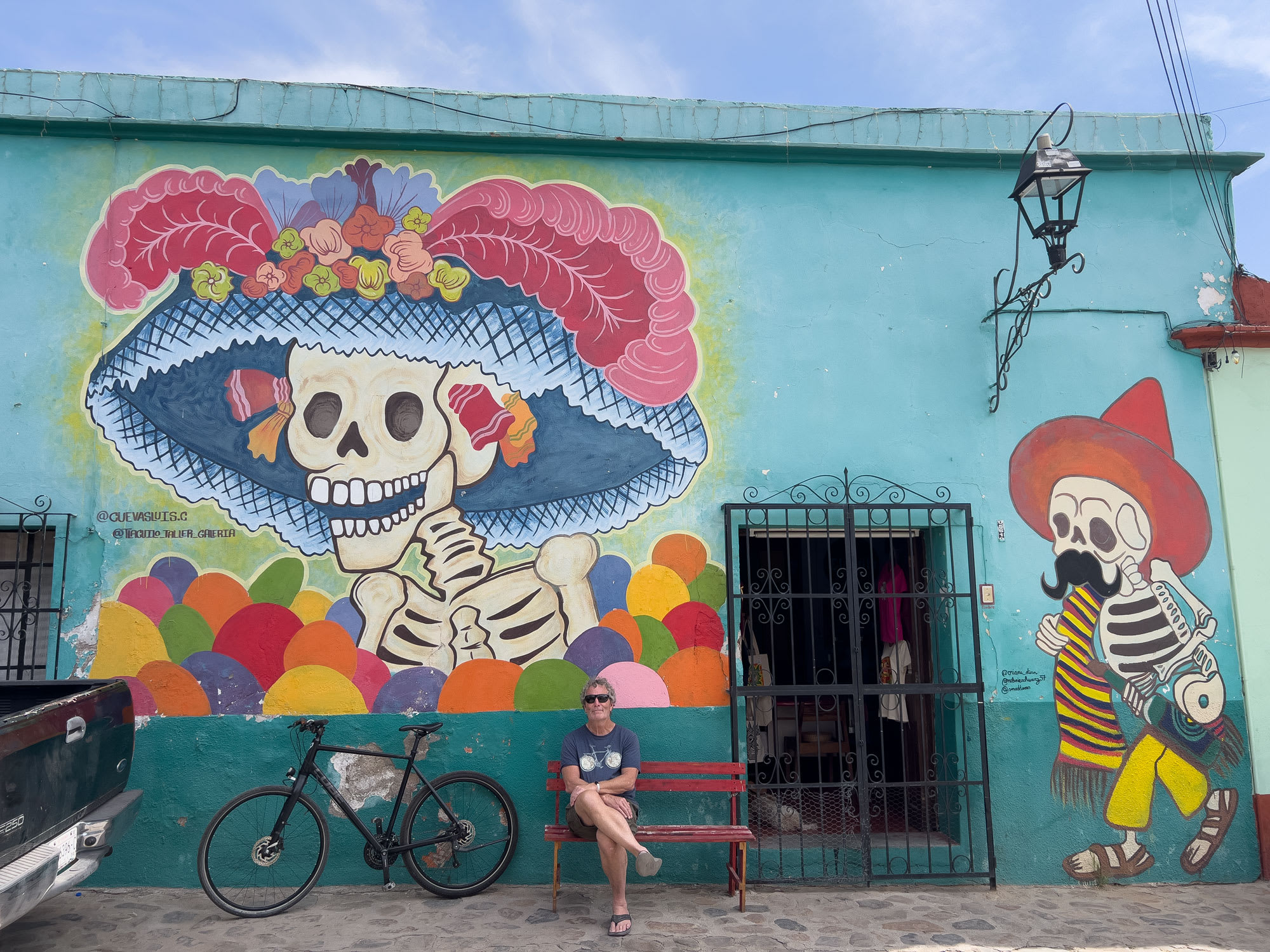
The thing about Oaxaca is that it doesn’t just show you its culture, it surrounds you with it.
You pedal through it.
You breathe it.
You ride right into it.
And through Diego’s eyes, the murals we saw became more than visuals. They became lessons about identity, community, spirituality, politics and the land itself.
A City That Pulls Artists In
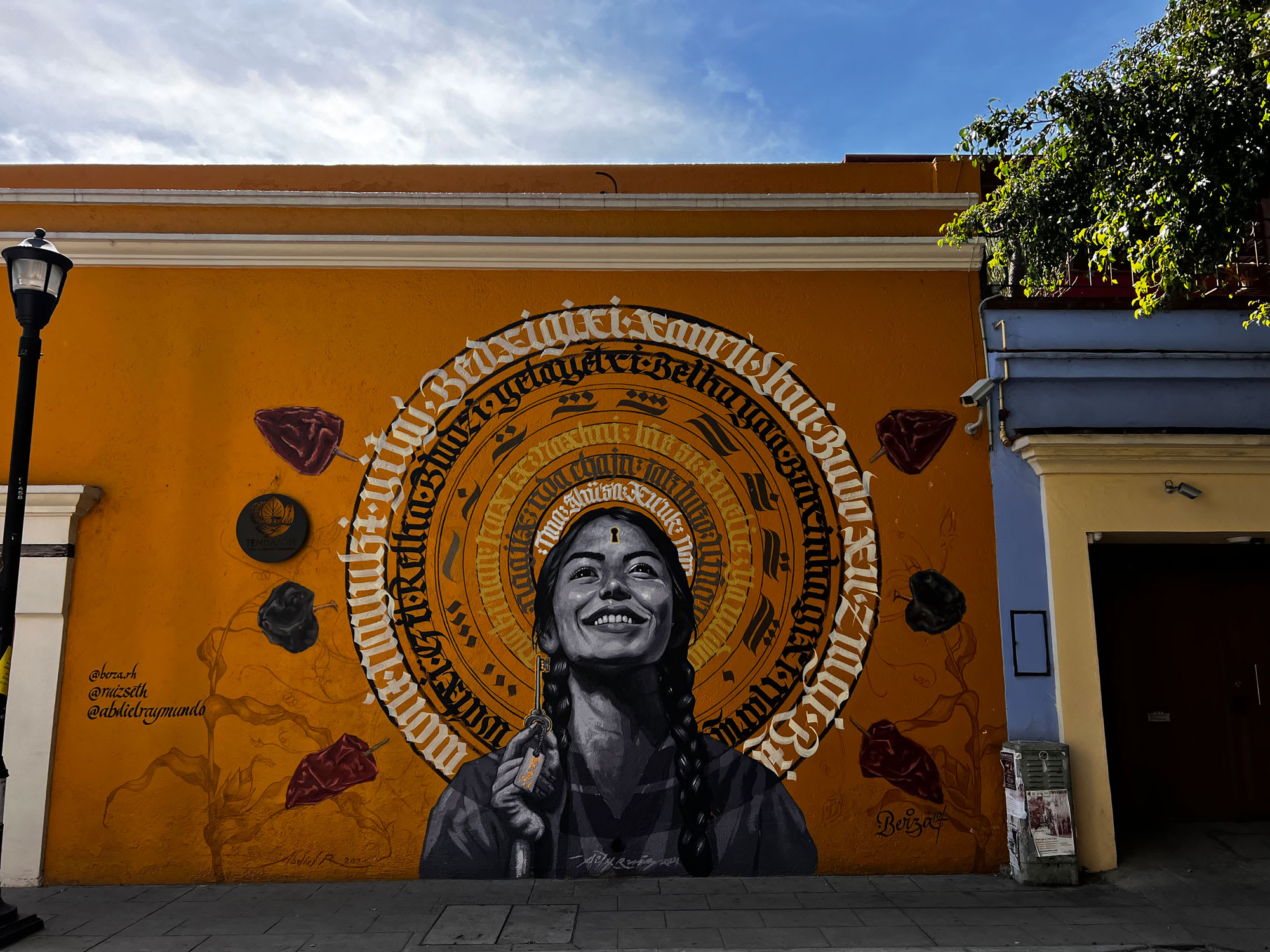
What Diego said early on stuck with us – “Oaxaca is where artists come to make sense of Mexico.” And you feel that immediately. There’s something in the air, a mix of spirituality, rebellion, community, Indigenous pride, and tradition, that attracts creators from all over the country. The colours are louder, the symbols are older, and the messages on the walls feel like they’ve been there for centuries, even if they were painted last week.
Pedalling through Xochimilco, Jalatlaco, and the northern part of Centro, we passed murals that felt less like street art and more like conversations between the past and the present. Like the large portrait of a woman surrounded by golden script, a celebration of strength, youth, and identity. Or the street covered in papel picado banners, glowing with festival colours. Nothing is random in Oaxaca. Everything is expression.
Papel Picado – The Flags That Make the Street Breathe
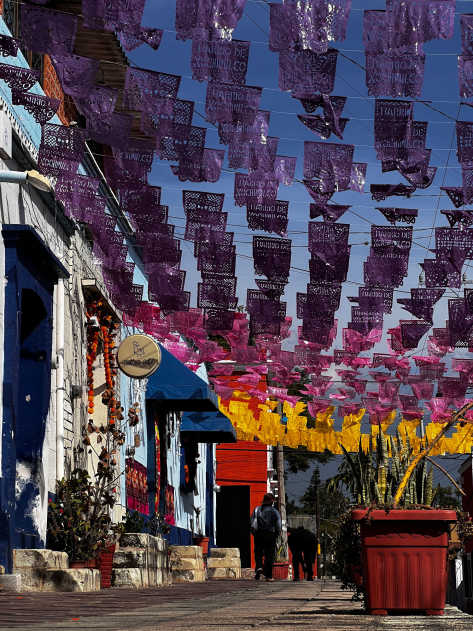
A few turns into the ride, we rolled under a sky full of colourful papel picado, and suddenly it felt like we’d biked straight into a fiesta. Pink, purple, yellow, turquoise, the whole street looked like it had dressed up just for us. Diego laughed when we slowed down to take pictures. “Everyone thinks they’re just decorations,” he said, “but trust me… these flags have deeper meaning.” He explained how each colour means something: purple for spirit, yellow for the path of the dead, pink for celebration, green for hope, white for offerings.
And the designs? Flowers, spirits, suns, moons, tiny stories cut by hand into delicate paper. The best part? Even the movement matters. When the wind hits them just right, the fluttering is meant to represent the presence of spirits passing through. (So basically, in Oaxaca, even the breeze is spiritual.) “Yes, people hang papel picado now for vibes and Instagram-worthy streets,” Diego admitted that with a grin but the meaning behind them is ancient. They were originally used during Día de los Muertos to guide the souls home, the colours acting like signposts in the sky. Riding under them felt like the city was cheering us on, playful, loud, alive. Like Oaxaca was saying – ‘Relax. Celebrate. You’re welcome here.’
Mezcal – The Spirit of the Land
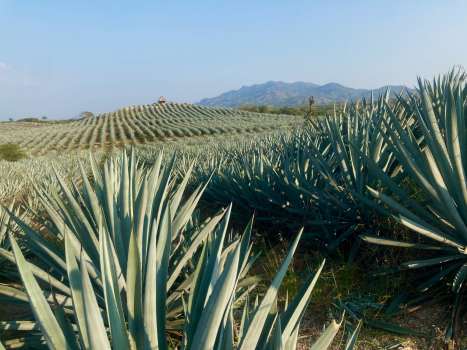
Coffee and cacao are important here, ancestral, ceremonial, but the story Diego kept coming back to was mezcal. And it made sense: we were literally cycling through mezcal country. Mezcal in Oaxaca isn’t something people use to get drunk. It’s a symbol of identity, a drink tied to ceremony, land, ancestry, and time. Diego explained how:
– Agaves take years — sometimes decades — to mature.
– Families guard traditional mezcal methods like heirlooms.
– Cooking, fermenting, and distilling mezcal is purely manual — fire, stone, wood, earth.
– Each region’s mezcal tastes different because the land shapes it.
– Mezcal is shared during Día de los Muertos to welcome ancestors back home.
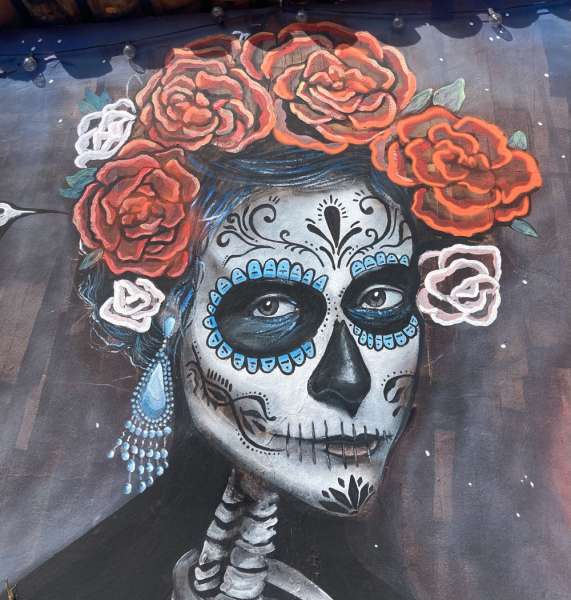
“Mezcal tells the truth of the land,” he said. And suddenly, the murals with skeleton musicians, marigolds, and mezcal bottles became clearer. They’re not images of death. They’re images of continuity, celebration, and memory. Cycling through agave fields, past smoky palenques, past murals referencing spirits and ancestors, mezcal wasn’t just a drink in this landscape. It was the pulse.
Spirit Dogs, Ancestors & Día de los Muertos
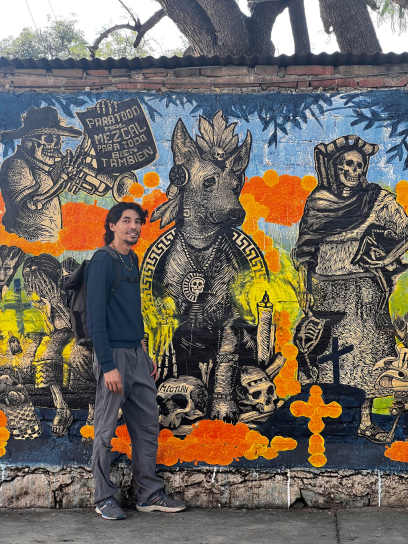
One mural stopped us cold, a huge depiction of the xoloitzcuintli, the sacred spirit dog who, in Indigenous belief, guides souls through the afterlife. Around him were skeleton musicians, mezcal symbols, and bright marigold flowers. At first it looked playful, but as Diego spoke, the wall turned into a doorway into another worldview.
In Oaxaca, Día de los Muertos isn’t a holiday, it’s a living relationship between the living and the dead. And this is the place in Mexico where the celebrations last the longest, because, as Diego told us – “This is where the doors open first. This is where the souls begin their return.” The orange marigolds you see everywhere, on altars, in murals, sold on street corners, are not just flowers. They are lights. Pathways. Guides laid out so the spirits can find their way back home.
Once you know that, the murals make sense.
The skeletons aren’t scary.
The spirit animals aren’t fantasy.
The candles, copal smoke, offerings, and symbols are all part of a system of memory and welcome.
You ride a few blocks and the themes repeat: ancestors watching over the living, animals guiding souls, offerings painted as if glowing. It’s intense, but it’s beautiful too, a reminder that in Oaxaca, life and death aren’t opposites. They walk the same streets.
A City Governed by Community, Not by Power
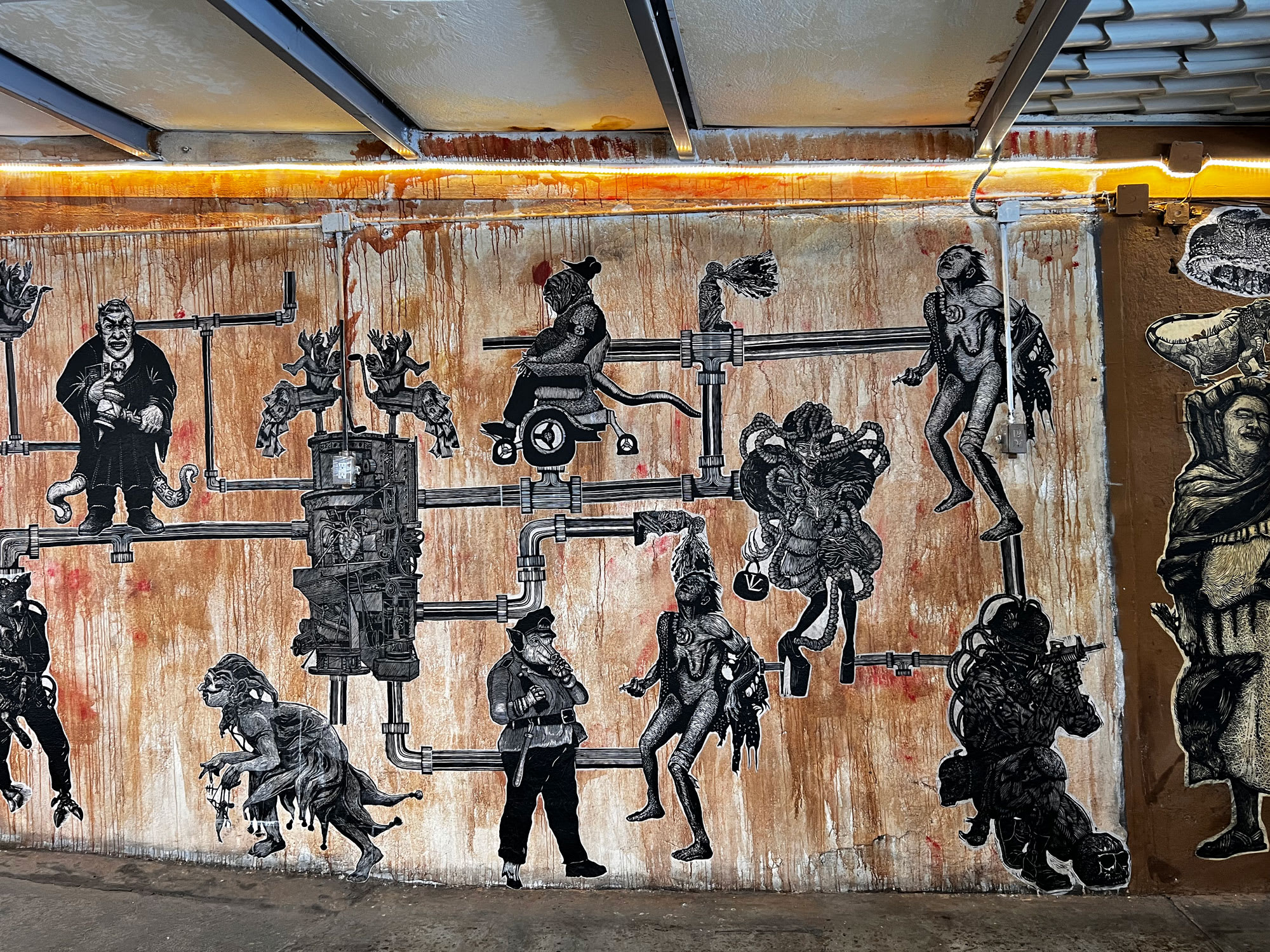
One of the most fascinating things Diego shared was how many Oaxacan communities still operate under ‘usos y costumbres,’ a collective system older than the Mexican state. Meaning
– No formal governors
– No centralized authority
– Decisions made in community assemblies
– Leadership rotates
– Responsibility is shared
This governance model is woven directly into the murals: unity, resistance, solidarity, ancestral protection, communal memory. For cyclists crossing an entire continent, moving from country to country, system to system, this idea felt both refreshing and powerful. There are so many ways a society can organize itself. Oaxaca reminded us of that.
Cycling Into the Heart of It All
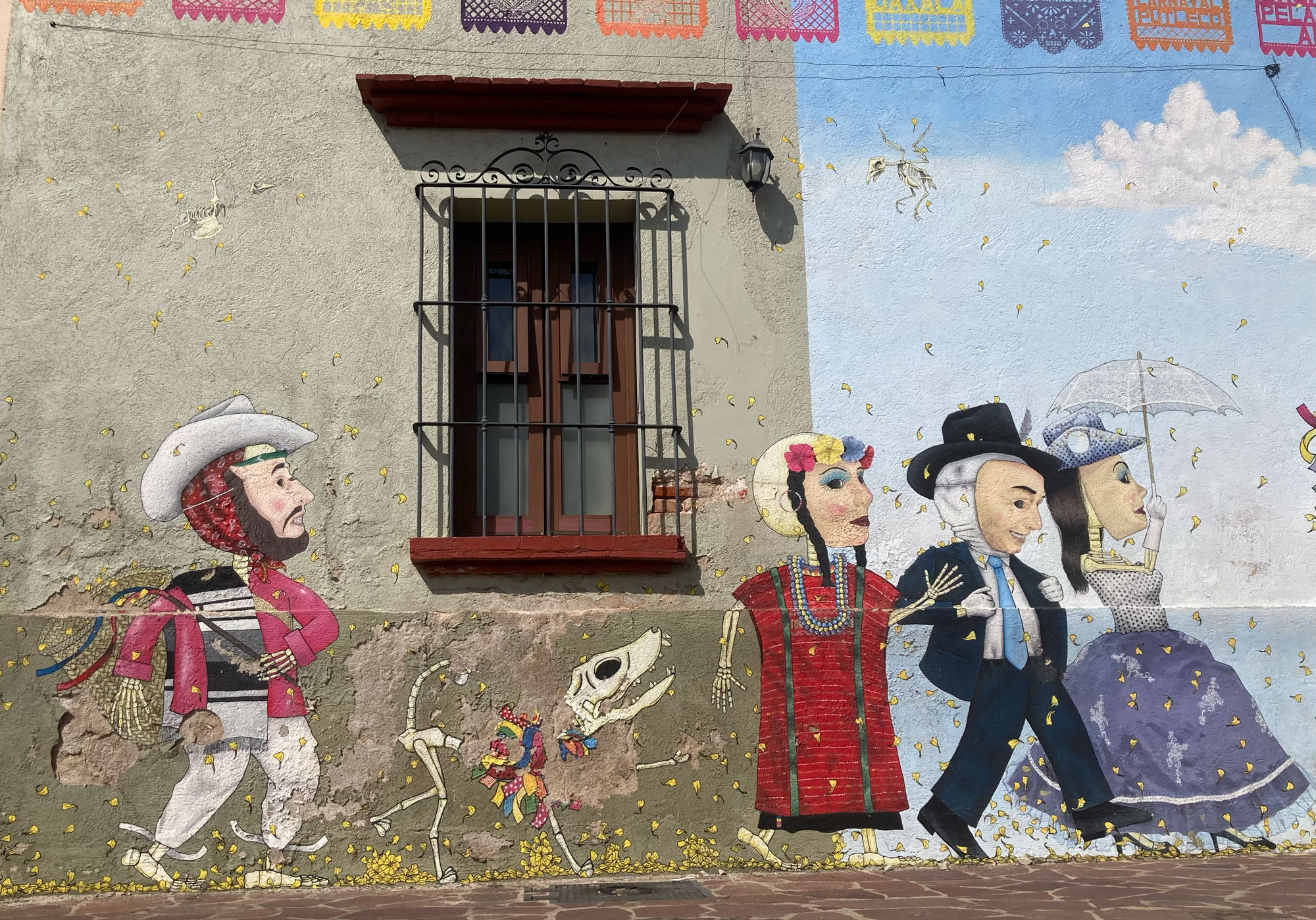
Moving through this environment on bikes felt perfect. At street level, every sound, smell, and colour hits closer:
Kids laughing.
Dogs barking.
Radios playing cumbia.
Smoke rising from agave ovens.
Cacao roasting.
Copal incense burning outside doorways.
You roll into colour.
You glide between traditions.
You absorb culture at the speed of curiosity.
By the time we looped back toward Centro, it was clear this wasn’t a side activity or a filler for a rest day. It was an essential chapter of the journey. Oaxaca didn’t just welcome us. It revealed itself. And in the mix of art, mezcal, politics, spirituality, spirit dogs, and community, we found a reminder of why we travel this way. Why we cross borders on bicycles. Why the road always feels bigger than the map. Because sometimes, the most unforgettable kilometres are the ones covered slowly, listening, learning, and letting a place leave its mark.
RELATED
TOUR
North American Epic
This incredible expedition is the only cycling tour that covers the entire North American continent, from the shores of the icy Arctic Ocean to the...

3 Comments for "Oaxaca On Two Wheels: A Street-Art Ride Into Mexico’s Soul"
Thanks for your in depth description and introducing the great Mexican Street Art to general public.
I love Mexico & Mexican Art and the culture.
You made it easier for me and others to see another perspective of the streets.
Thank you,
Any news about Ruta Maya?
Hi Bill, Currently we have no plans to run the Ruta Maya in the near future but you near know!